Adventures in China – November 2013 – Part 1
As CEO of Barkerville Historic Town, one of the largest historic sites in Western North America, I was invited to attend a conference of ‘Overseas Chinese Museums and Curatorial Specialists’ in Guangzhou (Canton), capital of Guangdong Province in southern China. The Conference was hosted by the Overseas Chinese Affairs Office. Barkerville was the centre of the Cariboo Gold Rush which opened up British Columbia to European settlement. Many Chinese from the area around Guangzhou joined other fortune seekers from around the world. As part of our 150th anniversary in 2012, Barkerville created an exhibit of photographs and stories of these Chinese pioneers and sent it back to tour their ‘home towns’ — Hong Kong, Guangzhou, Jiangmen, Kaiping and Taishan. Our trip also coincided with a visit of a delegation from Prince George who is developing a sister city relationship with Jiangmen, which allowed our exhibit liaison Nan Zhu and I to assist with a ceremony to celebrate the gift of a smaller version of the exhibit to Wuyi University in Jiangmen. After that Nan and I were joined by Nan’s girlfriend Nigele, and Nan’s parents were kind enough to host our visit of Xuzhou and Xi’an. From there I traveled on to Beijing to see some of the more popular sites which I have missed in 3 trips to China.
These writings were compiled from the journal I kept on the trip.
From Barkerville to Guangdong – Bringing the Stories Back
It is great to be back in Asia. I love the juxtaposition of the jarring, chaotic, noisy, aromatic in-your-face street life with the zen-like landscape aesthetic that leaves North America looking like a sterile waste land. Zhu Nan (I am now calling him by his real name) and I were met at the airport after an uneventful 14 hours trapped in a metal cylinder, and whisked away to Hotel Landmark Canton on the banks of Pearl River. Although it was 1:30 in the morning our time, we were immediately taken to dinner. Thinking it would be just Nan and I and our new friend Lim from Singapore, I was surprized to be ushered into a room of about 40 people just sitting down to a fantastic banquet. It might have been overwhelming, but I was immediately wrapped in a huge hug from Wang Minghui, Curator of the Guangdong Museum of Overseas Chinese, who I met in 2009. I was then pulled into a chair beside my old friend and travelling companion Lily Chow. So it was a merry evening, or morning, or whatever…
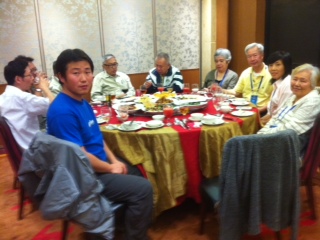
Zhu Nan on the left and Lily Chow on the right and new friends in between
Today, Wednesday, November 6th, the museums who are attending this conference, including Barkerville, made short PowerPoint presentations. Tomorrow the academics and researchers will present. I am the only Caucasian in the group and the only non-Chinese speaker. However, it’s not an obstacle for making some interesting new connections, especially since last night I passed muster with my chopstick skills. Although the entire proceedings are being conducted in Chinese, quite a few people speak English. There are museums here from China, Malaysia, Singapore, Thailand, Philippines, Australia, and Los Angeles and academics from all the above plus Montreal, Netherlands and France – at least that is who I have met so far.
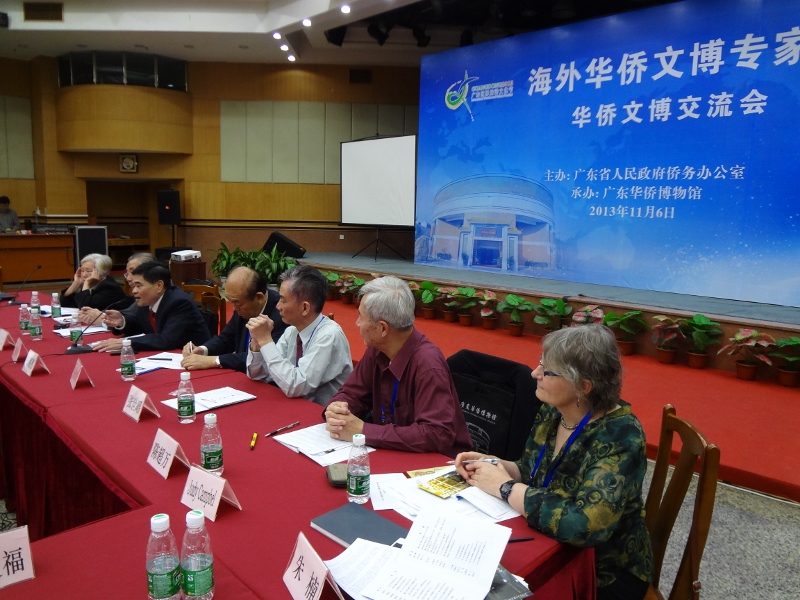
The response to our exhibit, Who Am I? Bridging the Pacific: from Guangdong to Barkerville and Back, currently showing at the Guangdong Museum of Overseas Chinese who is hosting this conference, has been fantastic. Definitely if we could duplicate this exhibit it could tour world-wide!
Tonight another fabulous banquet. At dinners like these there is a lovely habit of jumping up in the middle of the meal with your wine or brandy glass, running over to another table and proposing a toast, which is often a short singing rhyme. (Well, you have to do something when the meal is 12 to 14 courses long!). Tonight’s dinner morphed into a spontaneous talent show that included much singing, very cool magic tricks, some charades (or something similar) and even some dancing. Of course, when the mic got passed to me, the words to the only two Chinese songs I know, Jasmine and Half Moon Rising, which Ying Ying has beat into my head for the last 4 years, completely flew out of it. But everyone loved my rendition of The Water is Wide.
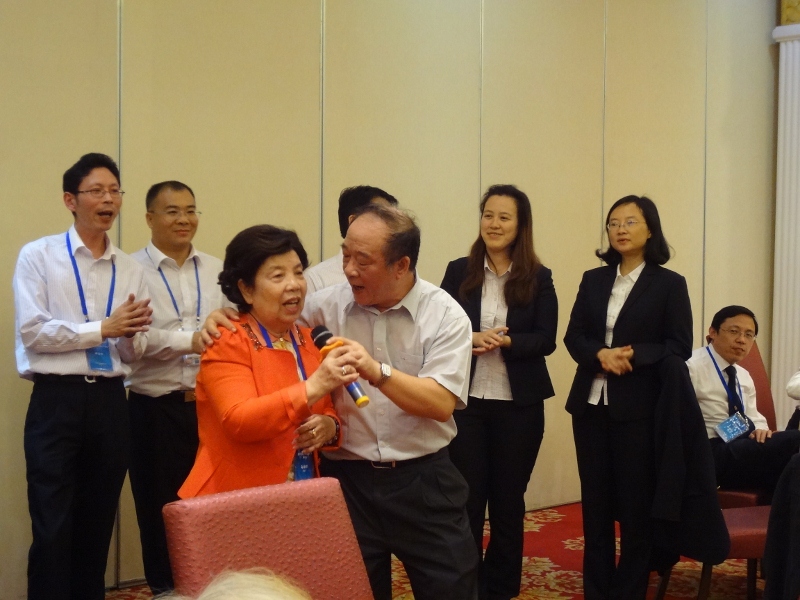
Tomorrow more workshops, but in the evening we are doing a dinner cruise on the Pearl River!
Adventures in China – Part 2
The Overseas Chinese Museums and Curatorial Specialists Conference
This get-together has been a whirlwind of non-stop activities, starting at 7:30 in the morning and often going until 10 or 11 at night. We are staying in an area of Guangzhou that looks interesting to explore, with a lovely promenade along the Pearl River. My 15thfloor window overlooks a small park that is filled with people doing Tai Chi, using the outdoor exercise machines or just visiting. It looks like a great place to hang out if I had time. I haven’t been able to nose around the local streets either, which is something I really love to do.
However much has been accomplished. A Global Alliance of Overseas Chinese Museums has been formed. This is the first step towards sharing information and expertise. Barkerville has been incredibly well received here and we received many accolades about our Who Am I Exhibit, which everyone had a chance to see, when we visited the Guangdong Museum of Overseas Chinese.
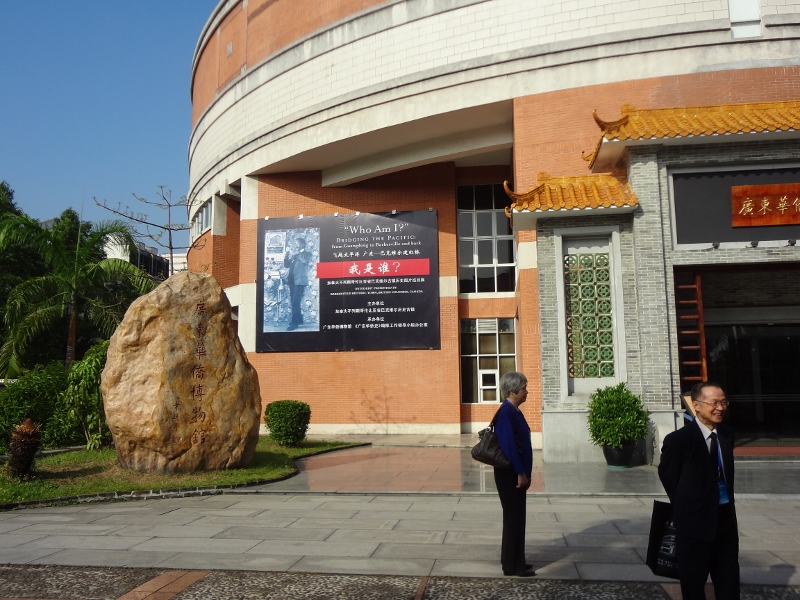
Poster for our Who Am I Exhibit on the front of the Guangdong Overseas Chinese Museum
I have made some very interesting and potentially valuable connections for Barkerville; of particular interest are the Chinese American Museum in Los Angeles and a number of groups in California. These contacts are of particular interest as we look to developing the ‘Gold Rush Trail’ as well as increased Chinese tourism.
Besides visiting the Guangdong Museum of Overseas Chinese, we have visited the Guangdong Museum (think Provincial Museum) and the Folklore Museum at the Chen Lineage Hall (fabulous traditional architecture – see the 2009 blog), cruised the Pearl River for an incredible light show, gone to the top of the 610 metre Guangzhou Tower, visited the South Canton Cultural Theme Park (traditional village presented in a quasi-Barkerville style), been treated to an incredible spectacle at the 8th Annual Tourism Festival, visited the Jiangmen Overseas Chinese Museum, and the Kaiping Diaulou (UNESCO World Heritage Site).
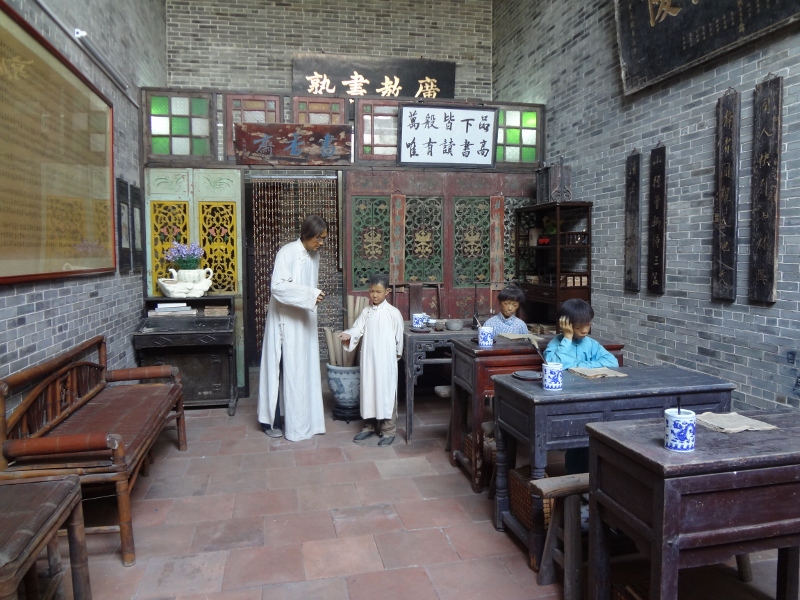
Diorama of a Chinese Private School at the South Canton Cultural Theme Park
Somehow Nan and I have managed to schedule our meetings with the Director of the GDMOC, the Vice-Director of the Overseas Chinese Affairs Office of Guangdong, and the Director of the Jiangmen Overseas Chinese Museum and a few others in between all of the above. However, we did have to negotiate the final agreement for the exhibit with the GDMOC on the bus, and sign it off between courses in a restaurant.
Guangzhou City
This is my 3rd time to Guangzhou and I have never really been impressed with the city, but on this visit I am seeing more of it, and it is growing on me. It has many faces. There is layer upon layer of freeways with all kinds of street life underneath, resembling the set of Bladerunner, but dripping greenery and flowers instead of noxious liquids. There are miles of sterile cement block tenements, which when penetrated, reveal winding alleys, hole in the wall shops and street markets. The modern architecture is superb with some of the most visually interesting and downright beautiful buildings I’ve seen. And of course tucked in amongst all this is the odd enclave of traditional architecture. I don’t remember there being so many green spaces (I think this was a function of the area of the city where we were staying). There are lots of parks, and they are all very well used.
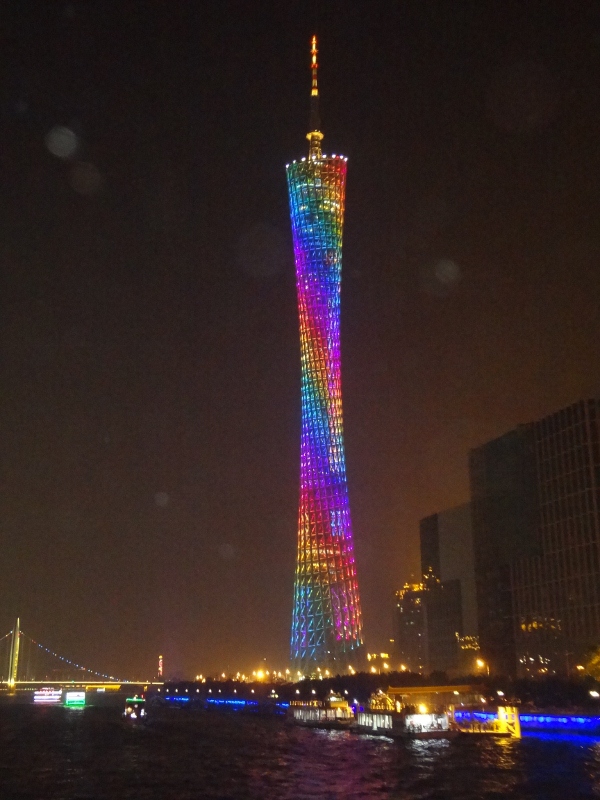
Guangzhou Tower from the Pearl River
Adventures in China – Part 3
Wuyi University in Jiangmen
The last night of the Conference we had dinner in Kaiping, with lots of toasting and singing which continued on the bus all the way back to Guangzhou. We have all made lots of good friends.
The next morning Wuyi University sent a van to fetch Nan and I to drive us the 1 ½ hours to Jiangmen for the next big task on this trip. Barkerville has worked with the Omineca Beetle Action Coalition (OBAC) and the City of Prince George to prepare a smaller version of the Who Am I? Exhibit which will be presented to the Overseas Chinese Research Centre at Wuyi University by Mayor Shari Green of Prince George. In this way Barkerville is contributing to the development of Prince George’s twinning relationship with Jiangmen, which it is hoped ultimately will lead to increased access to Chinese markets for northern BC products. OBAC recognized immediately that the Who Am I? Exhibit, which focuses on the strong historical and cultural ties that British Columbia has with Guangdong Province, can help develop and deepen relationships that will build a strong foundation for future economic interactions. This part of the project is a win-win-win situation. Wuyi University, particularly the Overseas Chinese Research Centre, is extremely excited about ‘bringing these photos and stories home’, and the emotion they felt about this was evident. The City of Prince George was delighted to be able to add this major gift as a contribution to their side to the twinning relationship and to renew connections with Chancellor WANG Ke and their staff who had come to Prince George and Barkerville last May. Barkerville is looking forward to the development of academic partnerships that will add to our knowledge of the Chinese community in Barkerville and our Chinese collections. The University hopes to send scholars to Barkerville as early as next year. We also had a great dinner discussion with Francis Zheng about the possibility of study tours, which could potentially be a revenue generator for Barkerville.
We spent the rest of the day and most of the next day with the set-up of the exhibit. There were a few glitches with missing parts and the TV not working, but miraculously it all came together in time for the ceremony. The Prince George delegation arrived, the Chancellor and the Mayor both spoke about the importance of these joint ventures, I presented some Barkerville books and the Wilds to Riches DVD to the University and then the Chancellor, Mayor Green and I unveiled the central panel of the exhibit. The ceremony was well attended by both University and local government officials and the Chinese media. At the dinner that followed everyone expressed their satisfaction with the success of the ceremony and could not say enough good things about Barkerville and the exhibit.
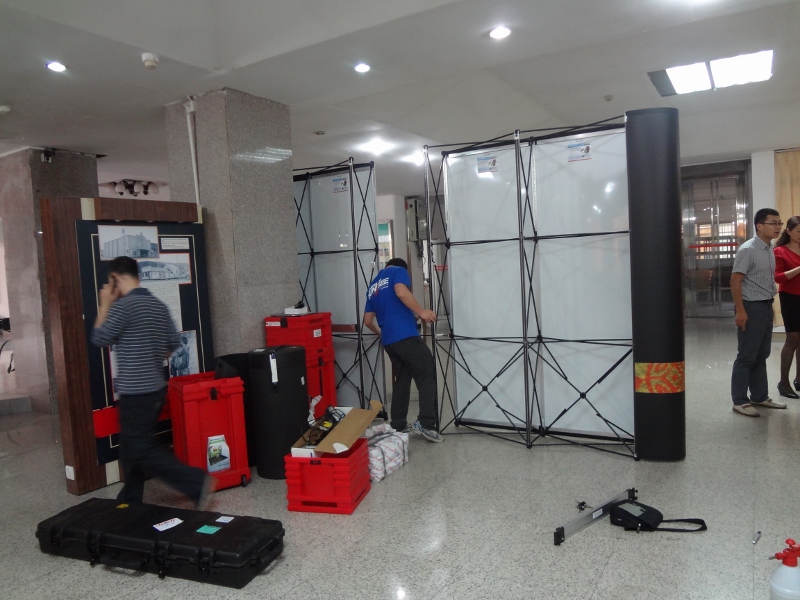
Luckily we had lots of help and the better part of two days to get the satellite exhibit organized on site
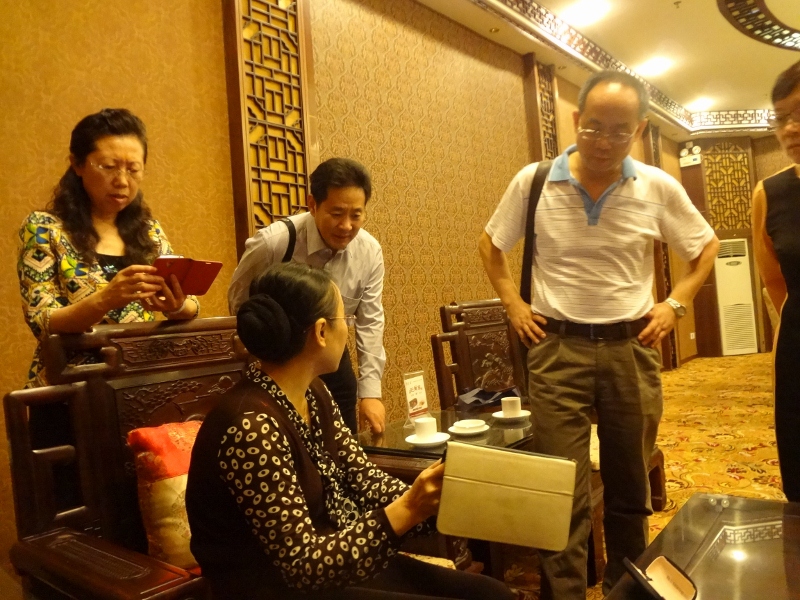
Chancellor of Wuyi University WANG Ke showing pictures of Barkerville on my Ipad to her colleagues
The next morning the university was kind enough to provide us with transportation back to Guangzhou in time for an 8:30 am meeting at the Canadian Consulate with Consul Stephen Doust and Counsel General Weldon Epp. The Consul has been extremely helpful to us in ensuring logistics have run smoothly, however, they opened the meeting by thanking Barkerville for the work that we are doing, saying the main exhibit, which the Governor General of Canada opened at the Guangdong Museum of Overseas Chinese last month has raised the awareness of not only of British Columbia in China but of Canada as a whole. This is exactly what we hoped for!
We have accomplished everything we have set out to do:
- We have signed an agreement with the Guangdong Overseas Chinese Museum for the management of the tour of the Who Am I? exhibit
- We have successful installed the smaller satellite exhibit at Wuyi University and arrange the gift ceremony with the City of Prince George
- We have had an initial meeting which may result in a bilingual book about the exhibit being funded by Chinese institutions
- We have established contact with museums across the globe with similar collections and interests
It is also important to note that other than our airfare, for which we got deep discounts due to Nan’s connections in the industry, all our costs were covered by either the Overseas Chinese Affairs Office or Wuji University.
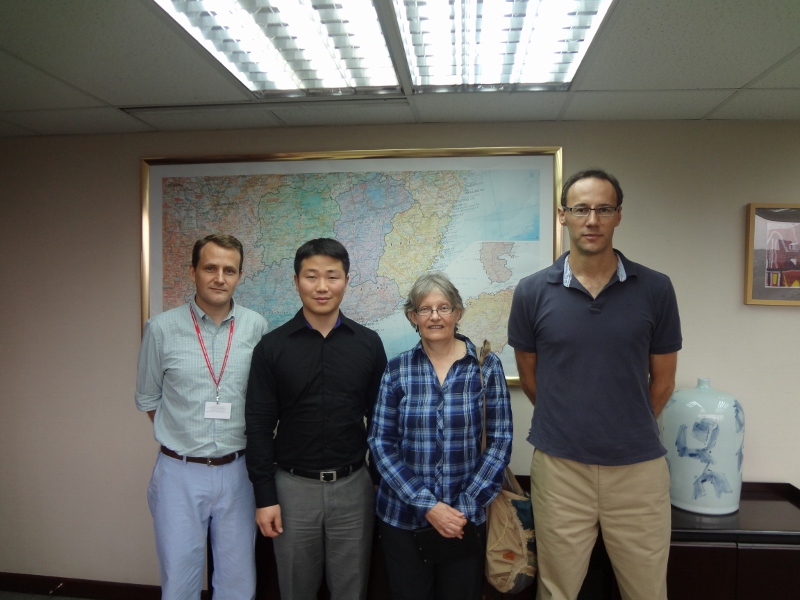
Consul Stephen Doust, ZHU Nan (Exhibit Liaison), Judy Campbell (Barkerville CEO), Canadian Consul General Weldon Epp
The above meeting was the last of our official business in China. It was great to touch base with the Consul General and his staff who had been so helpful during the process of getting the exhibit to Guangzhou.
Nan and I will now officially be on vacation. We are flying 2 hours north to his hometown of Xuzhou in Jiangsu Province to visit his parents. Nan’s girlfriend will join us there and then his parents are taking us all to Xi’an to see the terracotta warriors. Then I am going on the Beijing before coming home.
Adventures in China – Part 4
A Day in Guangzhou
After our meeting at the Canadian Consulate Nan and I had a few hours to enjoy Guangzhou at a more leisurely pace before leaving for the airport to fly to Xuzhou. We met up with our friend and drinking buddy from the conference Dr. Lim from Singapore. Lim had honed into the fact that there was a good pub around the corner from our hotel on the first night, so the one night we had off we gathered up a crew and went out. Today, Lim was kind enough to let us store our luggage in his room while he took us to a great little hole in the wall run by a Muslim family from the north east. We had cumin lamb and a great noodle soup.
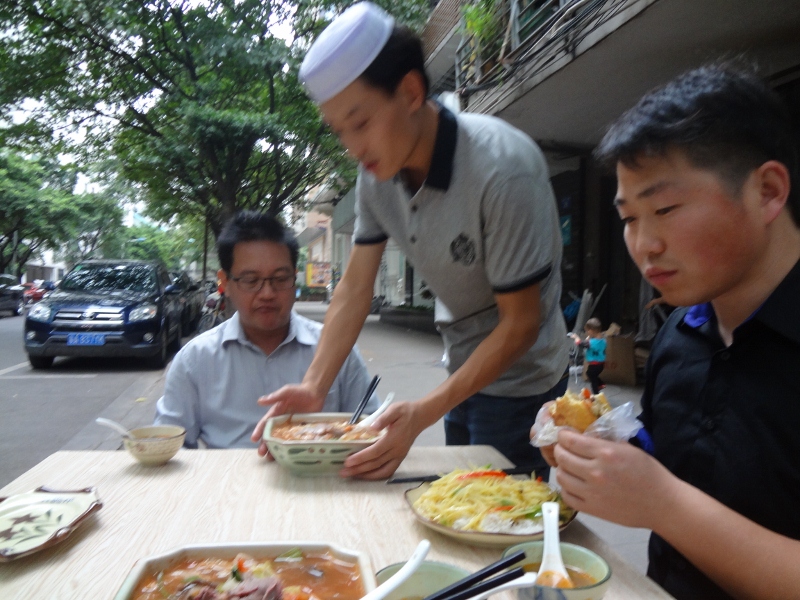
Lim and Nan tuck into another great meal
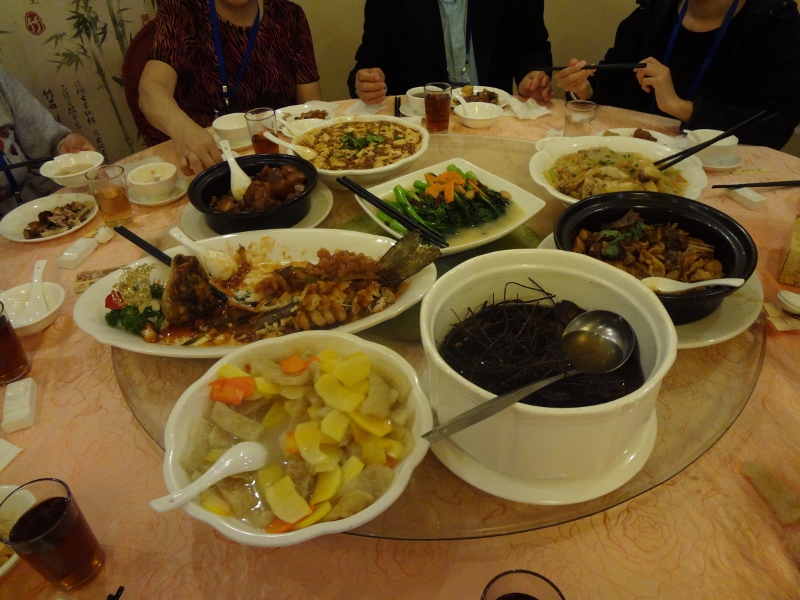
Which brings me to the topic of the food on this trip. I am not sure how much longer I can go on eating 15 to 20 course meals. I start the day with a resolution to eat lightly. But then I get to the breakfast buffet, which features a few token western foods, and dish after dish of … well I really don’t know what, but it all looks really interesting. Dumplings of all descriptions, rice dishes, fruit and congee (a thin rice porridge). I have to try just a few new things each day. And then lunch comes along before breakfast has even had time to settle. Twelve to fifteen courses. Mostly I have no idea what I am eating, but it is all good – lots of chicken, duck, goose and pork. I am learning to recognize lotus root and bitter melon. We have been treated to several meals that we are told are traditional Cantonese food. They don’t use a lot of heat, but try to accentuate the natural flavours of the ingredients. Dinner is similar but there are usually more courses.
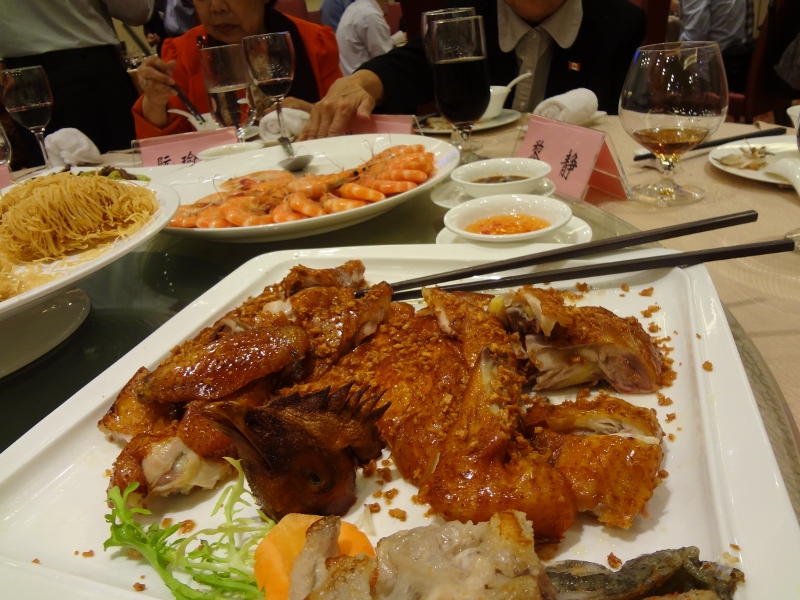
The head is always served with the chicken, but it is not eaten (I don’t think)
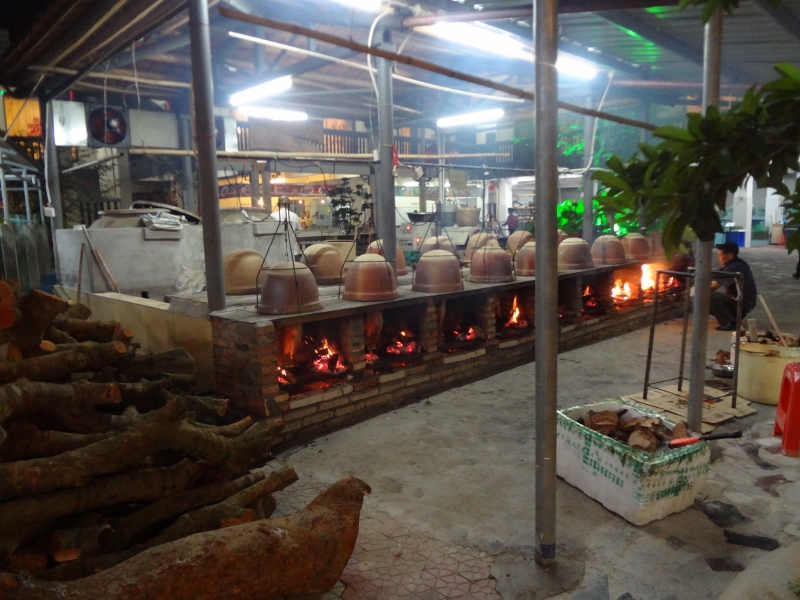
Roasting geese the traditional way at a Cantonese ‘country-style’ restaurant
After lunch Lim took us over to Beijing Street, a good shopping area. It was great to look at all the fashions and colours that won’t hit North America for another 6 months or so. We went to a street full of art shops, mainly calligraphy and painting. Lim bought a number of beautiful porcelain scroll ends for displaying some historic scrolls at his Museum in Singapore. I bought a pair of small smiling pigs (I was born in the year of the pig) which made me laugh as soon as I saw them.
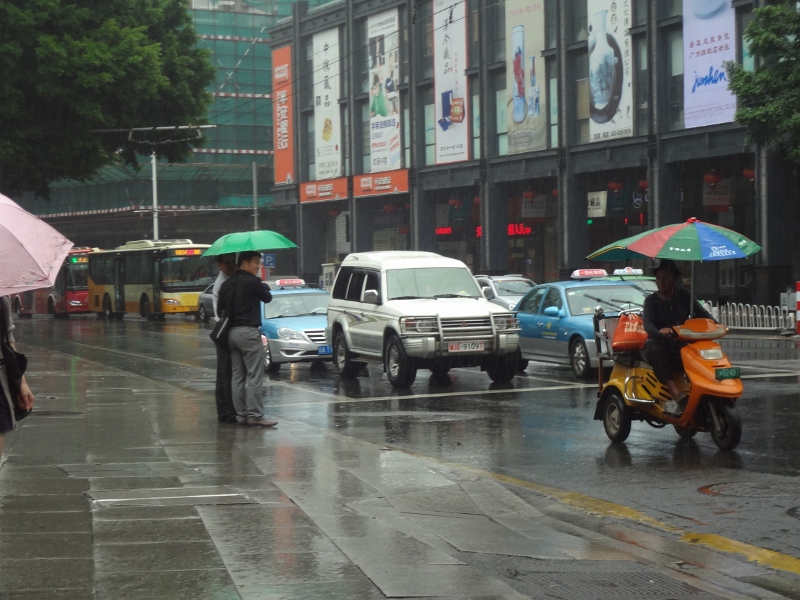
By this time it was pouring rain, but since Lim and Nan are both perfect gentlemen I waited under cover while they sought a cab.
Out of time, we returned to Lim’s hotel where we met our driver from the Museum who took us to the airport. It was a sad goodbye with Lim because who knows if we will ever see him again. Singapore is on my list, but I am not sure when.
Adventures in China – Part 5
Xuzhou
Xuzhou is a medium sized city (by Chinese standards – only 6 Million) in Jiangsu Province (east of Shanghai, north of Nanjing). It is just north of the Yellow River, so it is considered ‘the north’. We went from 30 C degrees to 8 C degrees. The inevitable smog persists, but at least the skies above are blue and the air is dry.
Xuzhou is the ancient capital Pengcheng of the Han dynasty (206 BC – 220 AD – think Roman times), with a history that goes back about 4,000 years. There are a number of important tombs and archaeological sites here and a great museum.
Nan’s father had arranged for a car and met us at the airport. I (and Nan’s girlfriend Nigele when she gets here tomorrow) are staying at the Garden Hotel where Chang Kai Chek once stayed, a plain but graceful Art Deco building built in 1916. Nan will stay with his parents and grandmother.
In the morning Nan took me to the Xuzhou Museum, (no – I am not yet tired of visiting museums) which includes a tomb of a Han Dynasty princess and king. The museum is mainly devoted to the materials that have been found in the local tombs including some fantastic jade carvings, but also a great display of porcelains. The tombs themselves are very well presented with a large structure built over the open excavation, and access to the original tunnels below.
After lunch, Nan’s father took us into an older section of town, the only remaining vestige of Ching Dynasty architecture remaining in the city. Then Nigele, Nan and I climbed Yunlong Mountain and visited the temple at the top.
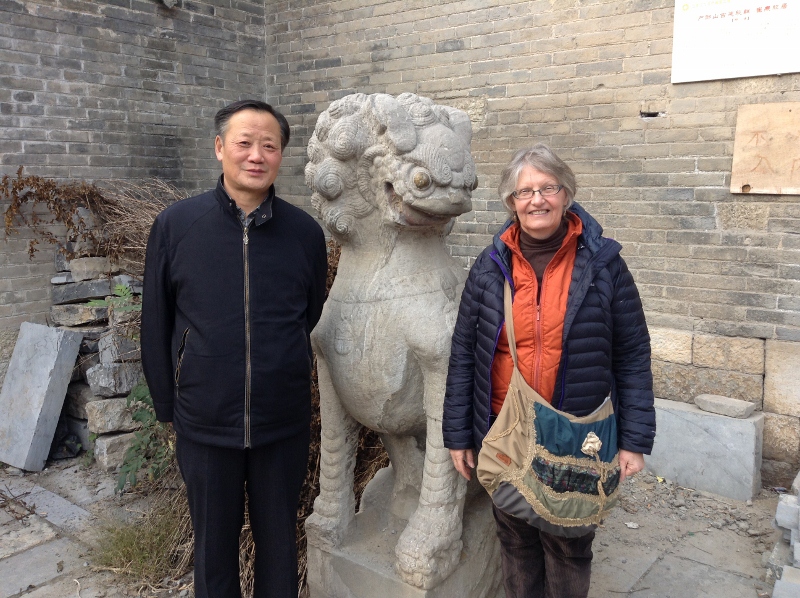
Nan’s father and I with a Ching Dynasty Lion. The Lion is eyeing up my handbag thinking I have catnip in it
In the evening Nan’s parents had arranged a dinner with old family friends at the best Peking Duck restaurant. This was yet another truly amazing meal. Although Nan’s parents and friends speak no English we still had a great time and drank a bottle of the excellent brandy that I was given in Guangzhou by the man whose company was producing it.
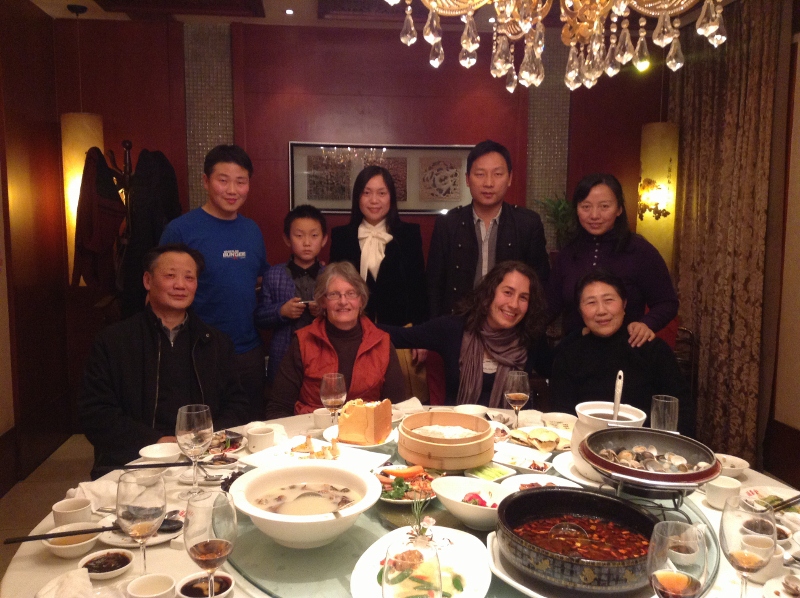
In the front row are Nan’s Dad, me, Nigele and Nan’s mom. In the back are Nan and friends of the family. And in the very front a demolished Peking Duck meal.
Today (Thursday) we visited another tomb site where Han dynasty terra cotta warriors were found. These figures are much smaller in size (12 to 14” high), but when they were uncovered they were painted vivid colours. Sadly the paint oxidized and the figures we see today are browny grey. Each figure is different, with an amazing variety of facial expressions. But my favourites were the dancers.
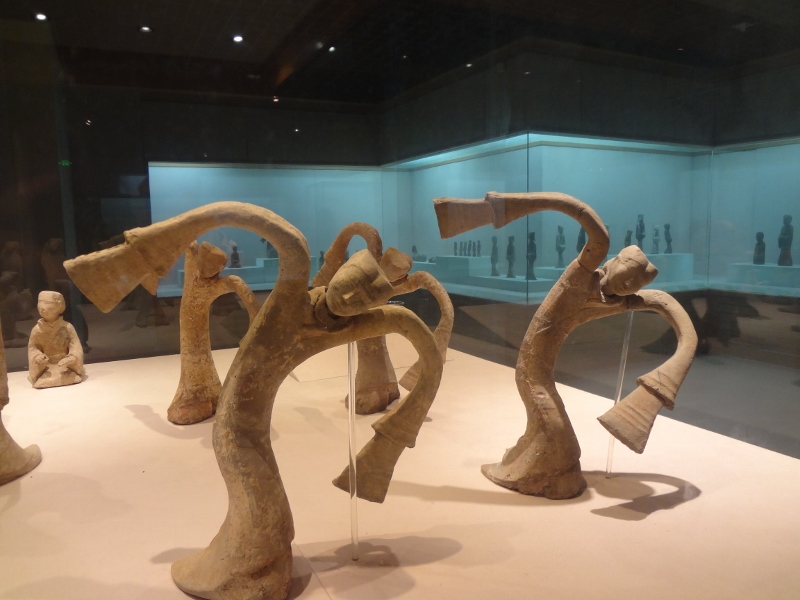
Han Dynasty terracotta dancers found in tombs in Xuzhou
Tonight we take the overnight train to Xi’an but we have ‘bunkers’ (Nan’s explanation).
Adventures in China – Part 6
Xi’an
The 4 bunk ‘bunker’ on the overnight train to Xi’an was pretty comfortable and I got a good 9 hour sleep, the most I have had on this trip. Nan’s mother was not able to come with us, as his grandmother had a fall and is not able to get around. The smog in Xi’an is just as thick as it has been everywhere else, if not thicker. Xi’an is another ‘medium’ sized city of around 10 million. We are staying in a hotel in which only Chinese nationals are allowed, so only Nan and his father checked in. It is obvious that Nigele and I are also staying here, but no one seems to really care. The hotel has a ‘Super 8’ sign on it, but is better quality than the Super 8’s at home.
We are close to the north gate of the city wall, the oldest intact city wall in China with a circumference of 14 km. It was built in the 1370s, but has been constantly renovated, repaired and upgraded, so it is hard to know which portions date from what period. I think most of what we see now is from the Ching Dynasty (1700s – 1911) Once you’ve climbed up on top of the wall (about 12 m), you can rent bikes to ride around. There are little signs in Chinese and English along the way and great views of the city both inside the walls and outside.
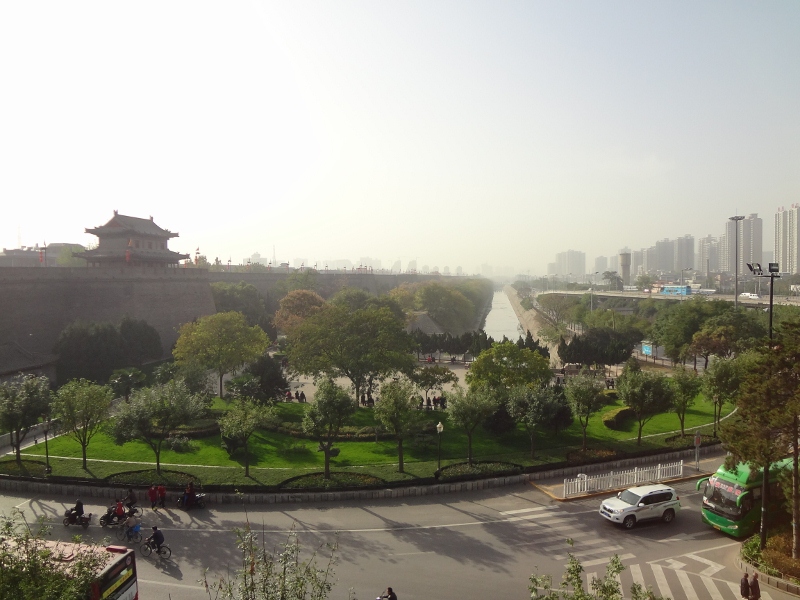
View along the outside of the wall and moat. The outside of the wall is surrounded by park
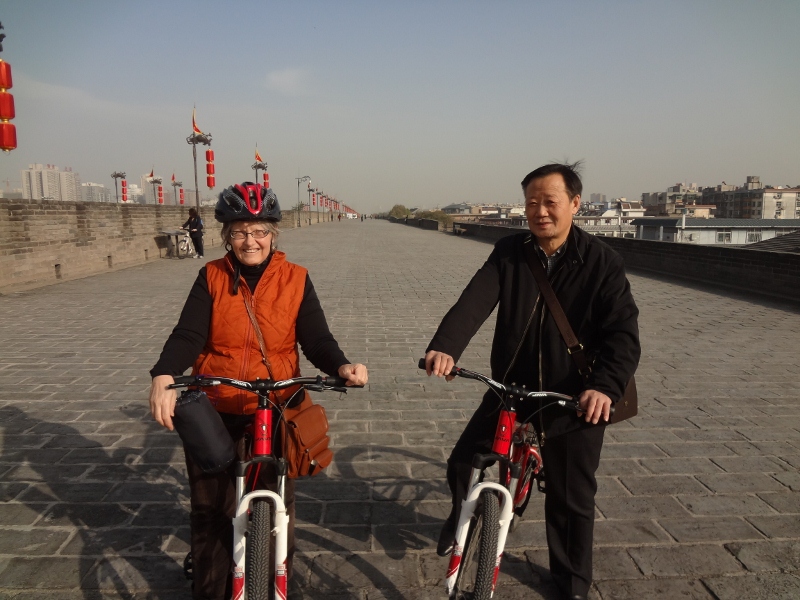
One speed bikes with front suspension were the ticket for this ride.
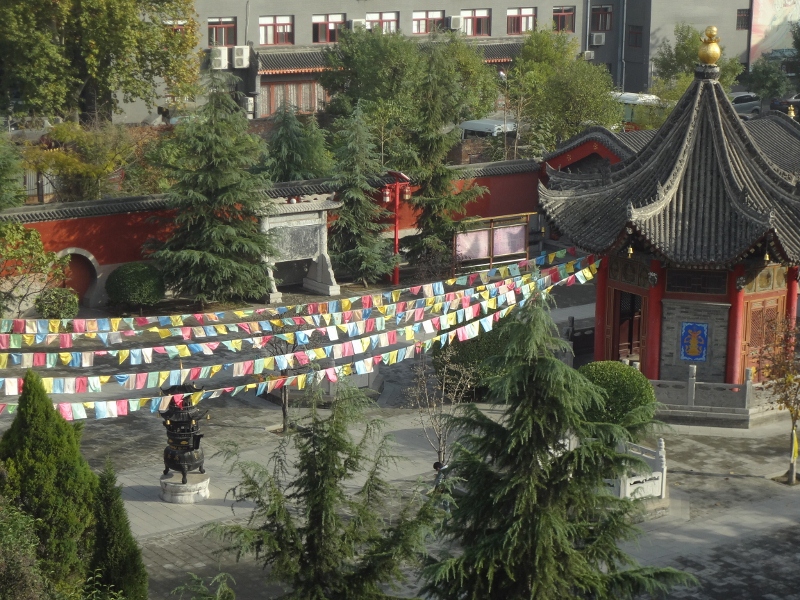
View into a monastery just inside the wall
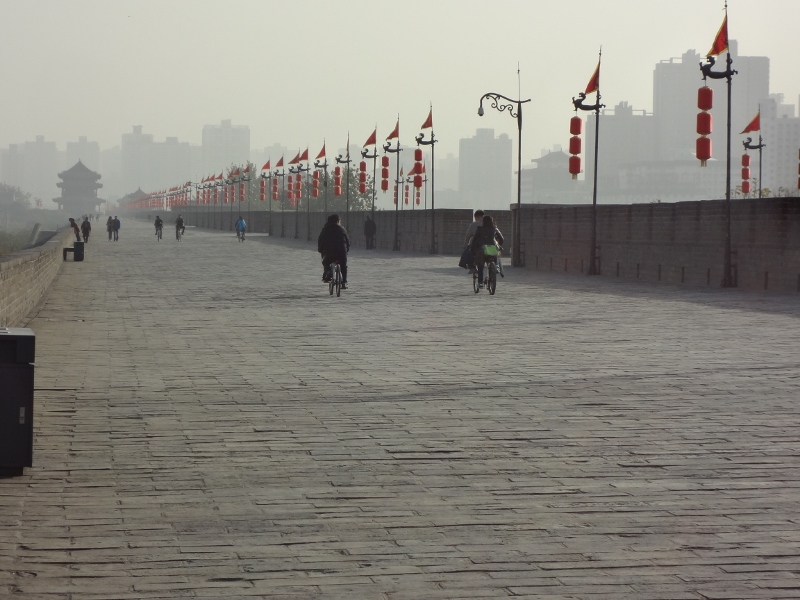
This view along the wall gives an idea of how bad the smog is
The Muslim Night Market
There is a strong Islamic population here (nearer to the northeast), so the place to eat is in the ‘street of the Muslims’, which is really a quarter rather than a single street. Another fantastic food experience as we wandered and tried things from different stands. We started out with a special soup. First you are given 2 round disks that are a cross between a hard pilot biscuit and a stale pancake, and some time is spend tearing these into tiny pieces while you socialize. Then your bowl is whisked away to the back of the restaurant and returned to you full of hot broth with various other unidentifiable floating objects. After letting it soak a bit, the bread bits are a bit like gnocchi, and overall it’s quite good.
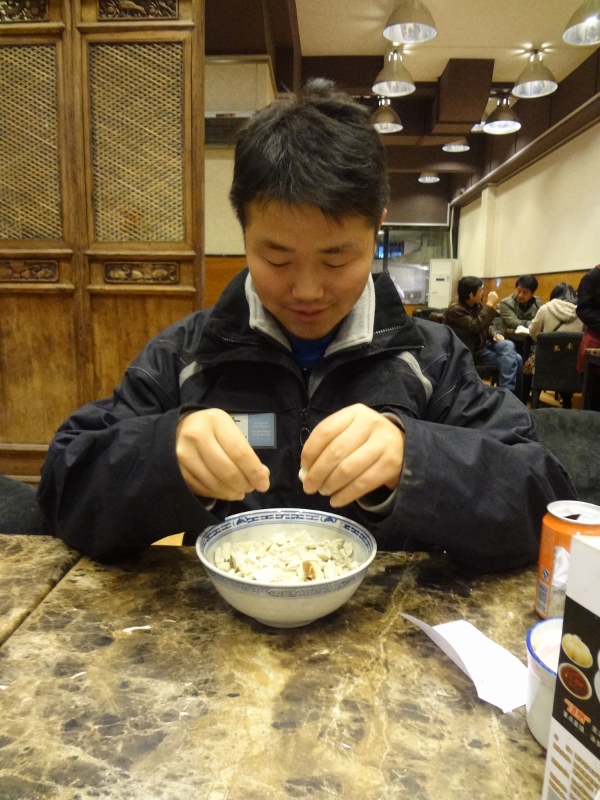
Nan preparing his bowl
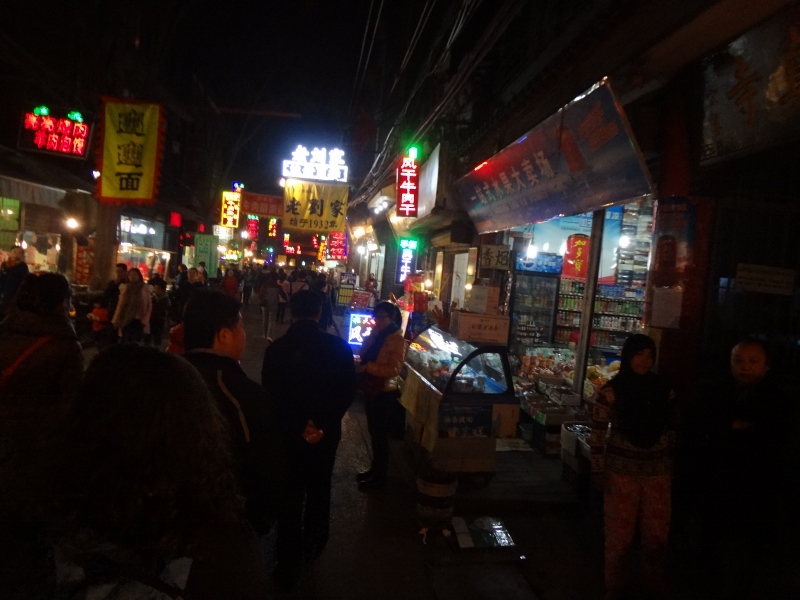
The district was vibrant and friendly and we seemed to be the only tourists.
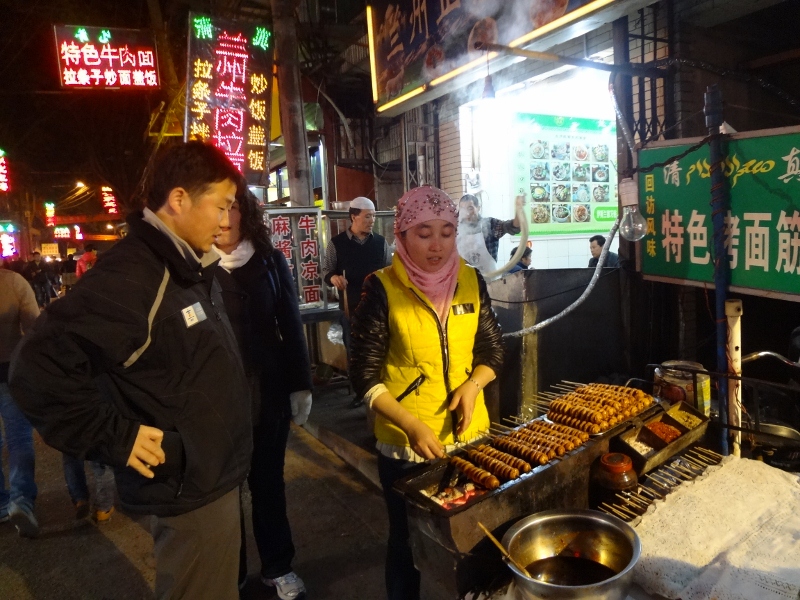
This reminded me of Latin American churros – doughy deep fried bread rolled in sweet and savoury spices
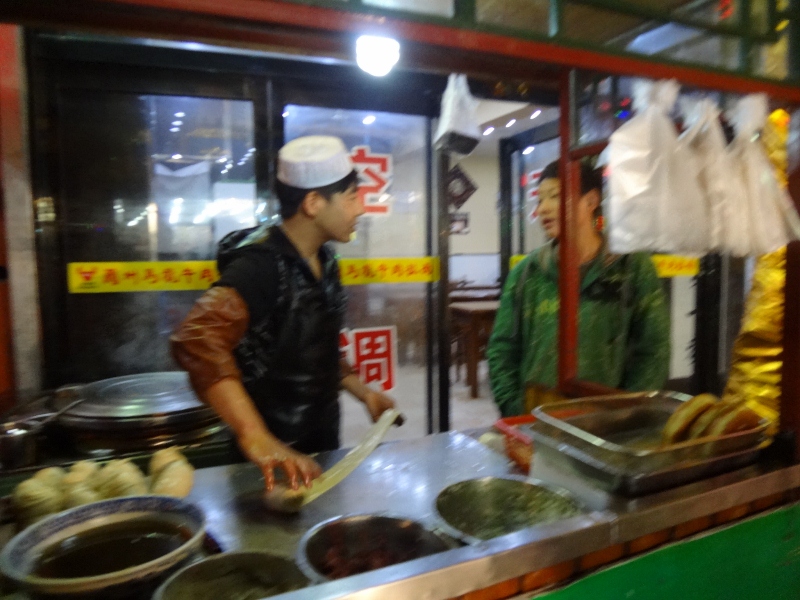
These were some sort of dumpling made from a stretched dough rolled in spirals
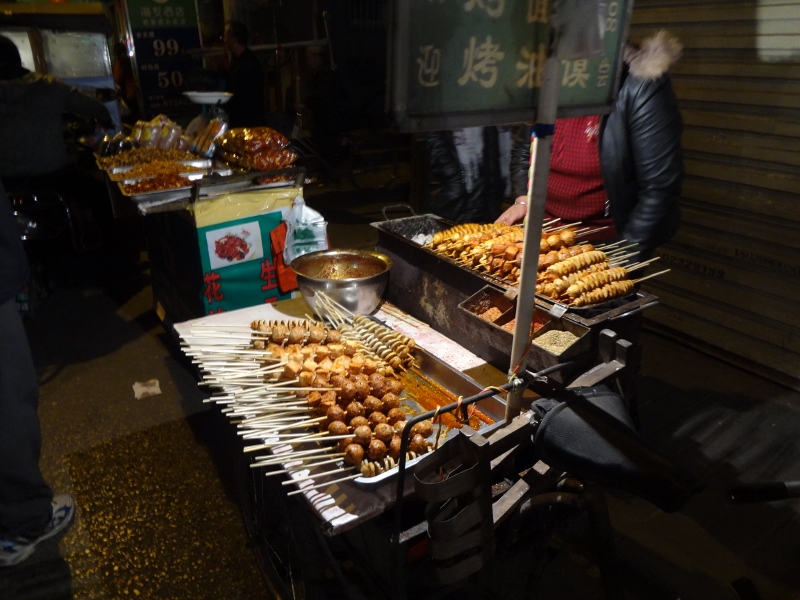
Kebobs of various sorts; we had some great pork ones
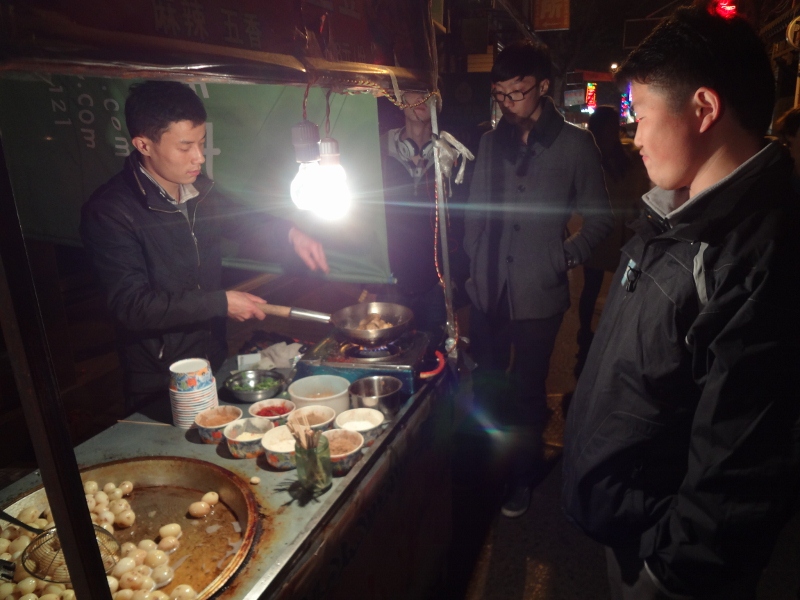
These were my favourite; steamed new potatoes that were then stir-fried with a bunch of spices and Served in a little cup.
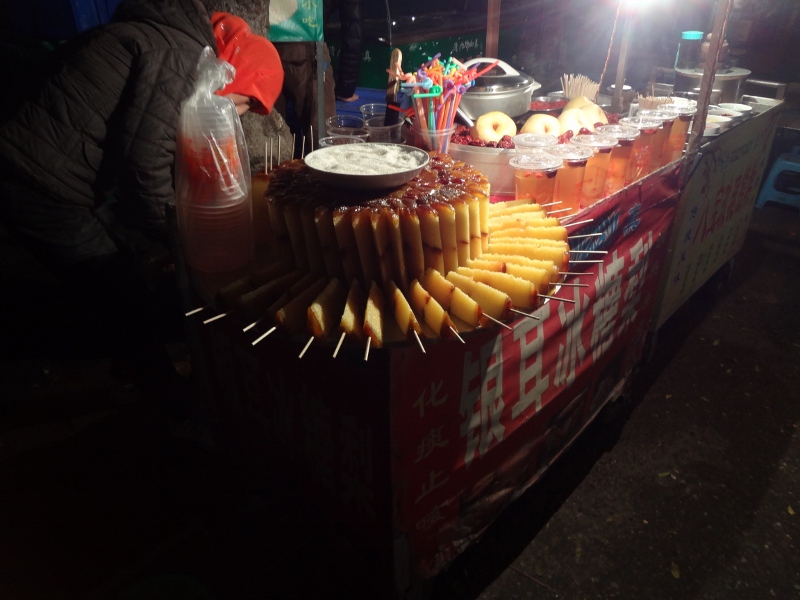
Kind of a gelatinous custard dipped in sugar – a bit disappointing
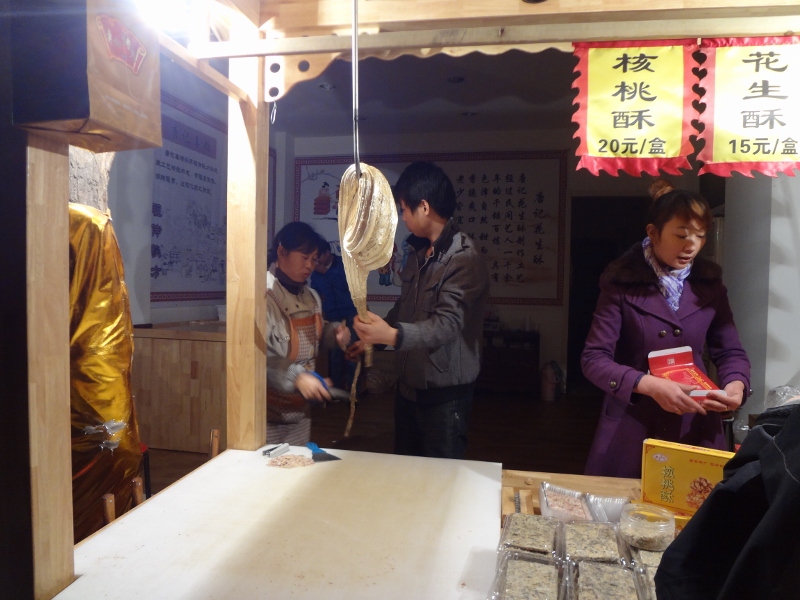
This looked like pulled taffy and resulted in a fantastic halvah like candy. Bringing some home.
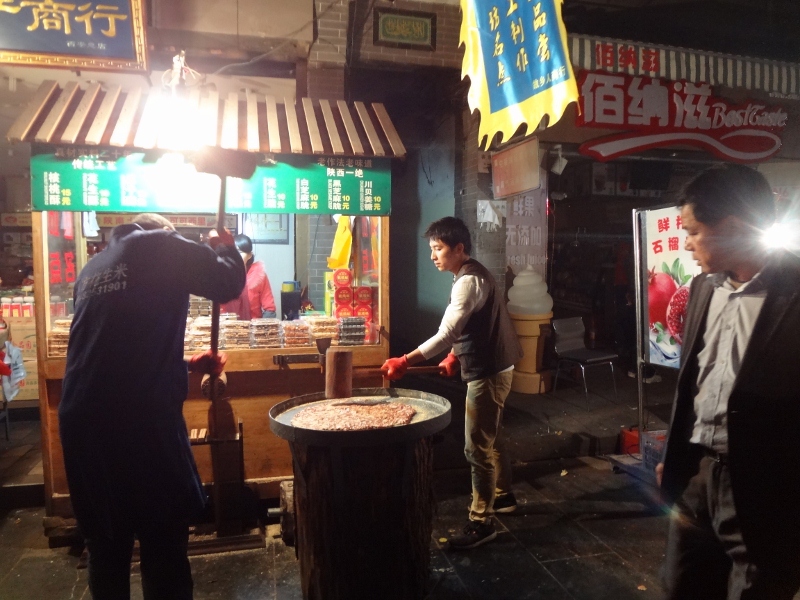
I think they are making a similar halvah like candy, but by pounding it with wooden hammers instead of pulling.
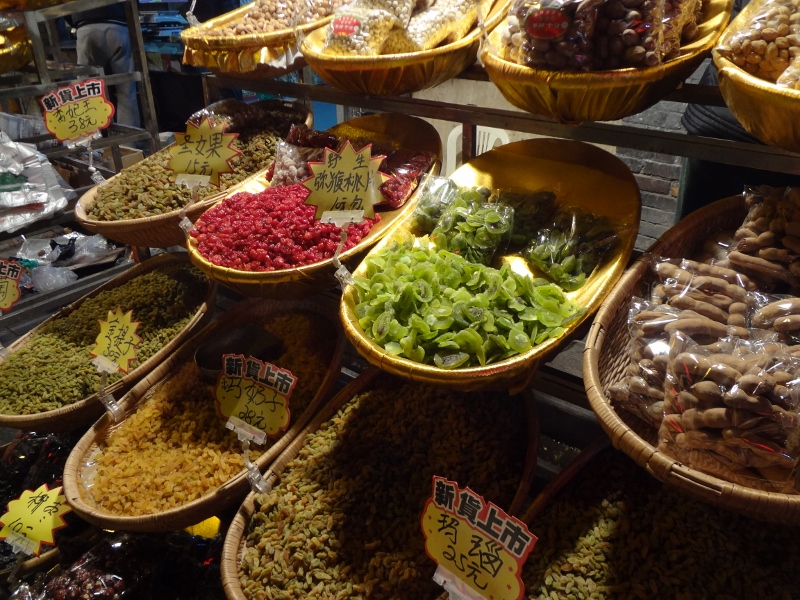
Dried fruits and nuts
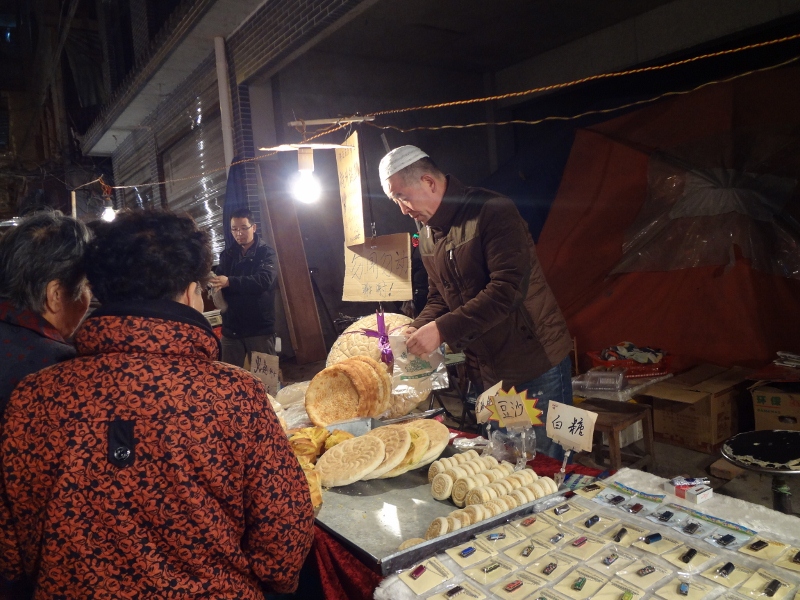
More breads and sweets
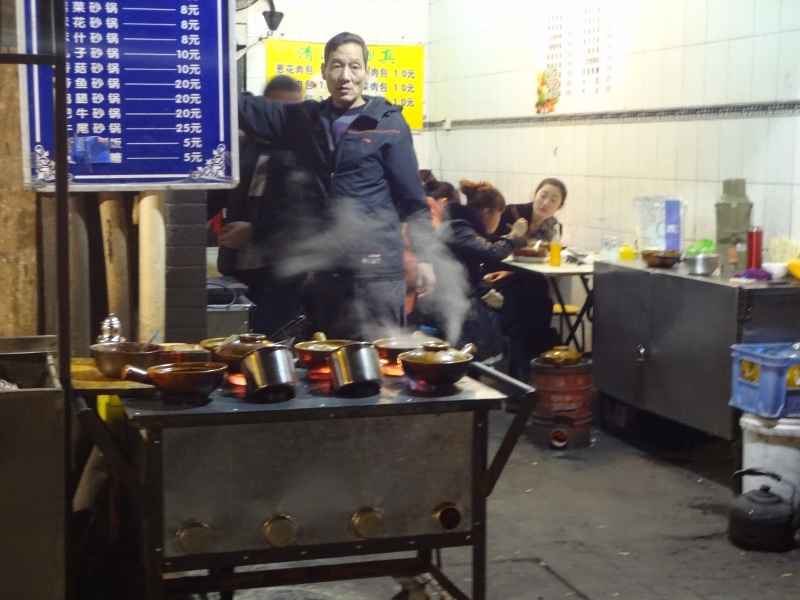
Hot Pots
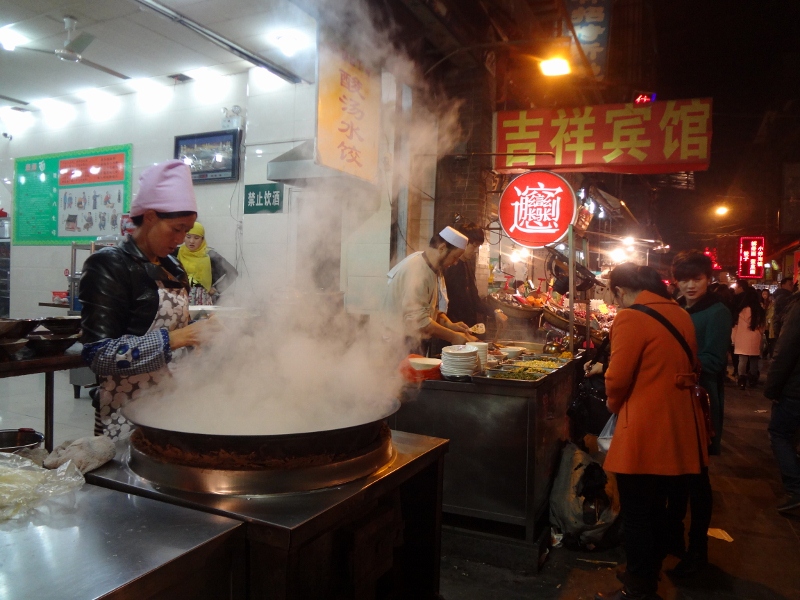
More Hot Pots
Are you hungry yet? We waddled off to find a taxi.
Adventures in China – Part 7
The Terracotta Warriors
This huge and truly amazing UNESCO world heritage site, encompassing about 56 square kilometers is at Lintong about an hour outside of Xi’an. It consists of a man-made hill wherein lies the mausoleum of Qin Shihuang, the first emperor of China. The surrounding area is referred to as the mausoleum garden, and several ‘pits’ have been discovered that have contained a variety of fascinating treasures. The mausoleum itself has not been excavated, but they have been able to glean a considerable amount of information from historical record and non-intrusive investigation. The part of the site that is open to the public centres around the ‘pits’ which are about 1.5 kilometers from the mausoleum.
Emperor Qin started building this tomb complex when he ascended to the throne at age 13, and it wasn’t completed when he died at age 51, in 209 BC. It is estimated that between 700,000 and 800,000 people worked on this complex. The Emperor searched high and low during his life for the elixir of immortality, but his fall back plan was to create a life in heaven exactly like he had on earth, complete with his armies, horses, household goods, a troupe of acrobats and a lot of money (just in case).
The soldiers and horses are beautifully made, each one different. Like the Han Dynasty figures in Xuzhou they were originally painted brilliant colours. They estimate that they will uncover about 8,000 figurines by the time they are finished.
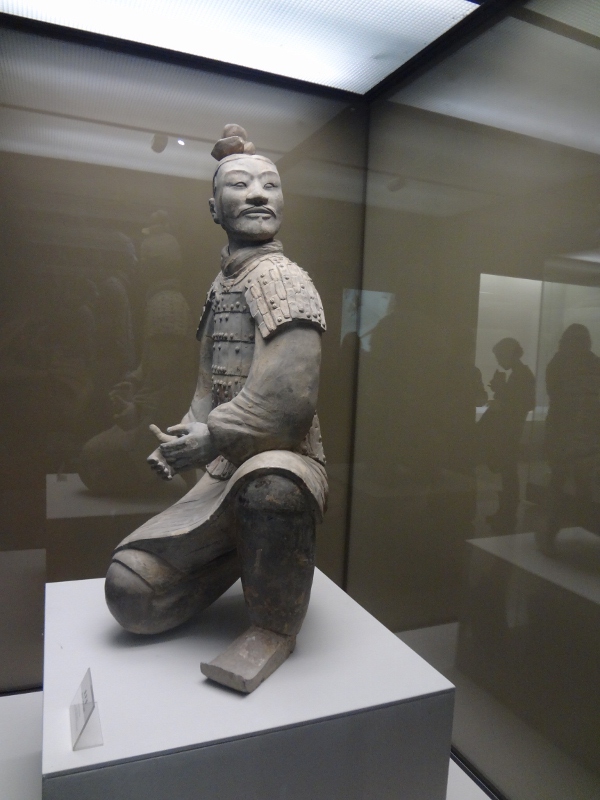
Kneeling archer
Our first stop was the museum, where oddly enough we went first to an exhibit on the Emperors of Rome. On the next floor were some of the more interesting relics that have been discovered. Getting to see the bronze chariots was a bit like trying to see the Mona Lisa at the Louvre. However it was worth elbowing my way to the front. These are two 4 horse chariots at half-scale. Exact in every detail. Made completely of bonze using methods that are difficult to duplicate today. For instance, the umbrella that shades the first driver is only ¼” thick and cast in one piece.
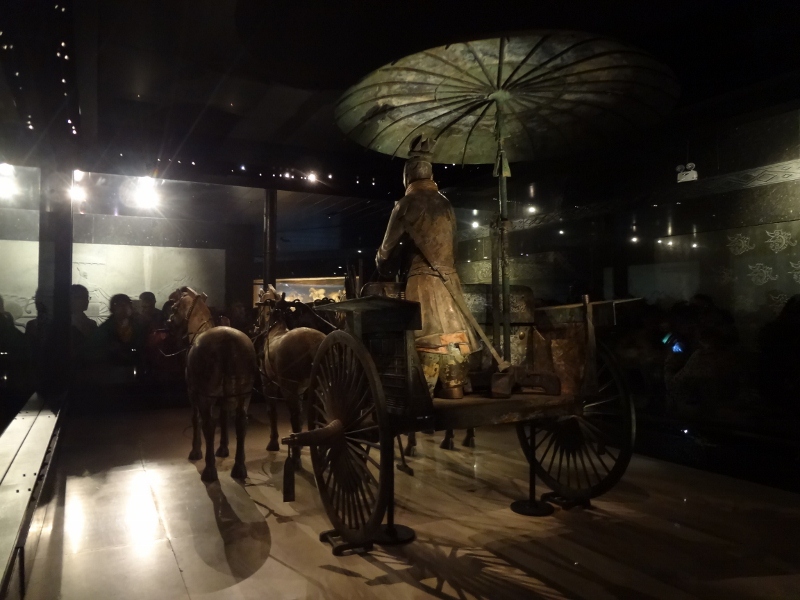
It was hard to get a good picture of this magnificent bronze carriage
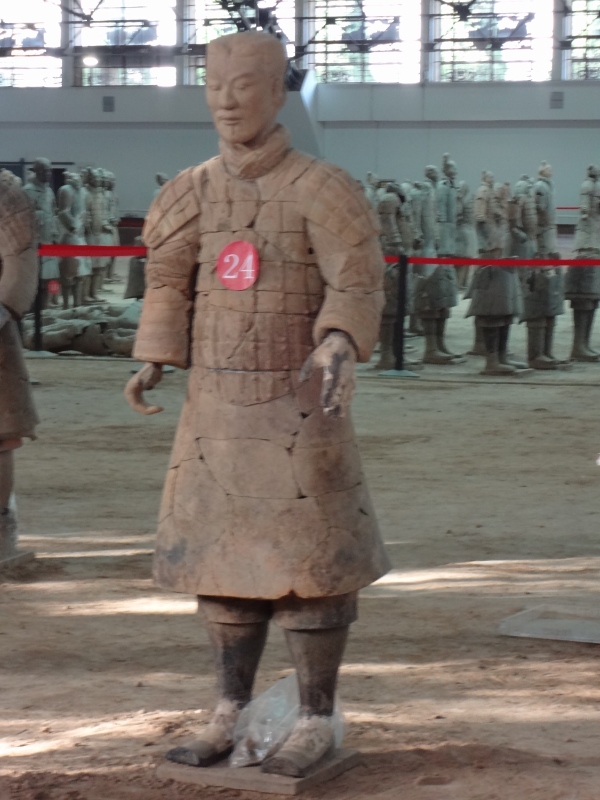
No complete figures have been found, but many can be recorded in situ and restored.
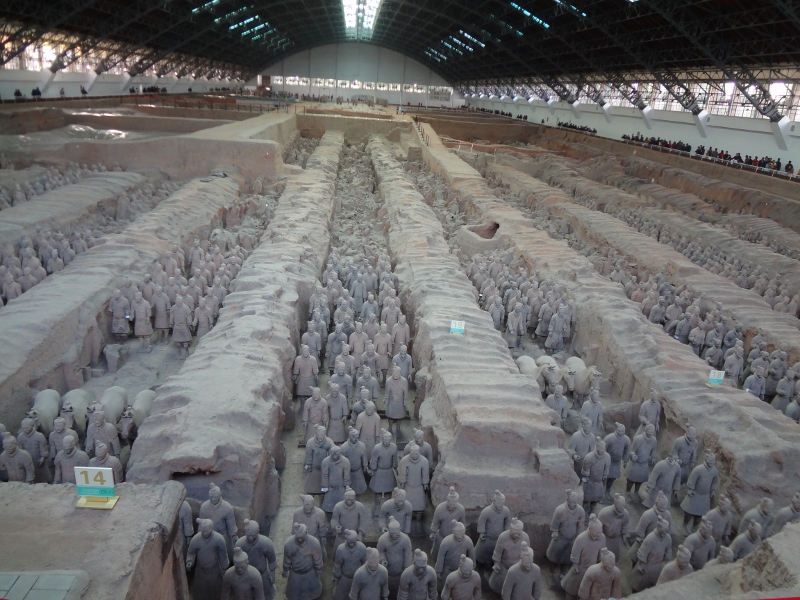
Pit 1 is massive in scale and the most impressive.
Tomorrow I am off on the high speed train to Beijing!
Adventures in China – Part 8
Beijing
Beijing was a pleasant surprize – it seemed almost laid back after Guangzhou, Xuzhou and Xi’an. The traffic was almost organized, drivers stayed in their lanes, instead of straddling the lane line in indecision, waiting for the best possible opportunity for advancement. I was actually able to cross the street by myself. In Xuzhou and Xi’an, Nan’s father would grasp my arm and propel me through the 6 – 8 lanes of traffic. This exercise would usually include rushing forward, stopping suddenly, perching precariously on the centre line, with the occasional leaping backwards or forwards to avoid a vehicle coming too close. All this interspersed with short expletives that led me to believe that I had just narrowly been spared from certain death. The air was clear (“good weather” the Chinese say), favourable winds having blown the pollution off towards Korea.
I booked a package online from Xi’an which included pick-up from the train station, hotel, small group tours to the main sites, and delivery to the airport. This seemed the best way to go given my limited time and lack of research. The hotel is rather grand, and the food expensive, but the location is great – within the inner ring of the city, fairly close to the Forbidden City and in Wangfujing Street, a famous pedestrian shopping area.
The first day of the sightseeing tour started at 7:30 (almost mid-day in China) at -5 C (glad I brought my down jacket) and included Tiananmen Square, the Forbidden Palace, a silk “factory”, the Temple of Heaven, the Summer Palace and a pearl “factory”.
Tiananmen Square is underwhelming, but apparently a million people can assemble there. The guide did not mention any embarrassing demonstrations or human rights infractions, but interestingly enough we did witness a small rally in front of a government building. Our guide pointed out that if people from the ‘countryside’ had issues that couldn’t be resolved, they would come en masse to demonstrate in front of the relevant government office to seek a resolution. Sounds like Canada.
The Forbidden City (forbidden to common folk) was started in 1407 and completed by 1420 during the Ming Dynasty, after the capital was moved from Nanjing. It is architecturally magnificent and doesn’t really fit into the camera well. It was very busy with tourists, mostly Chinese. These are ‘must see’ sites for Chinese citizens. The ‘city’ consists of several palaces or halls with names like the Hall of Mental Cultivation, the Palace of Earthly Tranquility, the Palace of Union and Peace and the Palace of Heavenly Purity.
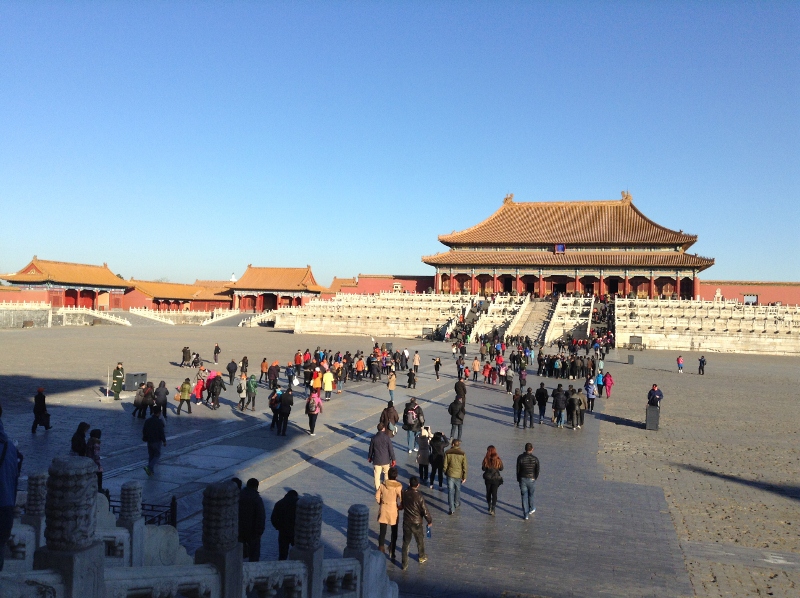
Heading to the Hall of Supreme Harmony
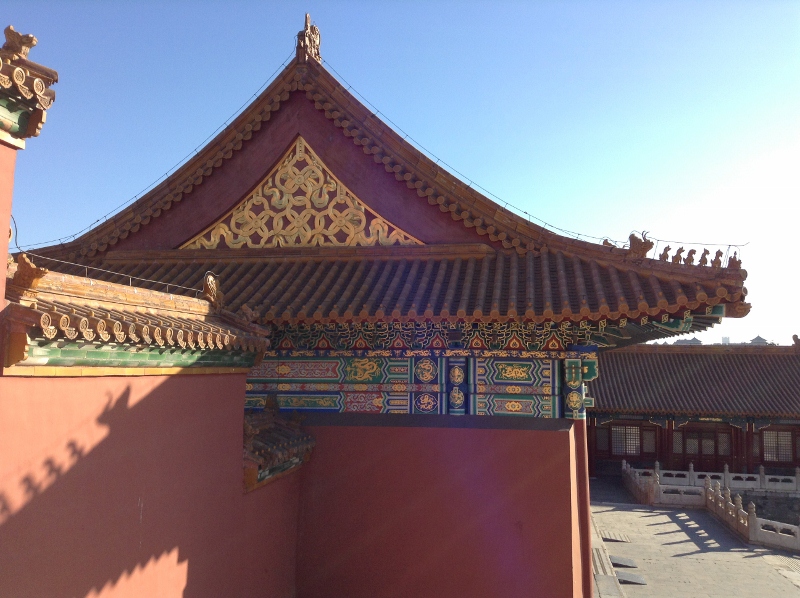
Architectural Detail – Forbidden City
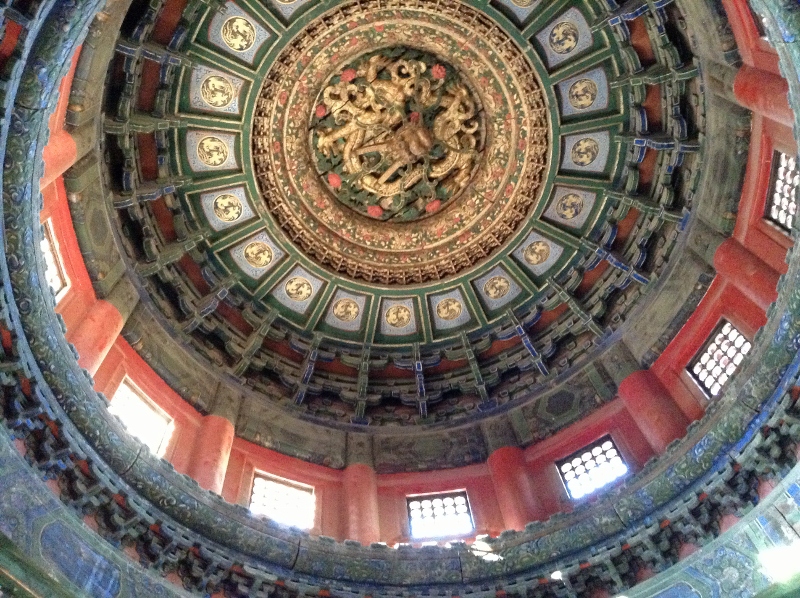
Dome in the Pavilion of Eternal Spring
The Temple of Heaven was equally stunning, especially the Hall of Prayer for Good Harvests, built completely of wood with no nails (except for the roof tiles)
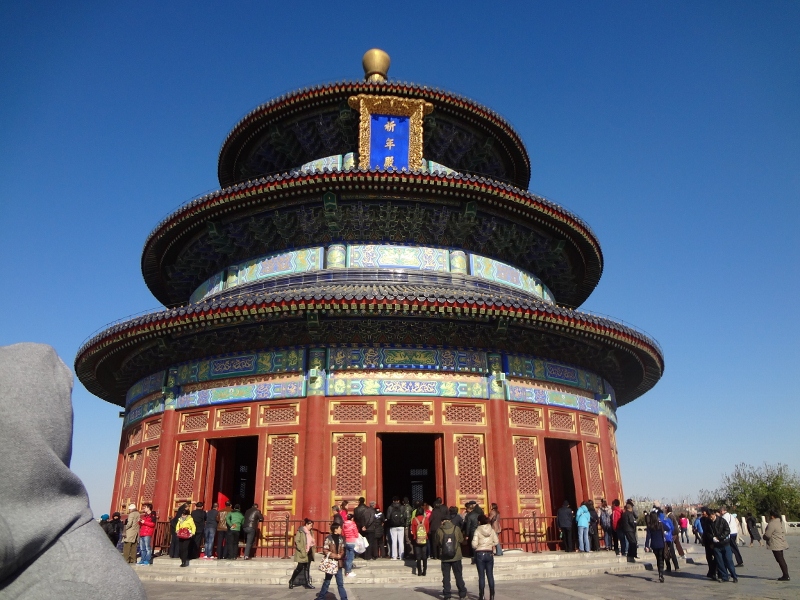
Temple of Heaven
But my favourite was the Summer Palace, a vast garden with various pavilions situated on a lake.
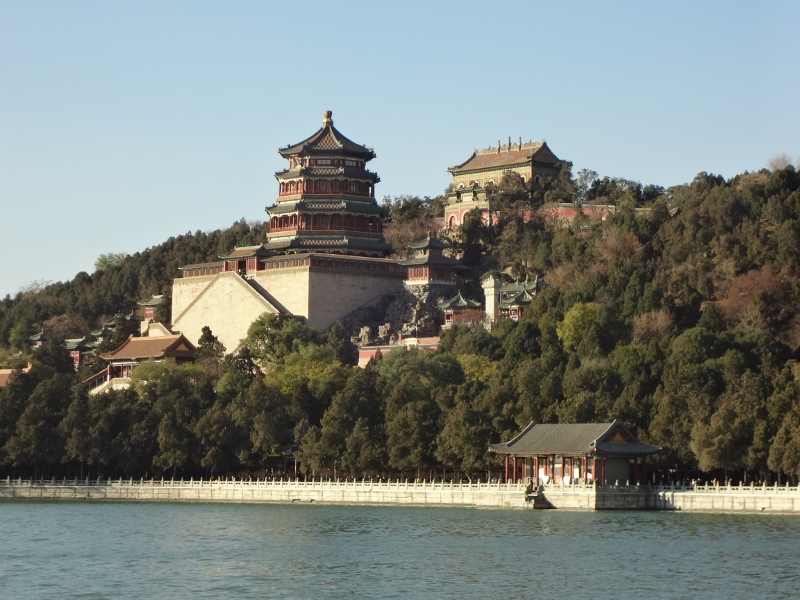
Emperor’s Summer Palace – Beijing
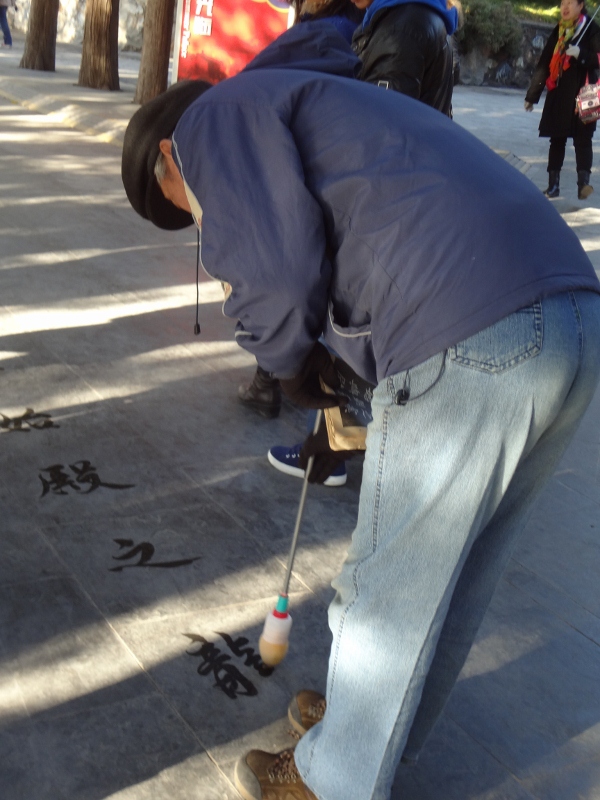
This man was writing poetry with water on the pavement; I loved that it was disappearing after it was read – ephemeral graffiti
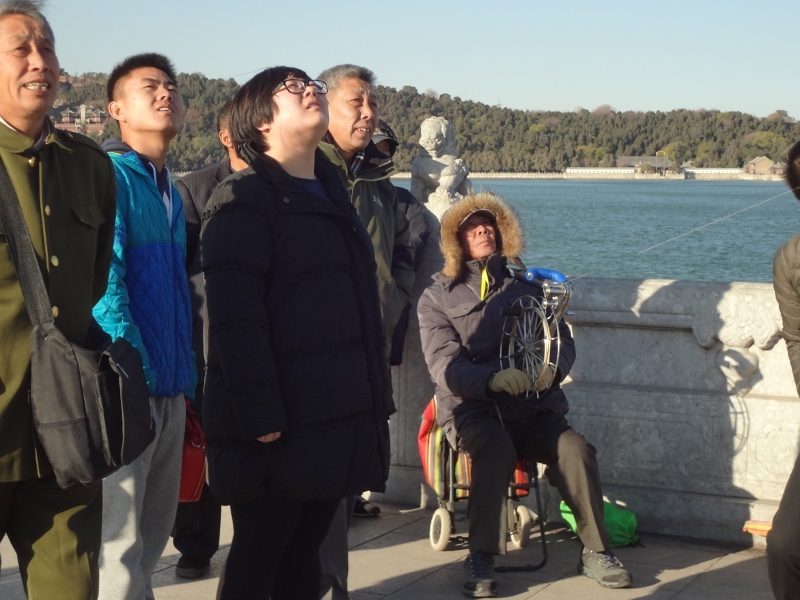
Now this is how to fly a kite
The thing about a tour like this, is it is too rushed. Sites like these deserve to be savoured, details lingered over, knowledge absorbed through all the senses. But alas, our guide marches us ever onward, towards the inevitable shopping experiences and, no doubt, his hoped for commission.
Adventures in China – Part 9
The Great Wall
The Great Wall stretches over 8,000 km (over 20,000 km if you count all the branches) across the historical northern boundary between China and Mongolia. It was begun as early at 700 BC with major construction around 200 BC when Emperor Qin Shi Huang unified China. Over the years parts have been left to decay and other built and rebuilt. The section of Wall at Badaling that we visited was refurbished in the 1600s (Ming Dynasty).
The Wall is actually incomprehensible to me. Instead of cutting a swath across the landscape, it wanders along the convoluted mountain ridges, often almost circling back on itself. It guards precipitous defiles that no army could possibly reach, and yet on easier ground it seems insufficient to withstand the Mongol hoards. There are branches that lead off and stop, I suppose supplying additional vantage points for archers. The walkway along the wall is in itself so steep in places it seems to be more of a hazard than the invaders. I would have loved to have had the entire sunny, almost smogless day to hike this section, but instead we had about 2 and half hours, and were conveyed to the mountain top via a cable car. Possibly best, it would have been like climbing up 60 stories of stairs.
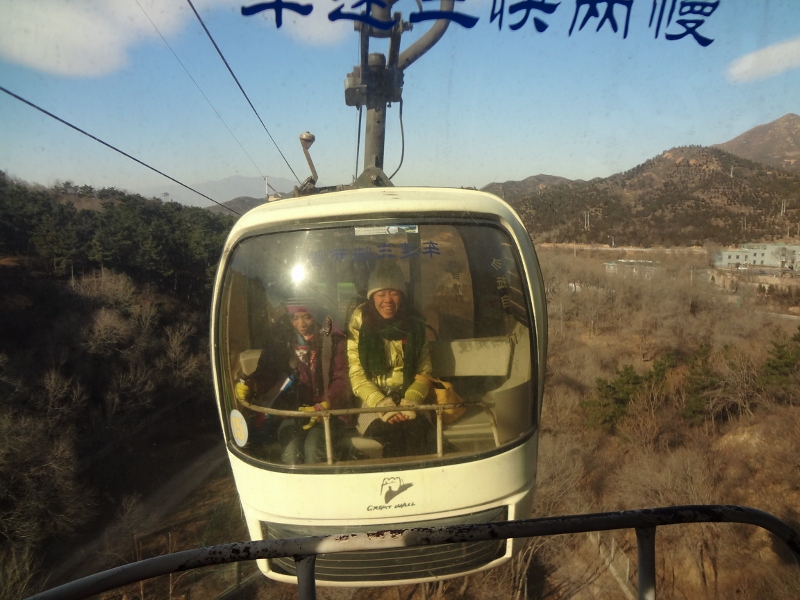
Girls from Hong Kong loved the gondola ride up to the Great Wall
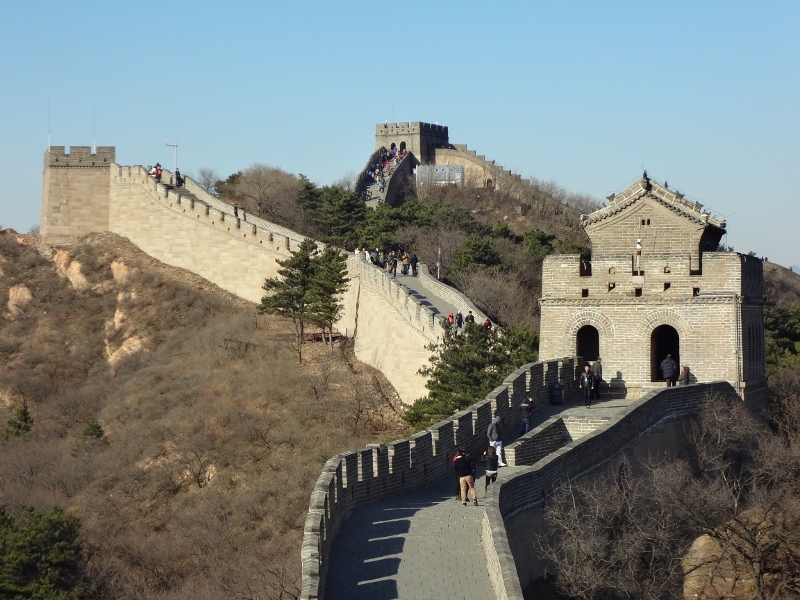
This Badaling section of Wall was restored during the Ming Dynasty (1600s)
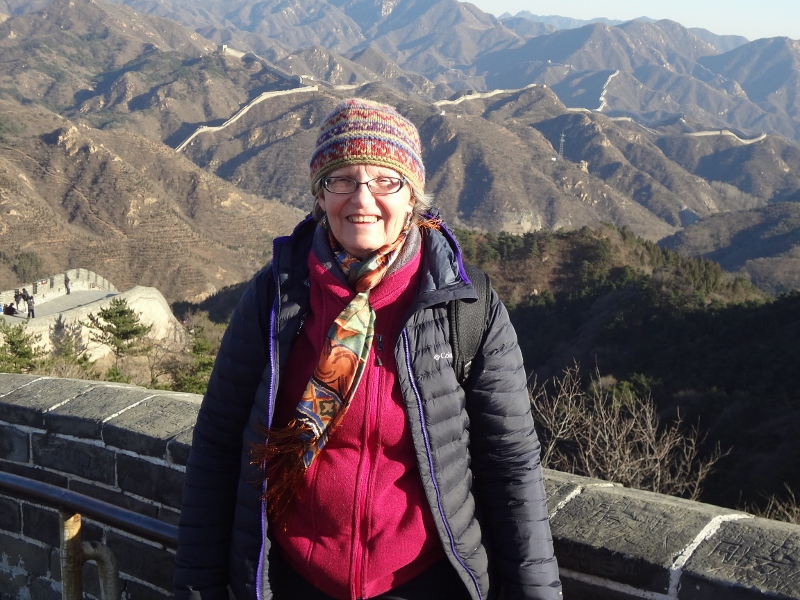
It was an amazing clear day for China
The day finished on a humourous but slightly bizarre note. ‘Shopping’ stops are part of these tours. They consist of visiting a ‘factory’ where you learn a little about something (silk, jade carving, pearls, etc.) and then there is a huge sales area. I am pretty sure that the guide receives a commission based on how much we spend and also that the sales people work on some sort of commission, given their attentiveness. On one hand I didn’t mind this because you do get some interesting information, and I had been particularly deprived of retain therapy on this trip. After the Great Wall, we were taken to what was alleged to be the most famous tea house in Beijing, Dr. Tea. To be fair there were pictures of famous people on the walls, most of whom I didn’t recognize of course. The 9 of us were shepherded into a narrow VIP room where we were seated at a long table, and a lovely young girl served us samples of 6 or 7 teas with short histories and comments on their medicinal qualities. It was all very lovely until she got into her sales pitch, which was very enthusiastic and direct. However, the problem was that these teas, and I don’t doubt that they were of the highest quality, were ridiculously expensive, a small box starting around $40 Cnd. When no one leaped forward to take her up on her buy 6 get one free deals, she just kept repeating herself, and we just kept sitting there. She was blocking our only escape route. She must of repeated her spiel about 20 times, each time to be met only with silence and polite smiles and nods. Finally one of us stood up and indicated we would like to see the rest of the showroom, so she finally relented and let us out. I felt sorry for her, because she did do a lovely job of the tea ceremony, and I’m sure here salary depends on how much tea she sells. In the end the couple from Sweden bought some small packages.
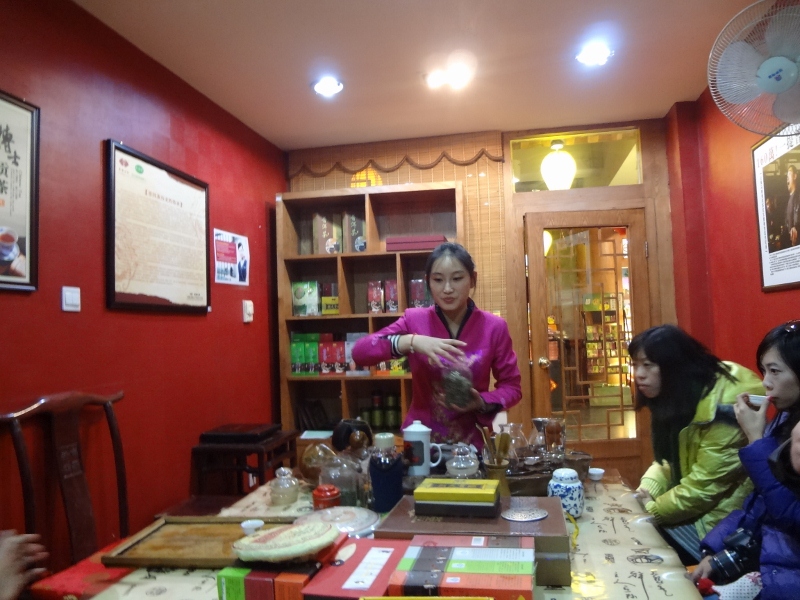
Sampling Tea at ‘Dr. Tea’
Adventures in China – Part 10
Last Day in Beijing
When I first travelled in China in 1987, it was a poor country. Even in the large cities of Guangzhou, Kunming and Chengdu cars were few and bicycles were many. Once out of the cities, life was simple but most people had the basic necessities. Luxury items, such as TVs were rare. A village might have one telephone. Today China has not only caught up to, but in some areas surpassed North America. Everyone has a cellphone, many families own condos. Beijing with 23 million people has 7 million cars. Cars now outnumber bikes and scooters. I was thinking about this as I wandering in Wangfujing street on my last day in Beijing. I was glad to have the day to wander on my own, and had spent my morning in the National Museum of Art. Now I was standing the middle of a huge shopping area. All the famous brands are here – Channel, Cartier, Nike, Gap, The North Face, KFC. I could be almost anywhere.
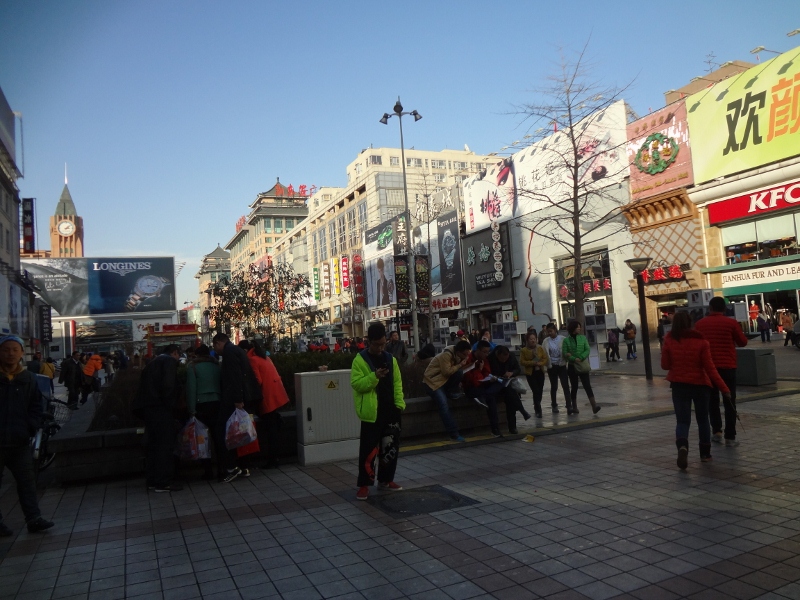
Wangfujing Shopping Area
Just as I was getting tired at looking at fashionable clothes that I would never wear in Wells, and getting hungry, I turned down an alley looking for a restaurant. I soon discovered thereal Wangfujing Street, crowded with food stands and stalls of cheap souvenirs. I started with corn on the cob from one stand, then chicken dumplings from another. Then I had candied fruit on a stick (like candied apples), which oddly enough included cherry tomatoes. I passed over the seafood and the pigeons.
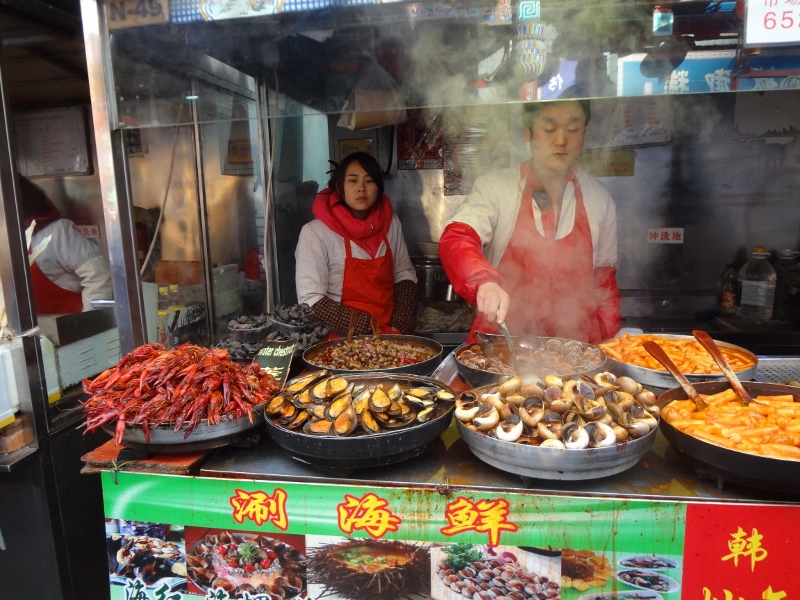
Seafood Stand
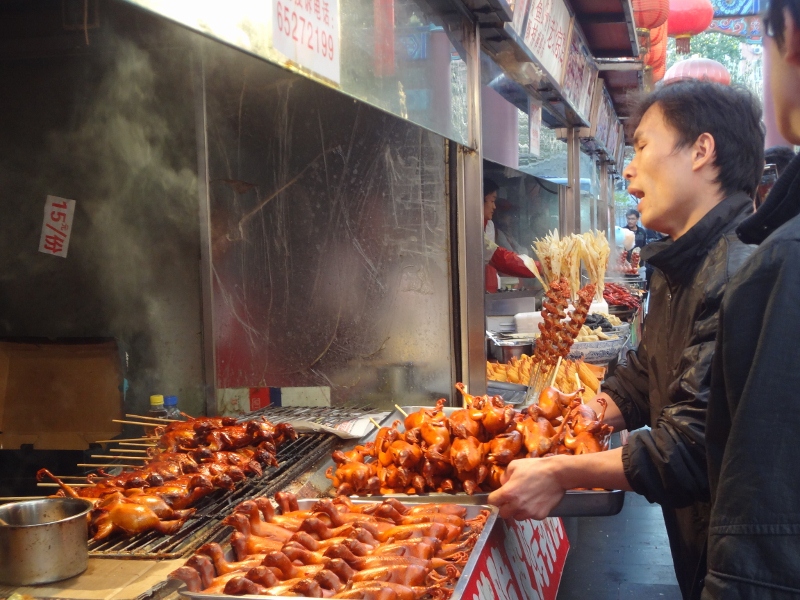
Roasted Pigeons
Until I came to this stand:
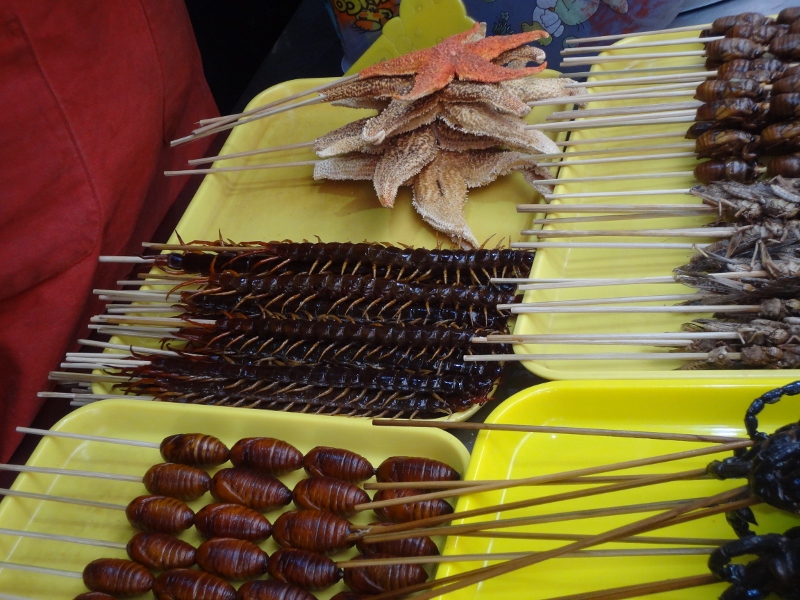
Centipedes, grubs, snakes and starfish, spiders and scorpions
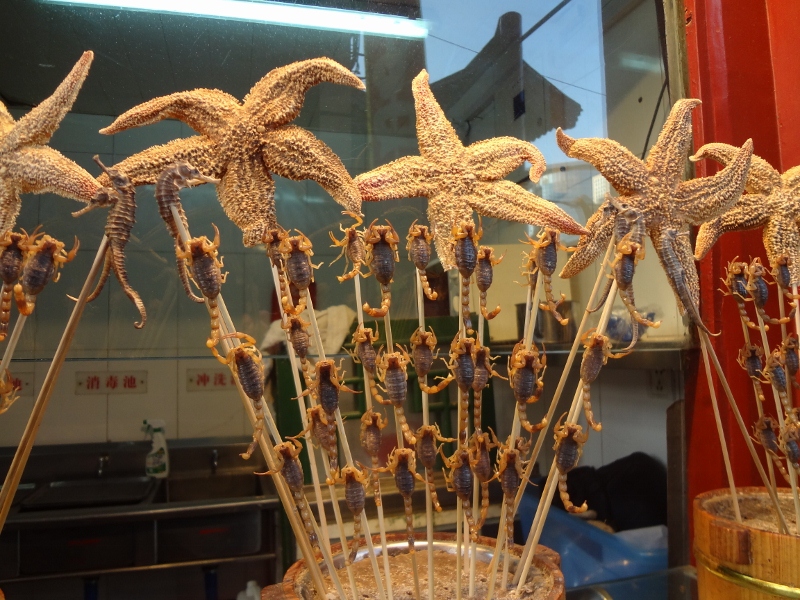
The scorpions are put on the sticks still alive and wriggling
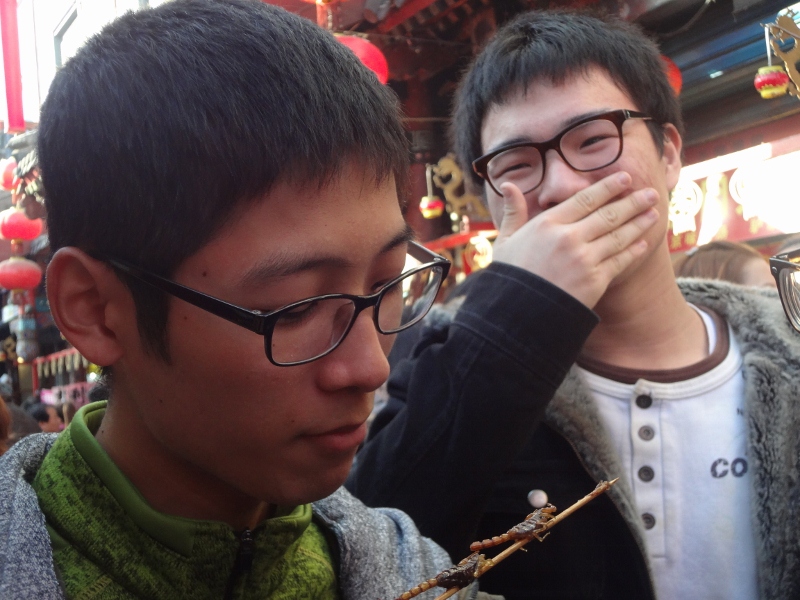
I actually saw people eat the scorpions, although these boys were doing it on a dare
Right! Well I could be almost anywhere, but you can bet it is not North America (or at least not NA north of Mexico!) Well they say that insects are an up and coming source of protein as world food supplies shrink, so I guess we better start adjusting our sensibilities. For me… maybe next time. Luckily I’m already full of chicken dumplings, so I am not the least bit tempted.
Now as I sit in the Starbucks at YVR overlooking the Bill Reid sculpture – its 3:00am China time and I have been up for 23 hours with two more legs of the journey and another 12 hours to go — I am glad to be back in Canada. I am sipping a vente cappuccino and eating Starbucks oatmeal, just about my favourite travelling food. Even in this busy airport the noise and the frenetic energy have dropped by 50% from China. China is endlessly fascinating and intriguing, but I look forward to the peace and solitude of my mountain home.
 jcstravels