In February 2014, my old friend Margie Jamieson and I set off on another (our third) cycling adventure in Cuba. This time we were accompanied by Belinda (Billy) Page another old friend of Margie’s. We flew to Santa Clara and then grabbed two taxis with our bikes still in boxes (it’s always fun to watch 6 Cuban men decide how to load 3 bike boxes and 3 women into two tiny cars) to Remedios, 40 km northeast. We were headed for La Rueda, the Casa of our friends Ania and Eberto, where we had stayed in 2012. We spent 3 days here while Margie recuperated from a killer cold/cough. Since our visit in 2012, Eberto Jr. has married his girlfriend Arianna and they have a son, Andres, who is about 18 months. They have moved in with Ania and Eberto while Eberto Jr. works on building their home.
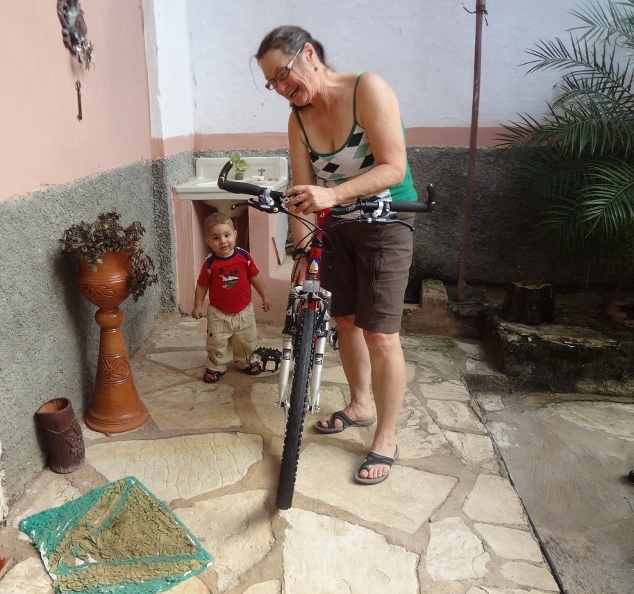
Little Andres helps Margie put her bike together
And they have a computer at home with dial-up Internet — something we are seeing more and more of in Cuba. Eberto Jr. and I are now friends of Facebook.

Eberto’s computer
Remedios is a very relaxing place to chill for a few days, hang out in the square and chat with folks. Billy decided to get her hair cut which was fun.
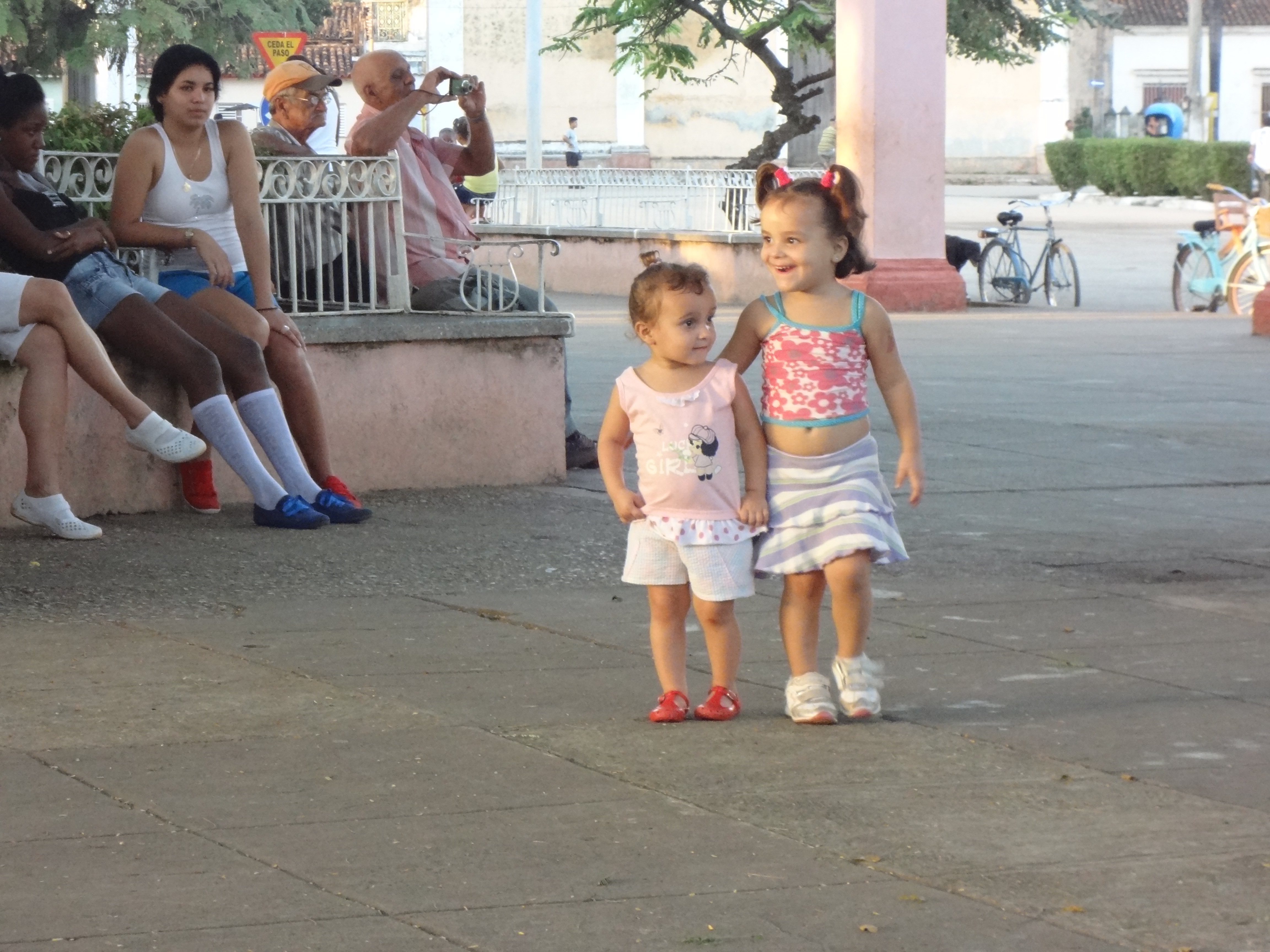
In the square in Remedios
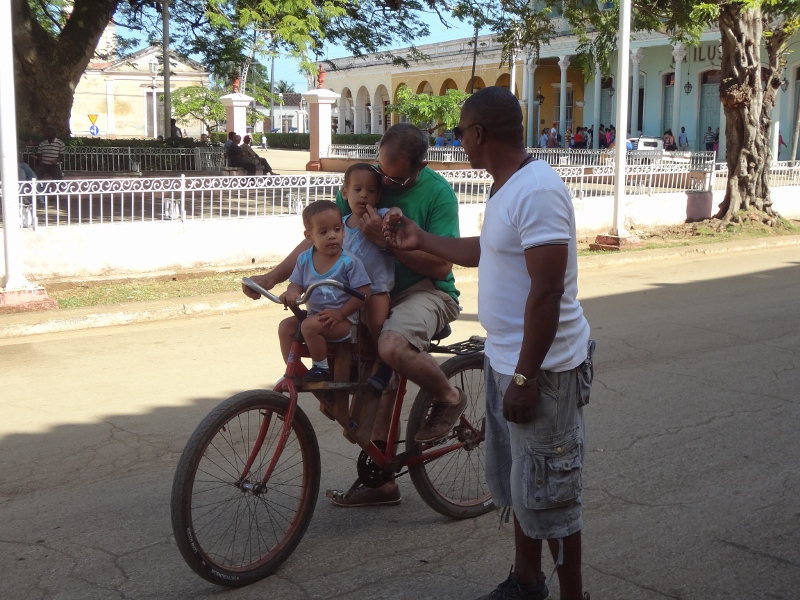
Twins on the family bike
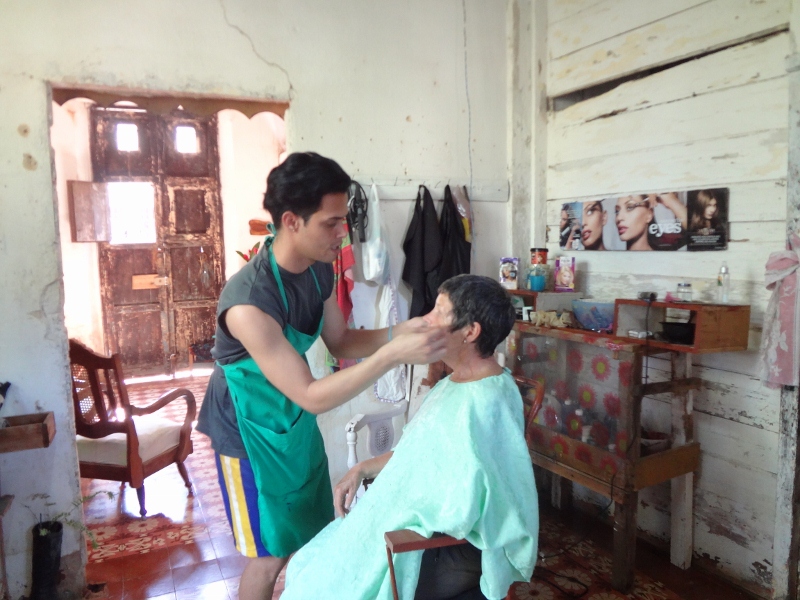
Billy gets a hair cut
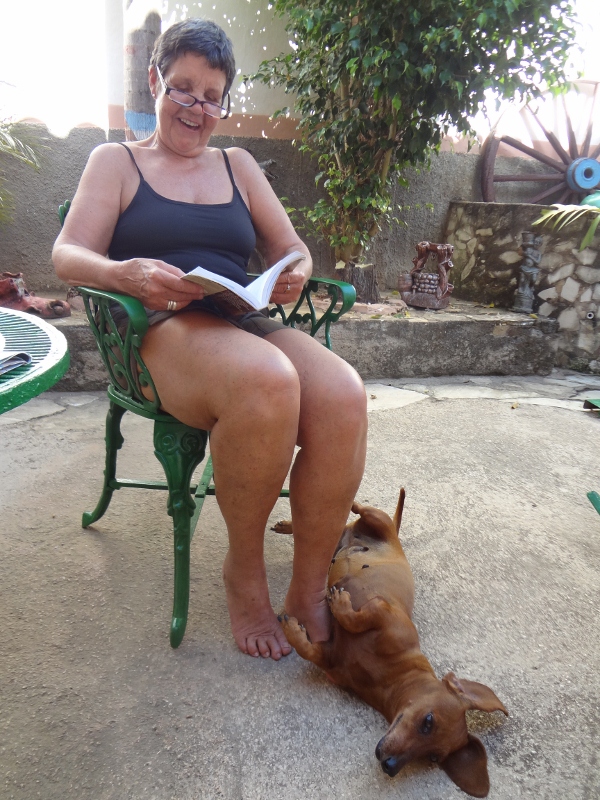
Chilling at La Rueda with Mima the Daschund
Why bike in Cuba?
Cuba is one of the best kept secrets in the cycling world. It had never been high on my list of places to visit, but three years ago, when Margie and I were considering a potential place to cycle during Canadian winter, it popped up in a Google search. A very informative site put up by an American couple who had clocked over 6,000 kilometers in Cuba peeked our interest.
I knew very little about Cuba. As a child I remember that North America was gripped in the terror of nuclear holocaust during the Cuban Missile Crisis and that had caused me more than one nightmare. Some of my politically astute friends consider the ‘Castro Experiment’ a great triumph for socialism, and a couple of my friends had been on ‘study tours’ to Cuba’s organic farms.
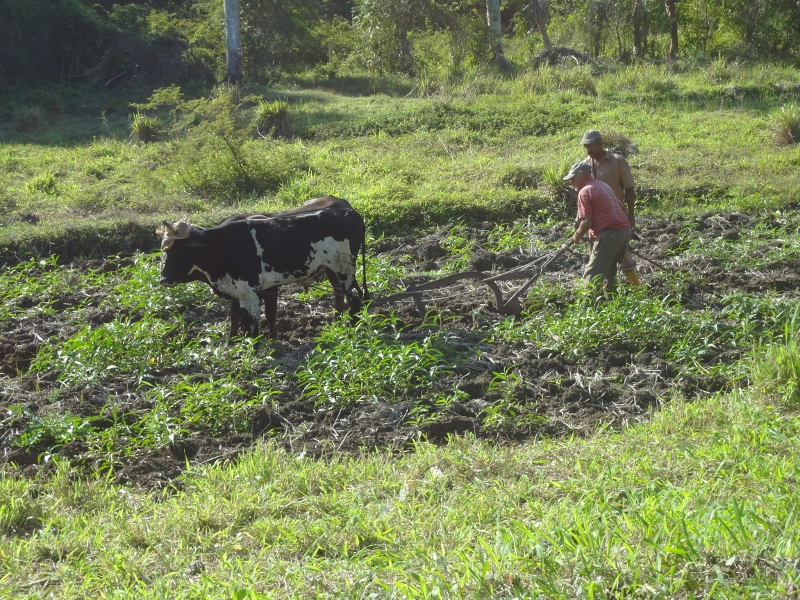
Plowing with oxen – lack of fuel caused Cuba to revert to organic and planet friendly methods during the Special Period
Unexpectedly, I loved Cuba almost instantly. The glitziness of our crass North American consumerism was refreshingly missing, and we were taken back to basics – honest, friendly people with no pretenses, people who instinctively looked after each other and took the time to assist perfect strangers with no thought of reward; good organic food, although with limited variety; a lack of technology which, while it is certainly not by choice, has resulted in a relatively clean environment. Cubans have been through a lot since the Revolution, including the ‘Special Period’ when support from the Soviet Union collapsed, but there seems to be a distinct lack of ‘victim mentality’ and a strong ‘can-do’ ethic. To me everything had a shabby, rundown feel, but was somehow comfortable and lived-in, like a favourite sweater.
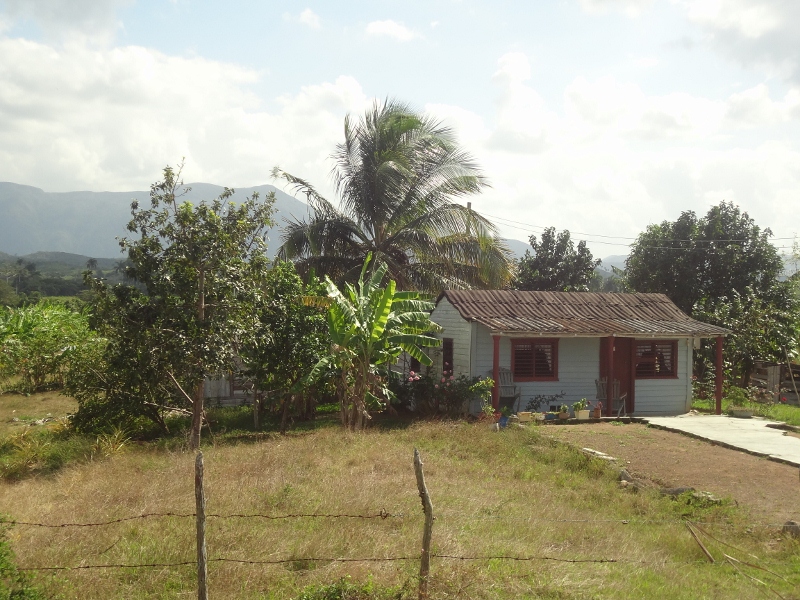
farm in Pinar del Rio
Travelling by bicycle in Cuba plunks you right smack dab into the middle ordinary Cuban life. Away from the cloistered resorts and the ugly ghettos that support them, the road ‘leads ever onward’ through the countryside, past sugar cane fields and organiponicos, over arid plateaus where Brahman cattle graze, through lush tropical forests with screaming exotic birds and along lonely hurricane swept beaches.
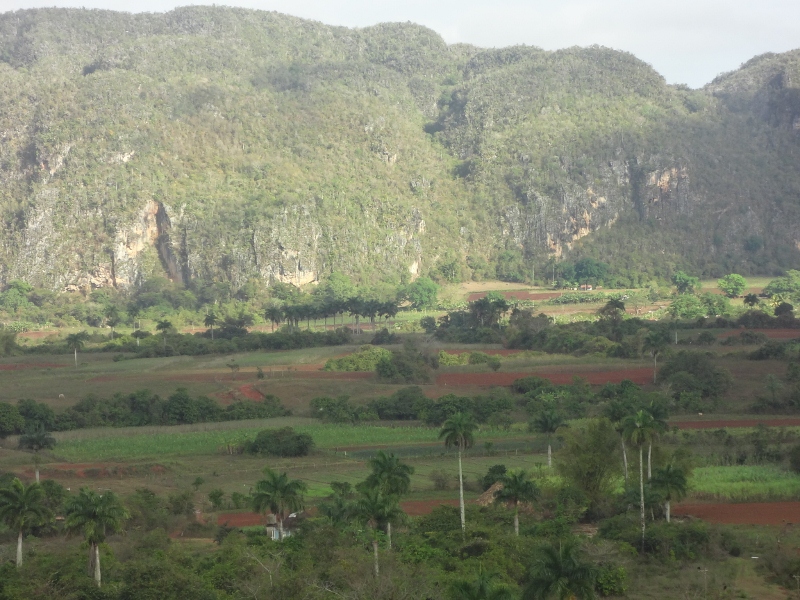
near Vinales in 2013
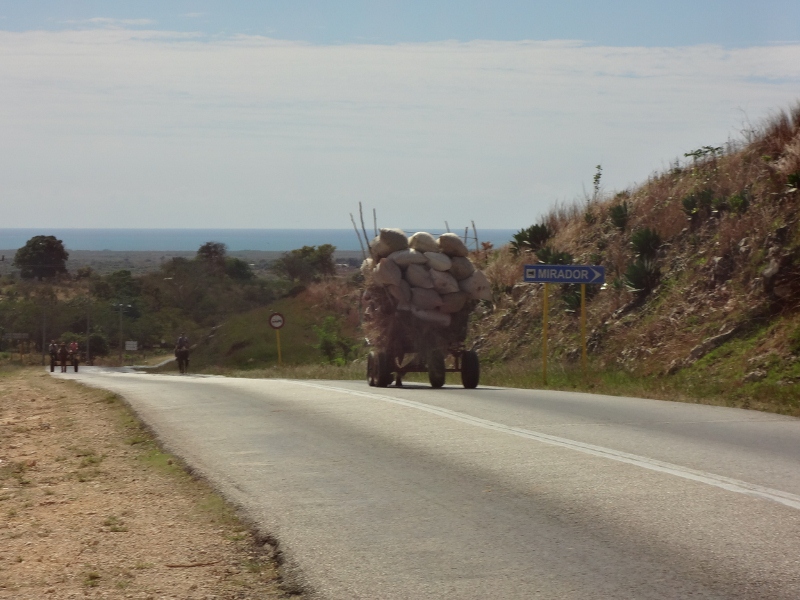
leaving the Valle de los Ingenios near Trinidad with a great view of the Caribbean
Along the way is an endless parade of engaging encounters with Cubans going about their everyday life. On a bicycle life glides by at a pace at which it can be easily absorbed and appreciated. Conversations along the way with the grandfather who passes you on his one-speed Chinese bike or the lady at the fruit stand, or a cowboy riding by, lighten up the day and provide laughter and camaraderie.
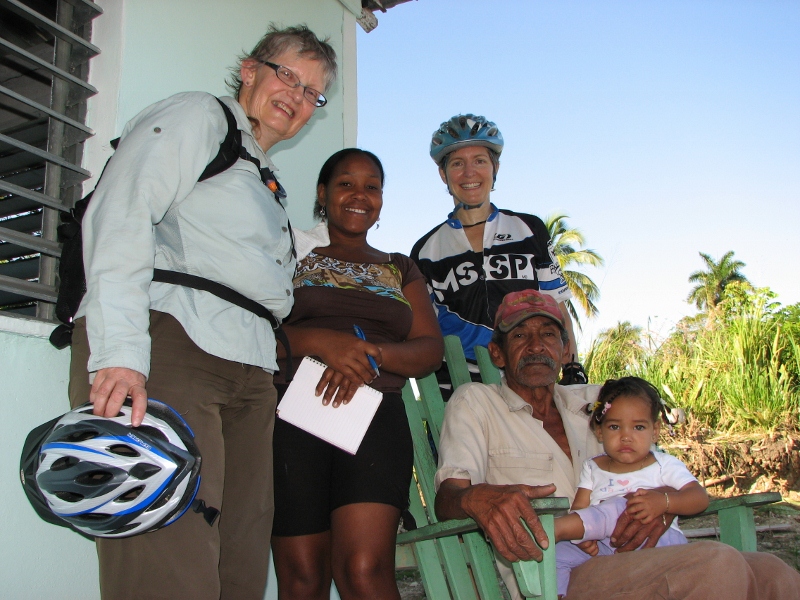
Family we met at the side of the road in 2013

A group of Cuban cyclists who gave me encouragement riding up a long hill in 2013 (photo by Cheri)
Although the roads are paved, they are often rough and potholed, but aside from that the cycling in Cuba is very safe. Because of all the other cyclists, horse carts, oxen teams and pedestrians, vehicle traffic is generally considerate. And the things seen along the side of the road never fail to interest and enchant.
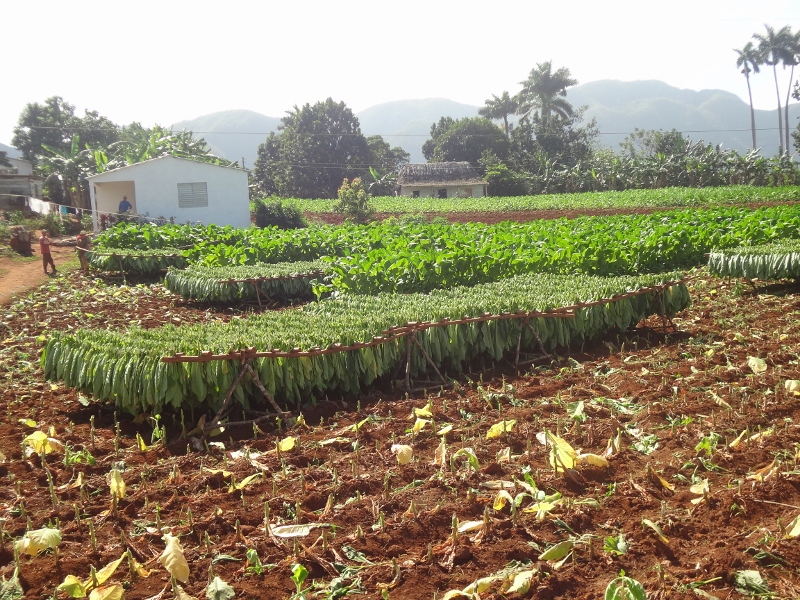
Tobacco fields in Pinar del Rio 2013
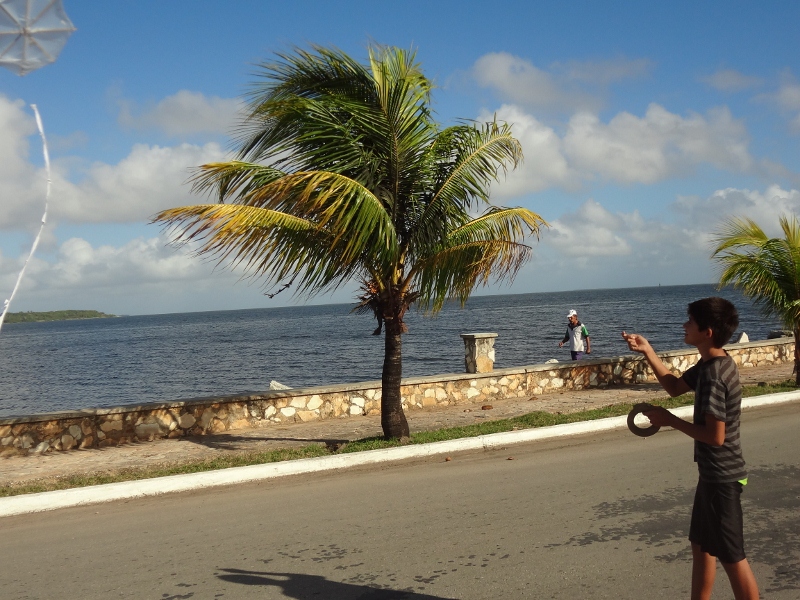
flying a home-made kite on the Malecon in Caibarien
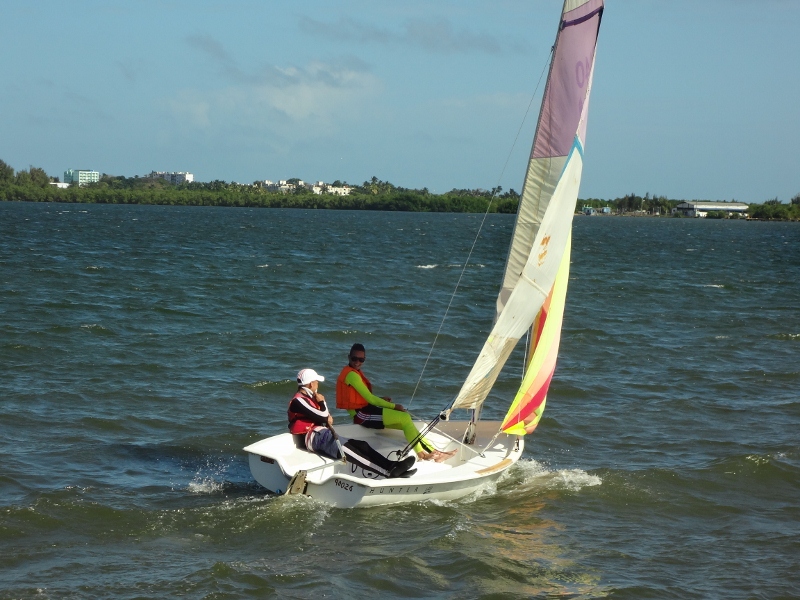
Sailing Club in Caibarien
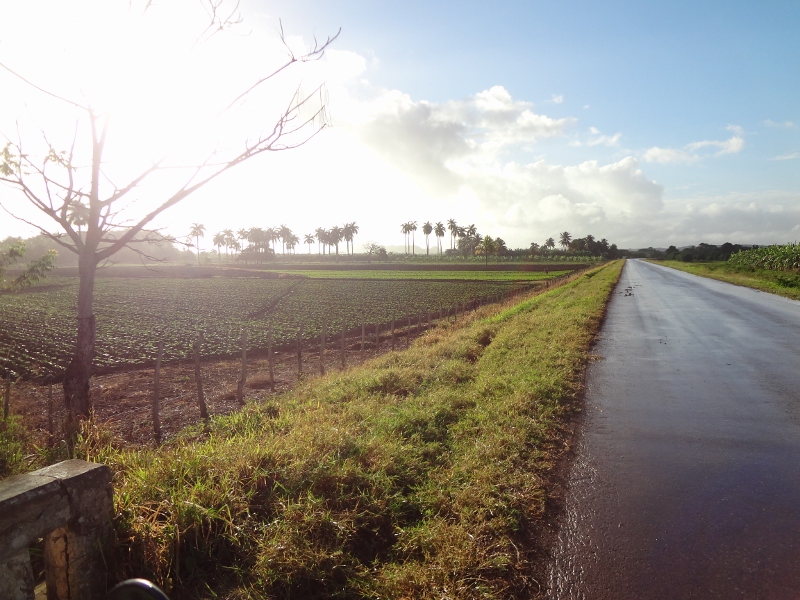
Intensive agriculture (organic) between Caibarien and Yaguajay
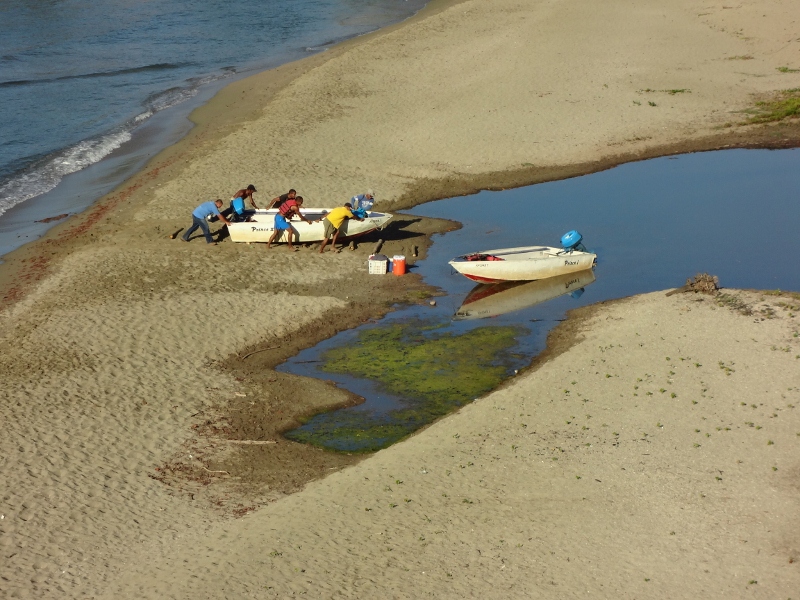
From the ocean to the river – Yaguanabo
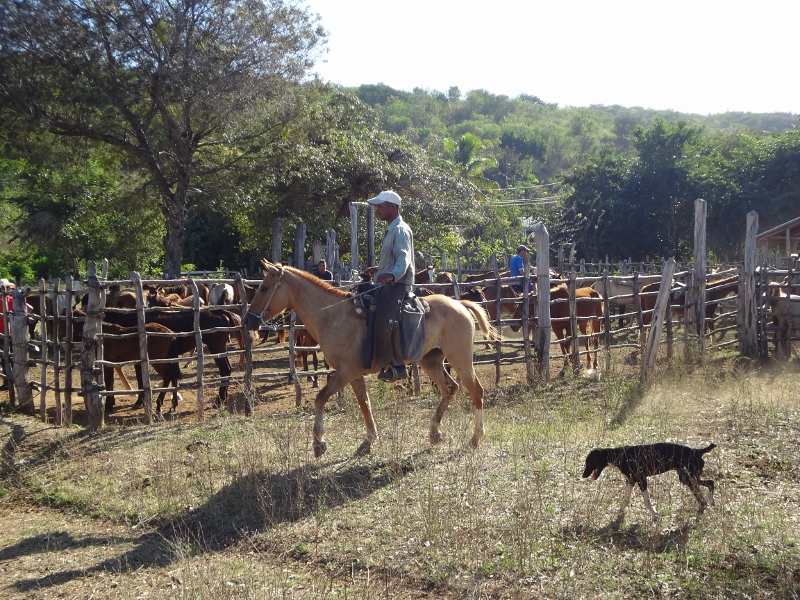
cowboys getting ready to castrate colts – near Yaguanabo
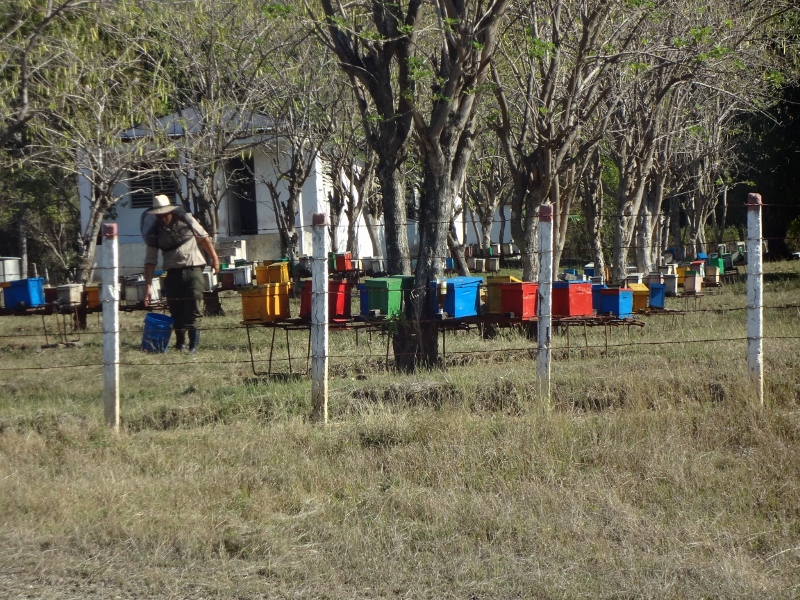
Apiary near Yaguanabo
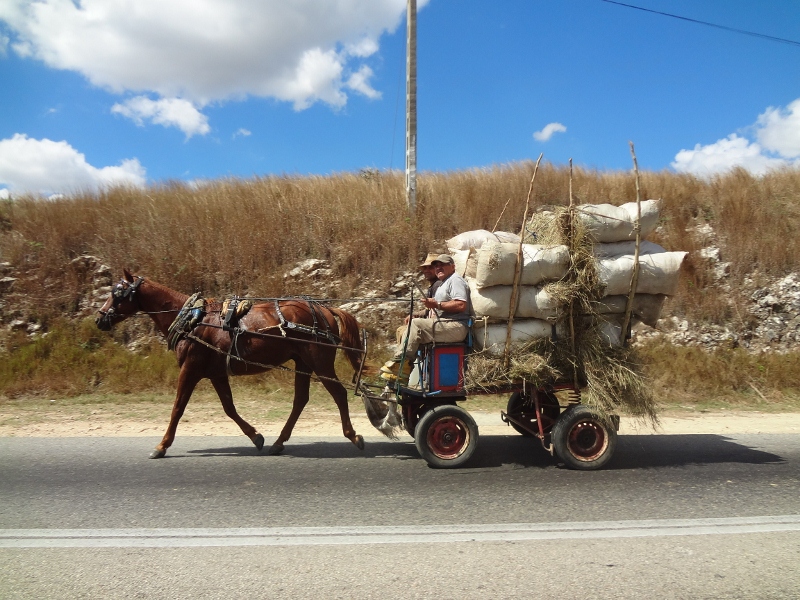
A very loaded cart
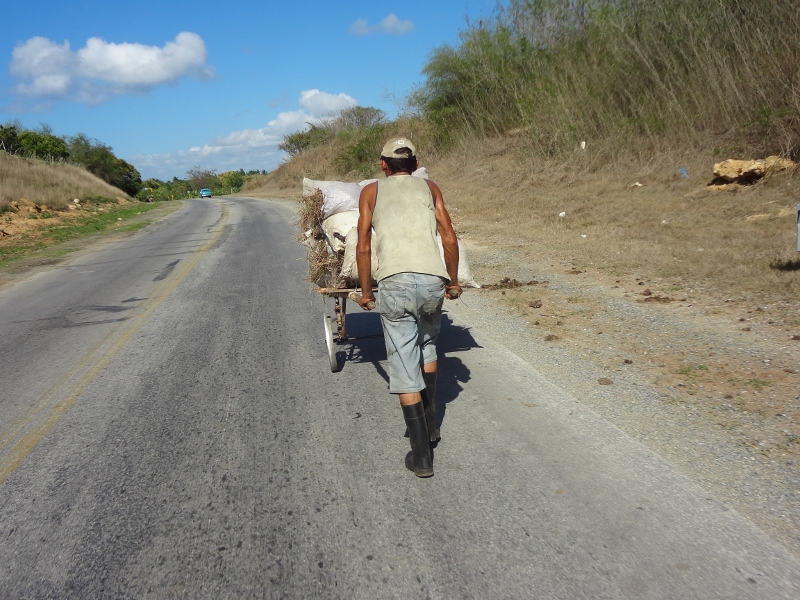
Another heavy load
Good bikes, Bad bikes and Cuban Bikes
Finding bikes to take to Cuba has been a bit of a trick. Since I am going to give the bike away to a Cuban family at the end of the trip, I don’t want to invest too much. Yet the bike has to be suitable to the terrain and comfortable to ride for a month and several hundred kilometers. We prefer mountain bikes with front suspension and city slicker tires.
In 2012, I got a really good used Norco Katmandu from a local bike shop for about $200 totally reconditioned, boxed and ready to go. In 2013, I was given a used Norco Mountaineer, another great little bike.
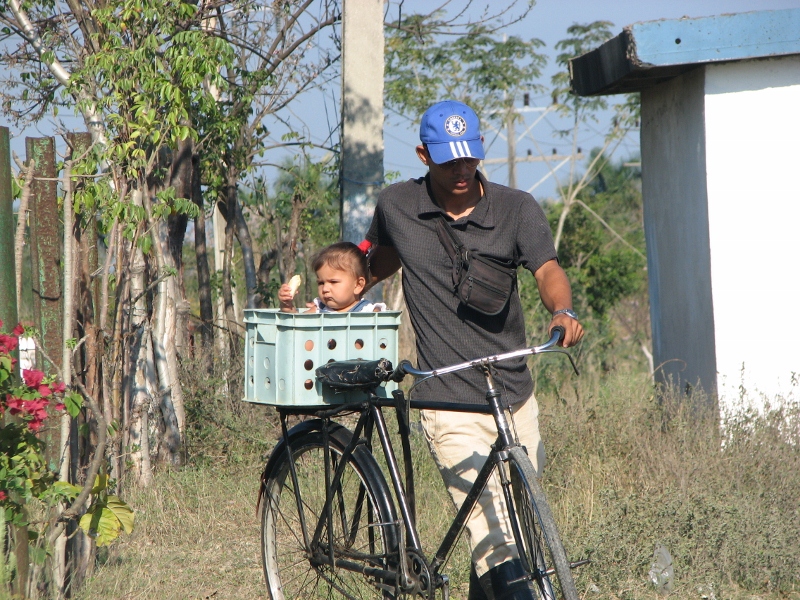
family bike near Vinales in 2012 (photo by Cheri)
In Cuba, the bicycle is still a major form of family transportation. It can mean that school children or working parents can avoid lengthy bus waits or costly horse cart rides. I have a great picture of Orgly, the musician to whom I gave my 2013 bike, riding to a gig with his guitar slung over his back and his amp strapped to the rack. It can form part of the family business – delivering milk or produce to local consumers. It can be used by family members for the numerous errands that form part of Cuban family life – going to this punta de venda at 9:00am for milk, and to another later on for eggs, and a different location for beans, rice and flour. This year in La Boca, I watched my 2012 bike come and go many times daily as different family members did errands associated with running their casa and restaurant.

Orgly going to a gig on my 2013 bike – in Cienfuegos
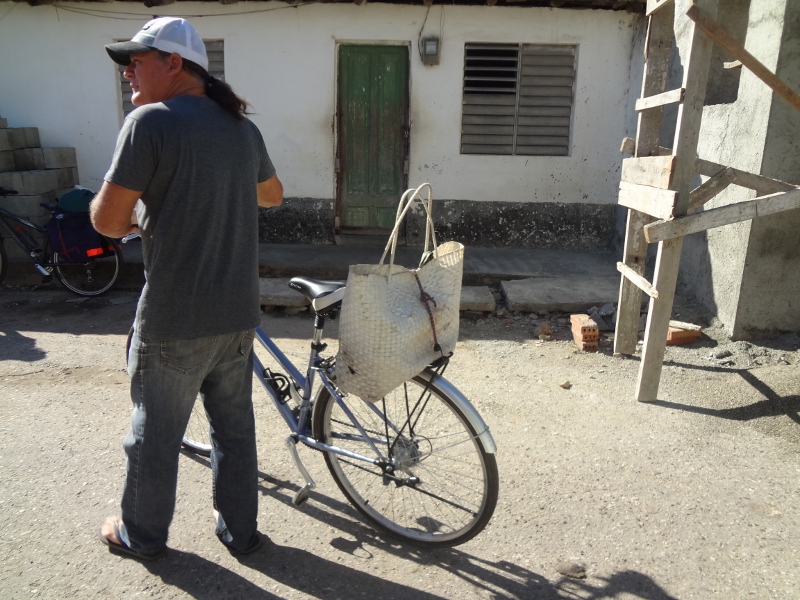
Jose heading out on an errand on TBFH in La Boca
Bikes are often converted for various purposes.
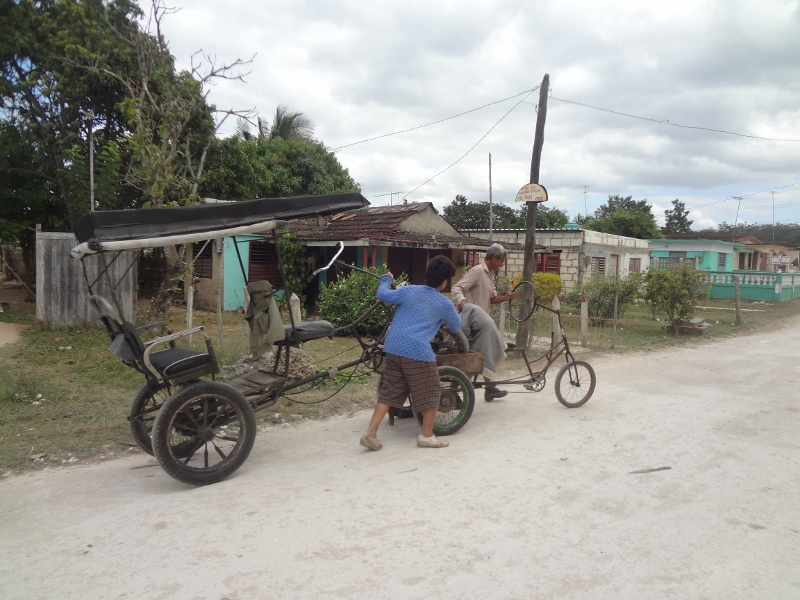
An ancient bici-taxi gets a tow from a cargo bike near Australia (north of the Bay of Pigs) in 2013
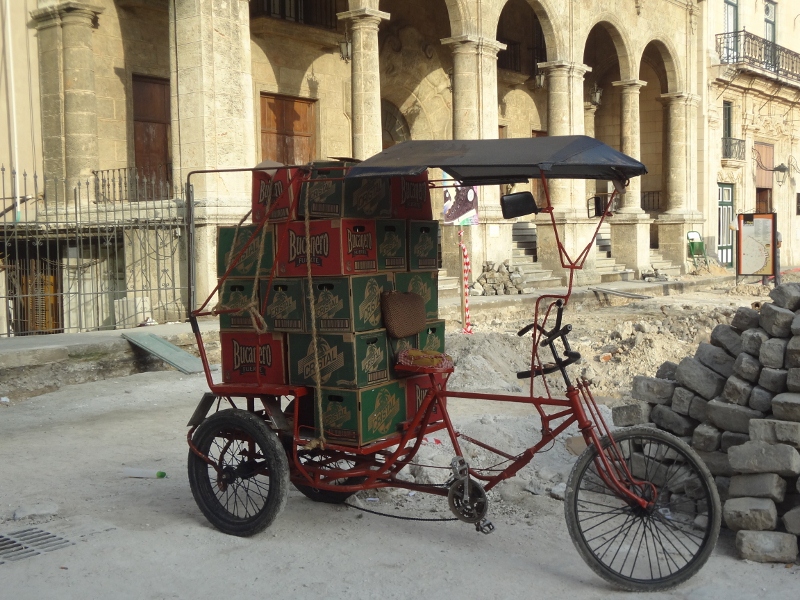
beer delivery bike in Havana (2013)
A good bike is a bonus in Cuba. Many people still ride one speed bikes of ancient Chinese vintage (perhaps the Ming Dynasty?), so a 21 speed bike with good hill gears is a treasure!
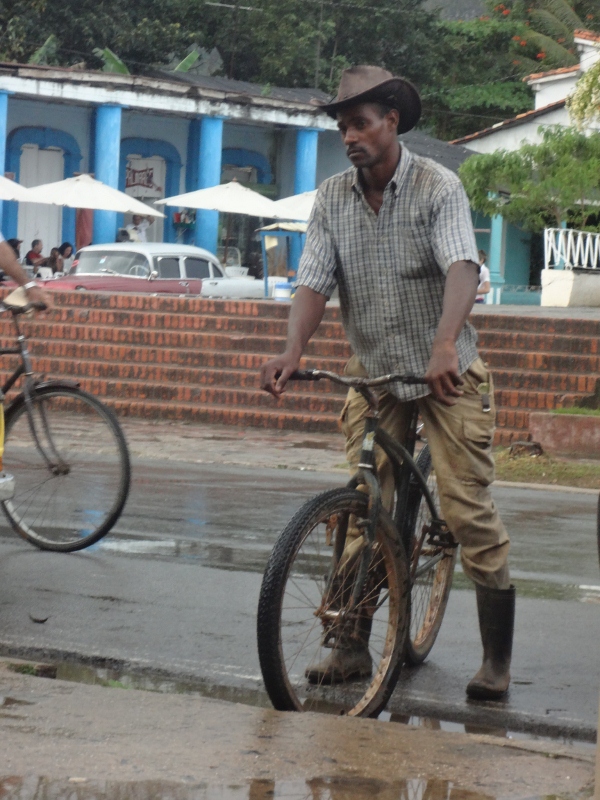
typical ancient vintage bike in Vinales (2013)
In 2014, I searched for a bike through the usual channels, but couldn’t locate one. I was super busy at work and I started running out of time. There was nothing on Kijiji or Craigslist. I looked at Canadian Tire bikes on line, and thought “for $200 I can get a brand new bike, not a good one, but how bad can it be? Surely it should be okay for a month and a few hundred kilometers”. Wrong. Wrong. Wrong.
As my neighbours and experienced bike tourers, Kate and Tim readied the bike for the trip, I began to have niggling misgivings. I could hardly lift the bike empty; what would it be like fully loaded with gear? Tim was already muttering about poor workmanship and wobbly wheels.
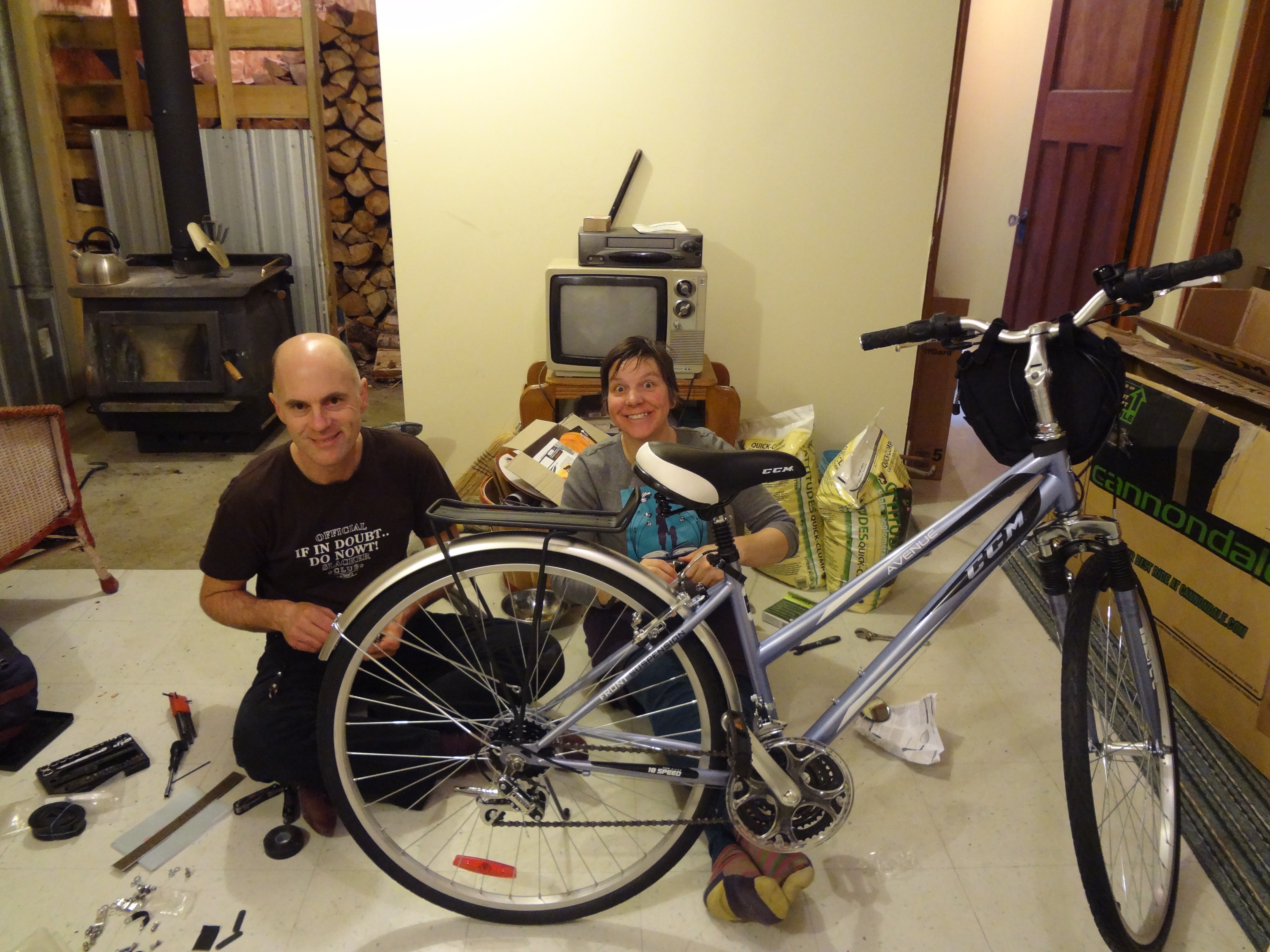
Kate and Tim prepare what will soon be known as TBFH (The Bike From Hell)
Once in Cuba, I discovered it handled like the heavy pig of a bike that it was. It felt like I was trying to ride an overloaded wheelbarrow underwater. Although I liked the more upright riding position of this bike, it’s gearing was poor – no really good high speed gear and no granny gear for the hills. Within 25 km of riding (without baggage even), the shifting mechanism started to become stiff. Soon I could not get into my high range. By the time we were on the road, fully loaded, I was soon down to 12 gears, and then to the lowest range of 6 gears. It was a long grueling 57 km from Caibarien on the north coast east to San Jose del Lago, luckily on a cool day.
Cuban Car Repair
San Jose del Lago is not close to anywhere except the tiny village of Mayajigua. It was clearly too far to either Moron to the east or Sancti Spiritus to the south to nurse the Crappy Tire bike, now know familiarly as The Bike From Hell (TBFH). We met Jon, a German cyclist travelling alone (so obviously able to mechanic his bike), who worked on the bike for 2 hours and came to the same conclusion I did – the problem was in the grip shifter mechanism and couldn’t be fixed through a screw or cable adjustment.
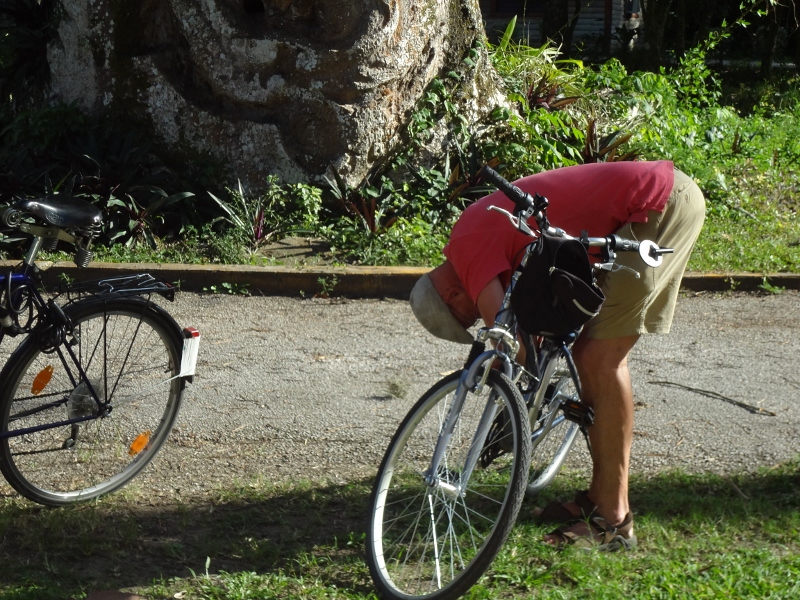
Jon, the German cyclist, has no luck fixing TBFH
Luckily I was travelling with two marvellous women who, rather than lamenting the difficulties of a broken bike, embraced the adventures that came out of the predicament.
We decided that we should go to Sancti Spiritus, and needed a big car or a truck to do so. We asked the girl at the desk in the small Cuban resort where we were staying. She knew of a couple of trucks in town, so we set off with her on our bikes to search them out. The first truck had its engine out on the ground, and the driver for the second could not be located. During a helado (ice cream) break, Margie struck up a conversation with Mereno, who later connected us to a car with a trailer which would hold the bikes.
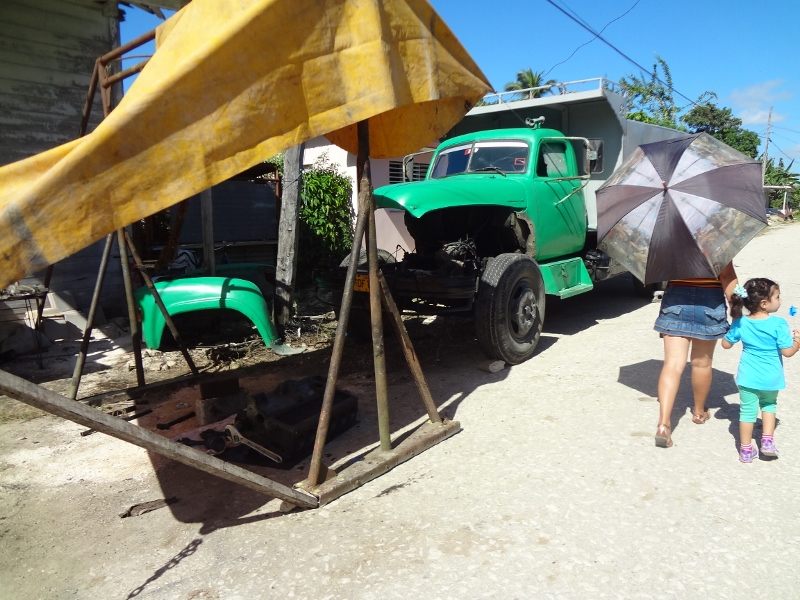
I guess this truck isn’t going to work
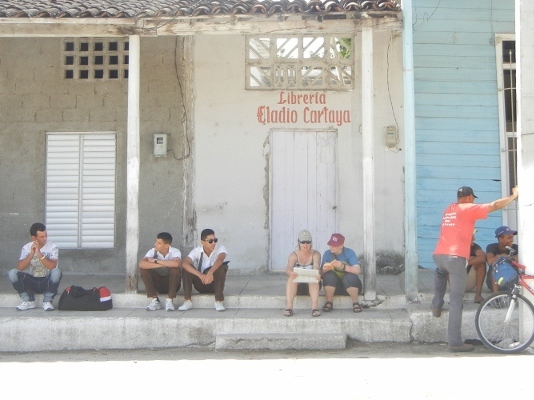
Margie and I (with dictionary in hand) read the Granma newspaper in Mayajigua (taking a break while looking for a car) (photo by Billy)
The inevitable green Lada, arrived on schedule at 10 the next morning. The car didn’t look bad from the outside, but inside it had been stripped bare of any panelling, but incongruently, beautifully polished hand-made wooden arm rests had been installed. And like all Cuban cars, no matter how wretched, it had an amazing stereo system, which was best appreciated at full volume. We set off, salsa blaring.
Once in third gear the car hiccupped forward in neck jarring spasms, a few coughs, a guttural grunt and then, engine catching, we would roar forward for a few hundred yards before having another spasm. Our driver, Ephram, would stop, blow out the fuel lines, conduct a consultation with the car’s owner over his cell phone, and we would carry on for a short distance. About 10 km out of town it became obvious we wouldn’t get to Sancti Spiritus this way. We assumed the car was a lost cause; we knew enough about Cuba to know the chances of being able to find another fuel pump for this aged Lada were as remote as our location. However Ephram assured us “Solo cinco minutos con el mechanico”. It took a bit more than 5 minutes, but the fix was ingenious. The gas was siphoned out of the tank into a small plastic container which was then strapped to the roof. A line was run directly from there into the carburetor. It looked a bit dodgy with rags wrapped around any leaks in proximity to the hot engine, but two hours later we were off-loading the bikes on the outskirts of Sancti Spiritus. Although this sort of creative mechanicing is common in Cuba, Ephram did not want to tempt the policia too much.
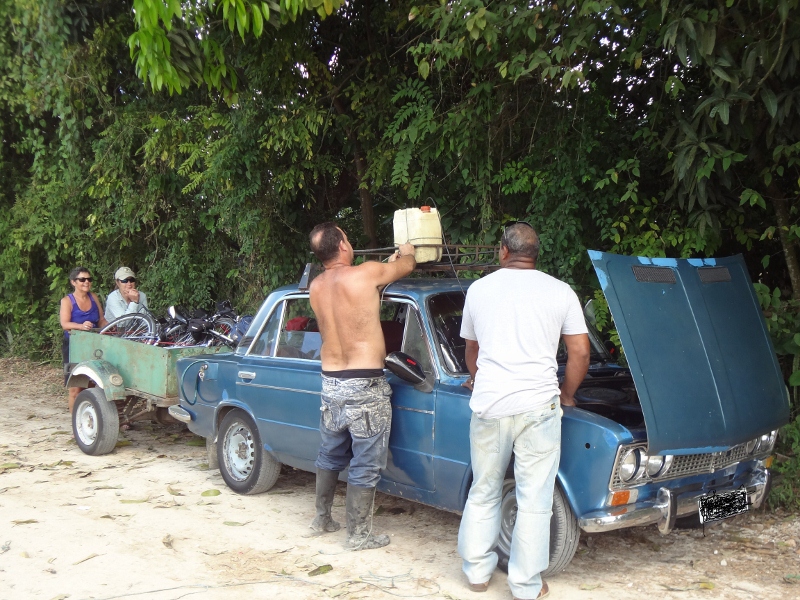
Who needs a fuel pump?
Sancti Spiritus
Sancti Spiritus was a pleasant surprise! It is not really on the beaten track for tourists, lacking the colonial charm of Trinidad, the museums and revolutionary significance of Santa Clara, or the architectural delights of Cienfuegos. We felt instantly at home. We decided to treat ourselves to a night in the beautifully restored Hotel del Rijo, which at $120 a night was far beyond our normal budget ($25 – $30 a night). The room with a balcony overlooking the square was delightful with oodles of colonial charm and all the mod cons. And a great restaurant, with, of course, a resident trio. Unfortunately, (fortunately for our pocket books) they could only take us for one night, but suggested the nearby Hostal d’ Martha for the rest of our stay.
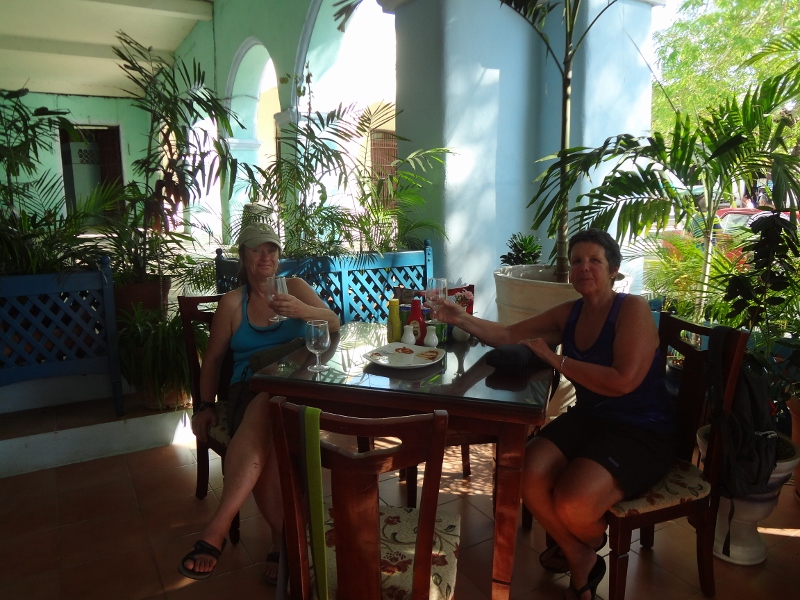
Chilling on the patio of the Hotel del Rijo
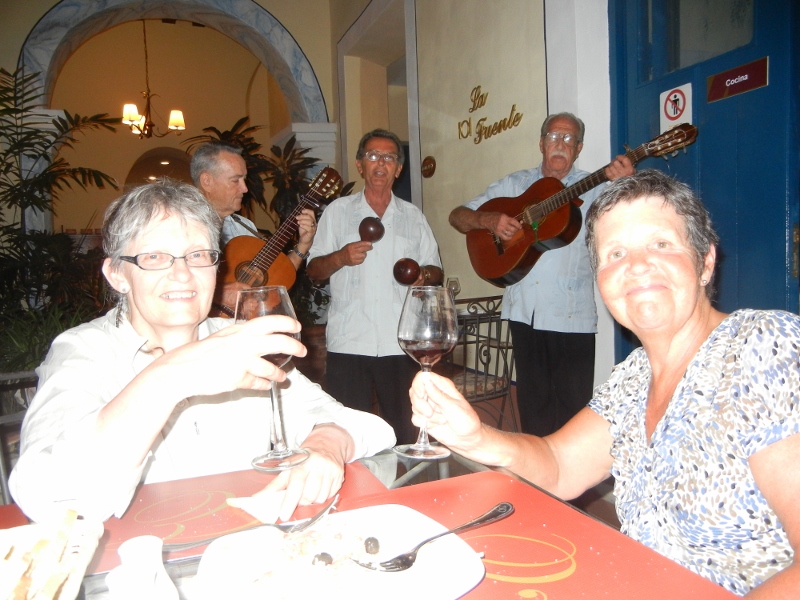
Demolished chocolate flan after a great dinner at Hotel de Rijo
We spent four days in Sancti Spiritus and never ran out of things to do. One of the art galleries had a display of minaturas, amazingly intricate scenes in a tiny 2” x 2” format. A Saturday morning museum visit, coincided with youth dance and music classes to which we were welcomed with open arms. We sat down with a group of young people playing and singing led by an older man playing a bandurria, a 12 stringed mandolin-like instrument.
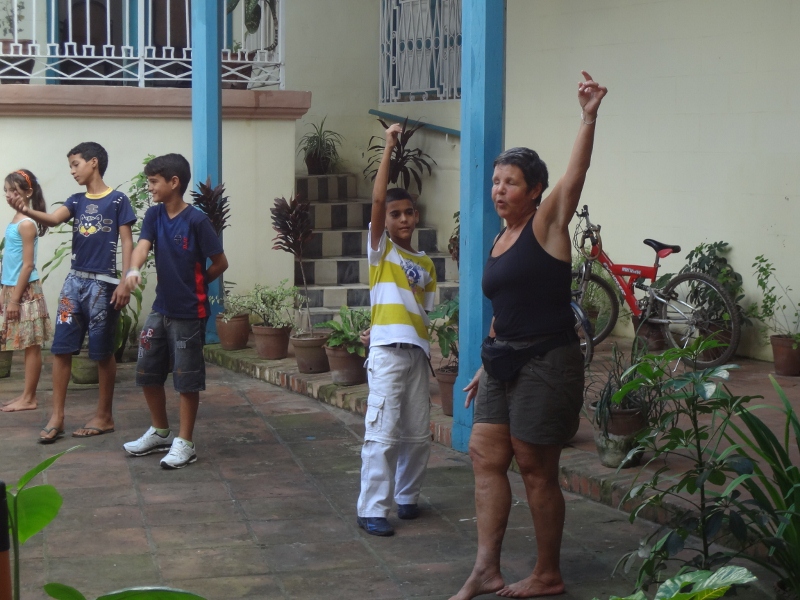
Billy joins the folk dancing lesson
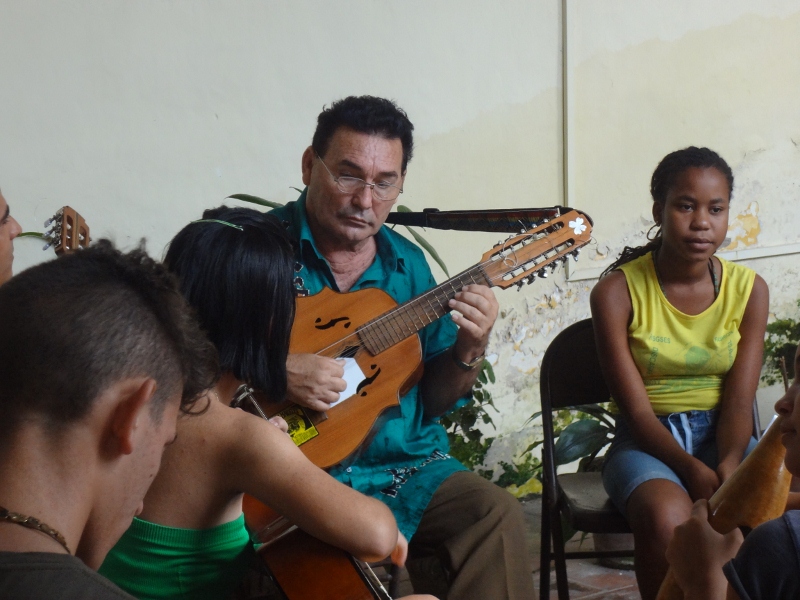
the Bandurria
On Sunday we went to the rodeo. Margie, being a cowgirl, had been hoping to go to a Cuban rodeo. This was a provincial competition between teams from Sancti Spiritus and Villa Clara. The fair grounds were extensive and lots of people were there just to attend the large produce market. The rodeo was low key, but lots of fun, including calf roping, steer wrestling, bull riding and girl’s barrel racing.
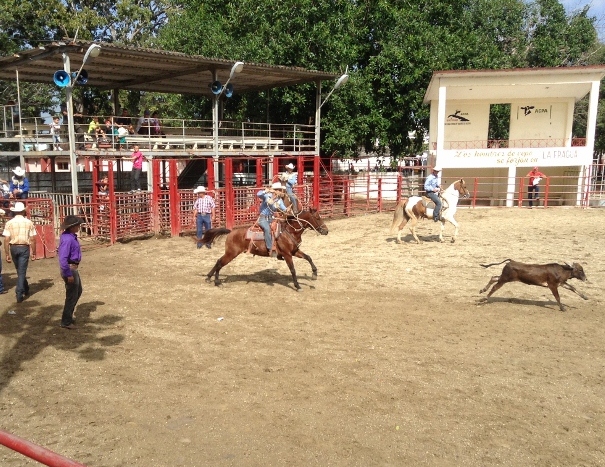
Calf roping
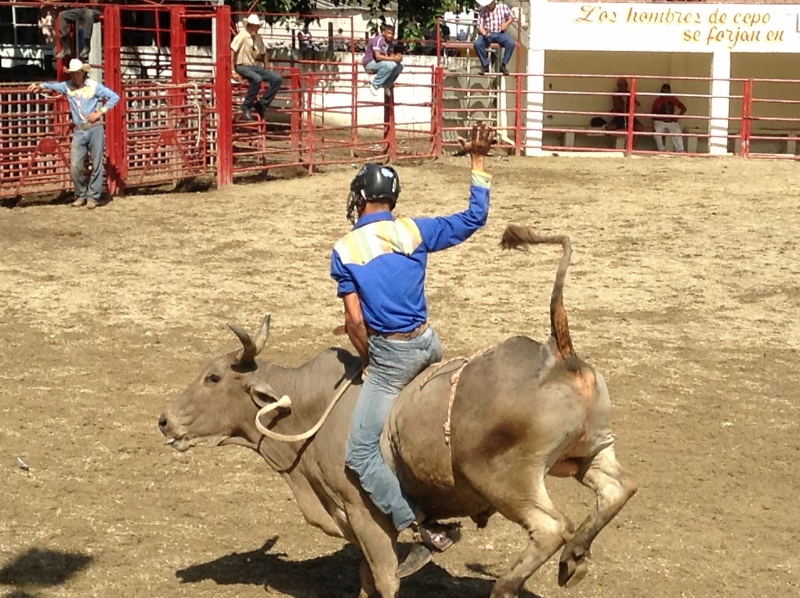
Bull Riding
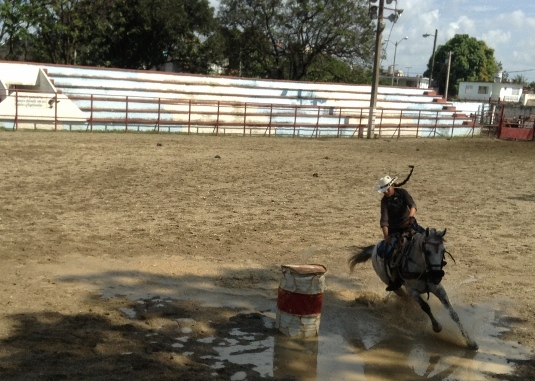
Girl’s Barrel Racing
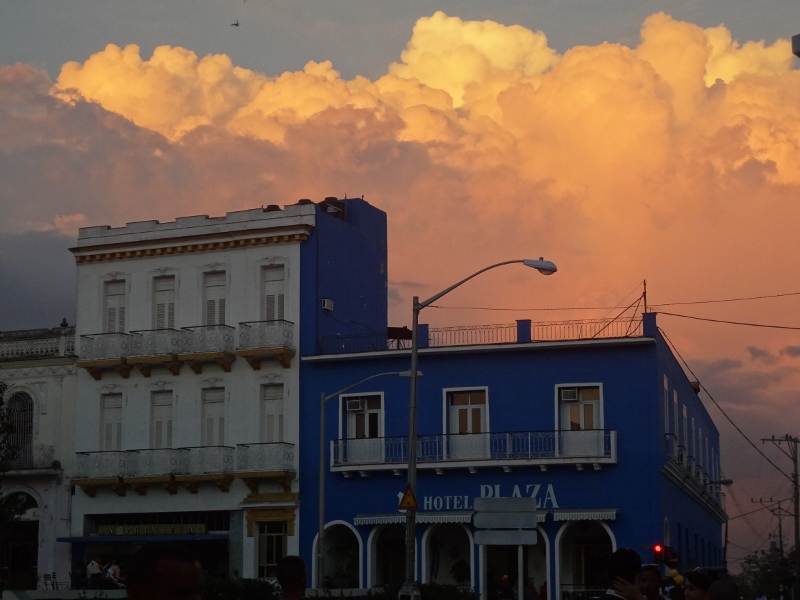
spectacular sunset in Sancti Spiritus
San José de las Biciclettas
We were sceptical about fixing my bike. From San José del Lago we had phoned our friend José. José and his son José Carlos are bikemaniacs. They have both raced in the Vuelta de Cuba (Tour de Cuba). In 2012, both Margie and I gave our bikes to this family, so we were hopeful that I could borrow one of those bikes for the rest of the trip. When José heard of our distress, he immediately leapt on his bike and rode the 75 km from La Boca to meet us that evening in Sancti Spiritus. Arriving with a red rose for each of us (Cuban men!!!), he arranged to take TBFH to his ‘special bike mechanic’ who works on the bikes for all the racers. Meanwhile, José delighted in showing us his home town.
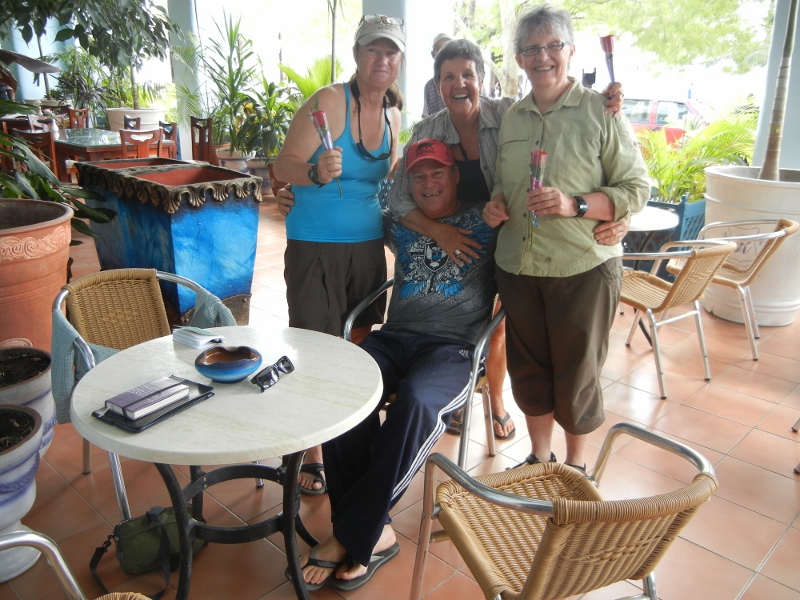
Jose and girls with their red roses
Cruising Sancti Spiritus with José was fun. Everyone knows him, and every pretty woman seemed to be one of his ex-girlfriends. We visited a market street where according to new government regulations which opened up private enterprise, everything for sale had to be ‘made in the home’. And the most amazing things were – cast aluminum utensils, leather boots and shoes, bicycle seats, and even a complete hot plate. A testament to Cuban ingenuity! After years of the US embargo and collapse of the Russian imports, they have learned to make the things they don’t have!
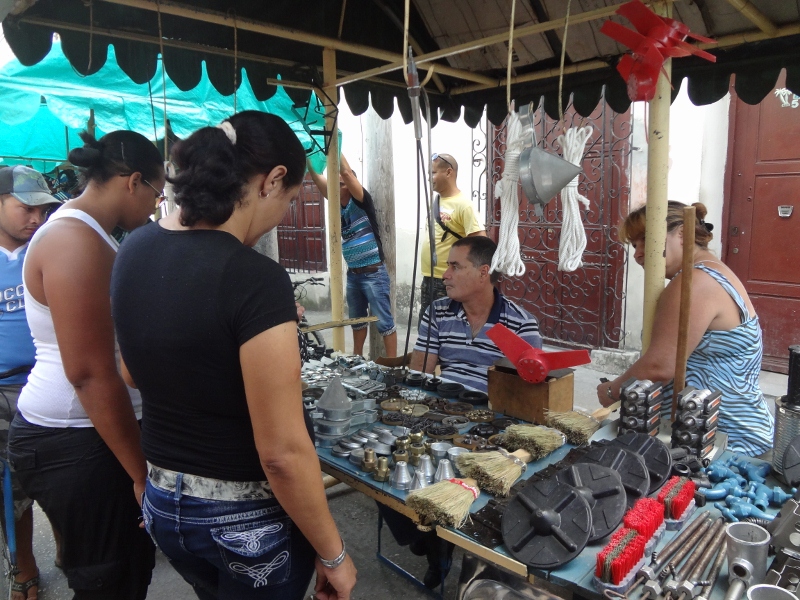
Believe it or not everything here was hand made at home. Cubans can make anything!
José also took us to the meat and produce market where Cubans can buy food at subsidized prices. He took a stab at explaining to us the very complicated system of food rationing. Families receive a coupon booklet (libreta) that entitles them to basic rations of rice, beans, flour, sugar, eggs, and for children under 7, milk, at rates 20 times less than the market rate. Meat rations of chicken, pork and fish are distributed separately. These rations are not enough to sustain the family, so additional supplies can be bought at mercados paralelo, like the one we visited, at somewhat higher but still subsidized rates. Cubans must buy their libreta supplies from specified outlets, and since deliveries are often sporadic and random, long line-ups occur when supplies arrive. Cubans will often line up at one time of day to get rice, and then again at another time to get eggs, so ‘shopping’ for food is never simple. There are also an increasing number of ‘dollar stores’ where things such as bottled water, canned goods, and cheese can be bought in Cuban Convertible Pesos (CUCs), the currency used by tourists which is worth 24 time the national currency.
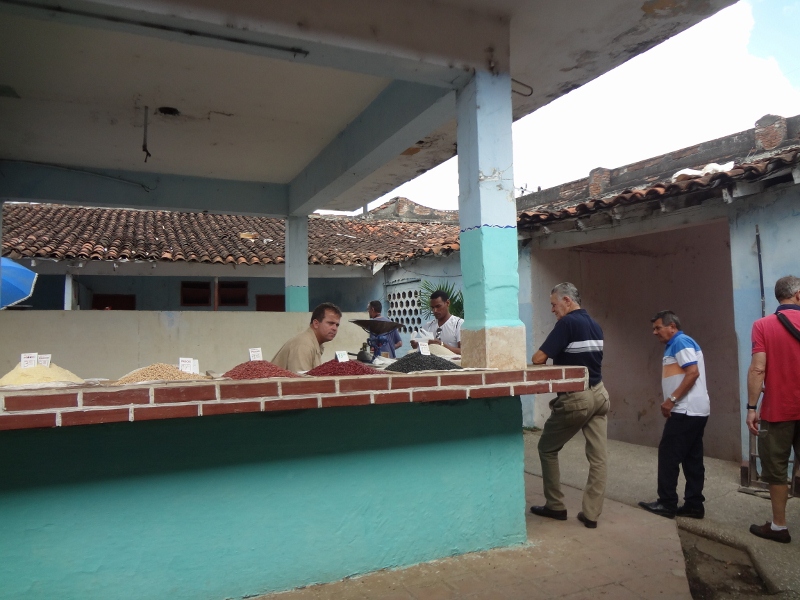
Rice and beans at the mercado paralelo
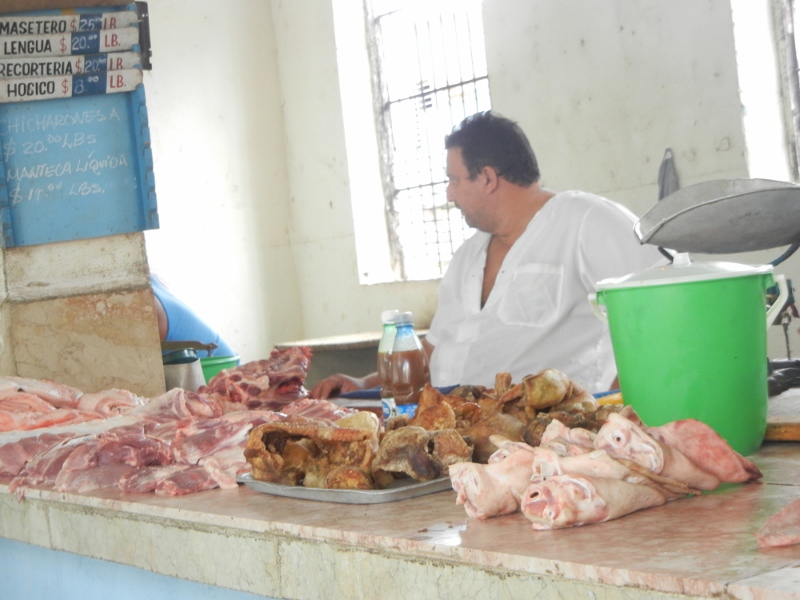
meat at the mercado paralelo. The prices are in National Pesos so $8/lb for pork hocks is about 25 cents/lb
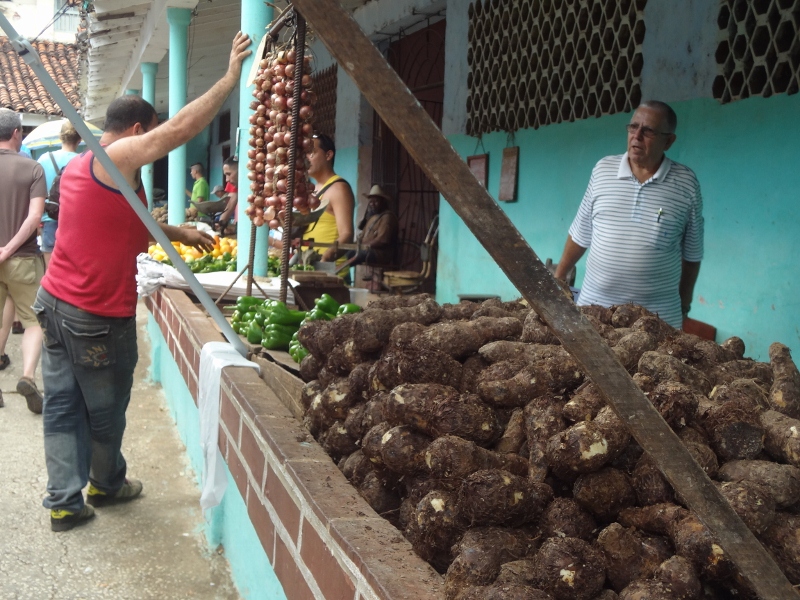
melanga and other vegetables at the mercado paralelo
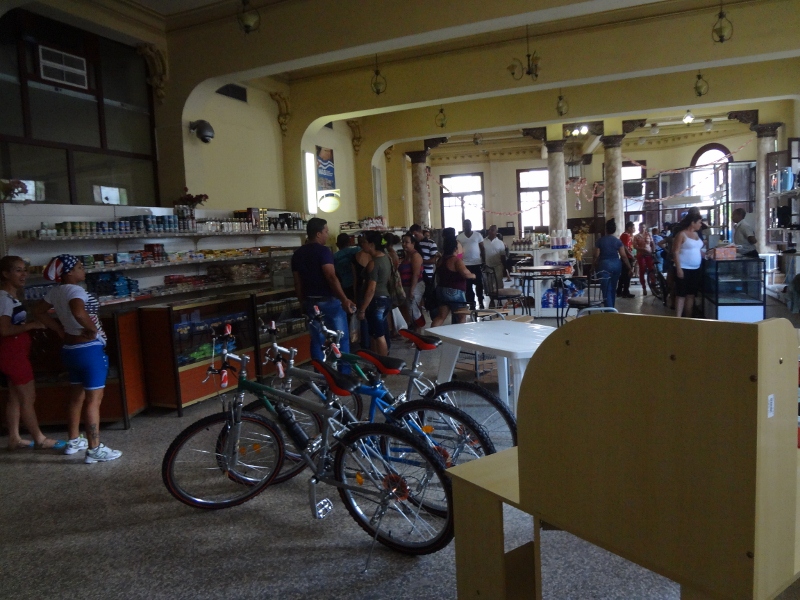
A department store where only CUCs must be used
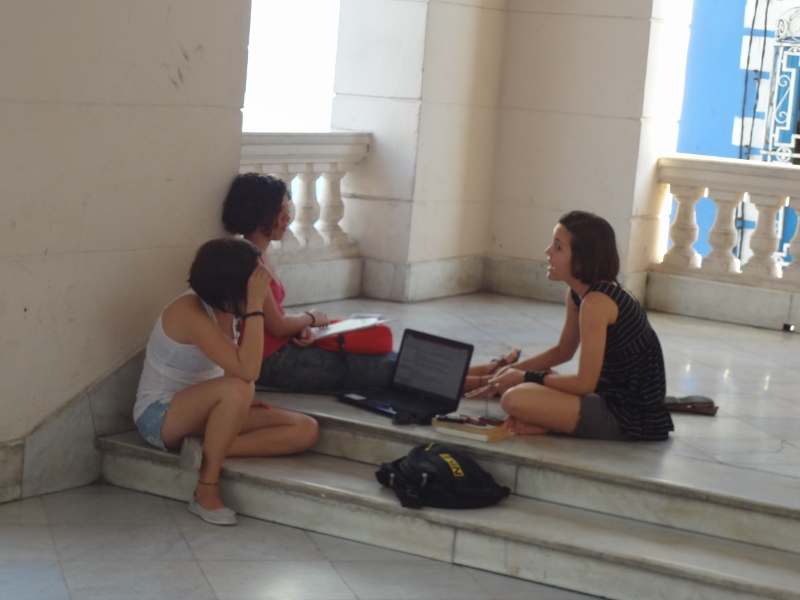
Another sign Cuba is changing rapidly. Teenage girls on the steps of the Library with a laptop
José brought the bike back from the mechanic in a semi-fixed stage. The shifting mechanisms were looser, but it still took all the strength I had in my hand to get into the high range. But we figured it was in good enough shape now for me to limp it down to La Boca, where I could connect with my old Norco from 2012. The riding would be fairly easy, as we would break up the distance by stopping in Banao, where we hoped to arrange a mule trip into the Escambray Mountains.
The day we rode the 50 km from Banao to La Boca, José rode out to meet us and took all of my gear onto his bike, to make it easier for me on TBFH. On the long hill out of the beautiful Valle de los Ingenios, he rode beside me and pushed me up!
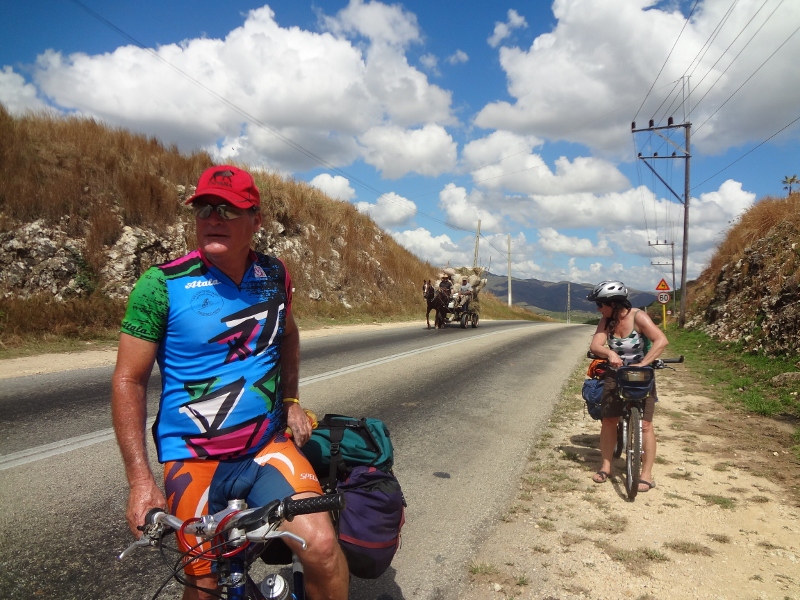
Jose carrying my packs on his bike
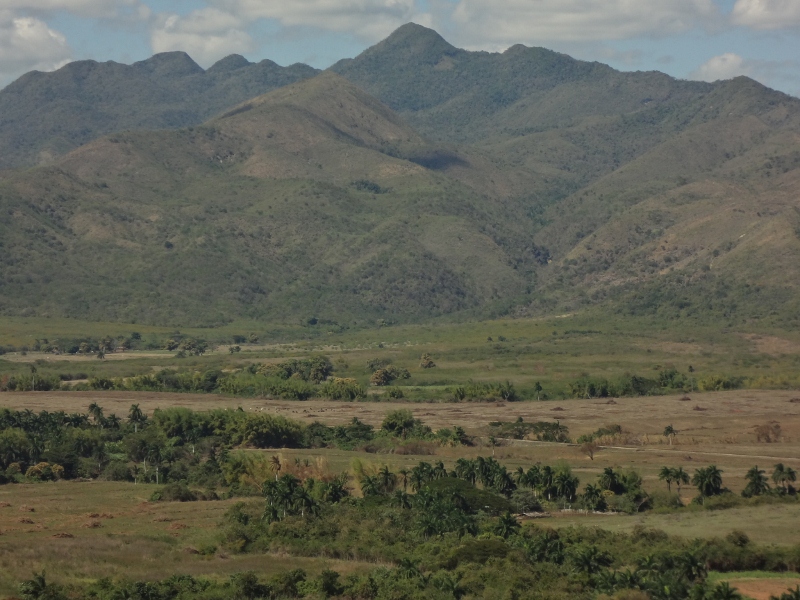
Valle de los Ingenios with the Sierra Escambray in the background
While we were in La Boca, José and José Carlos undertook the management of our bike maintenance. If we lifted a wrench to adjust a thing, one of them was there to take over. José fixed Margie’s two broken spokes (from a rather spectacular unravelling of her packing system, which luckily did not result in a crash), prepared my old Norco to go on the road, adjusted Billy’s breaks. He was truly San José, the patron saint of bicycles!
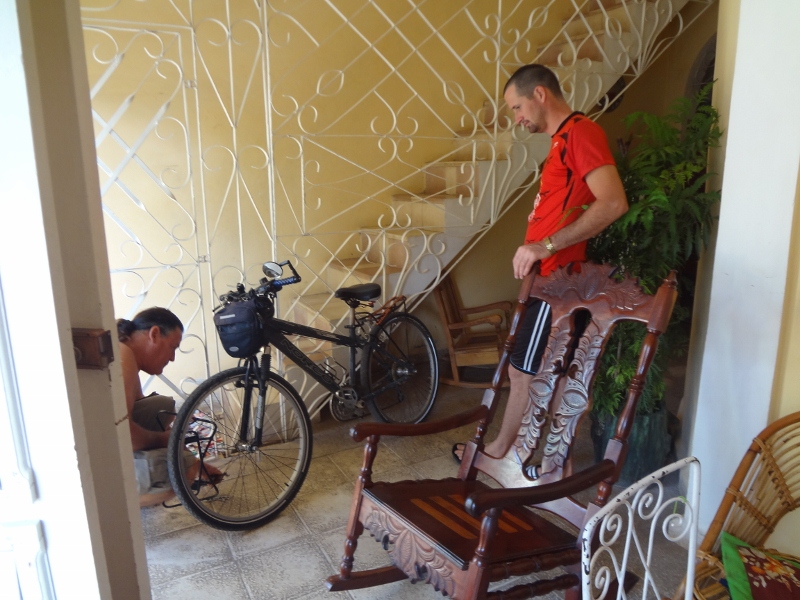
Jose and Jose Carlos prepare my old Norco for the rest of the trip
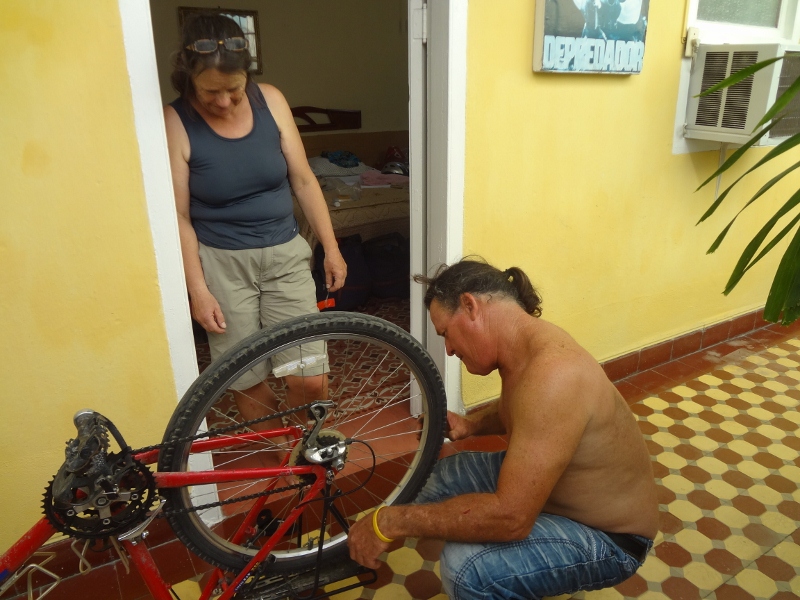
Jose working on Margie’s bike
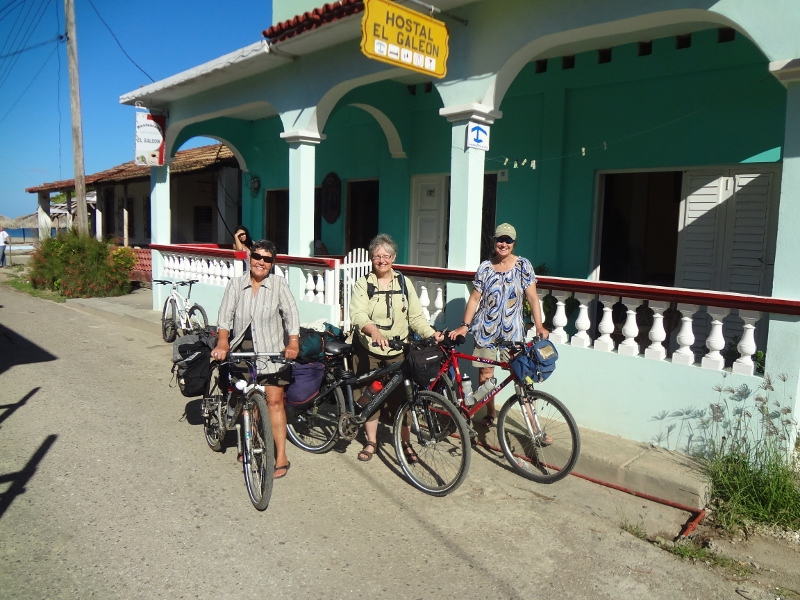
We set off again from La Boca – this time on 3 good bikes thanks to San Jose de las Biciclettas
Mule Trip in the Mountains
The ecological reserve Alturas de Banao receives a small mention in the Lonely Planet guide. It sounded interesting, and would break up our ride between Sancti Spiritus and La Boca into two more manageable sections, given I was at that time limping along on the TBFH. Unfortunately, the contact number in the Lonely Planet didn’t seem to work. José and our Casa host Martha snooped around and came up with other numbers and we left Sancti Spiritus under the impression we had a reservation to take a mule trip up to Sabina. We arrived at the park headquarters at Rancho Jerico, after peddling the steep 3.5 access road from the highway, to find that in fact they had never heard of us. This all worked out for the best, as heavy rains had made the trails into the mountains impassable and we couldn’t have gone anyway. Thankfully the park headquarters included a great restaurant and overnight accommodation, so we made arrangements to come back in a few days to go into the mountains, booked a room for the night and spend the rest of the day hiking around and swimming at the nearby waterfall.
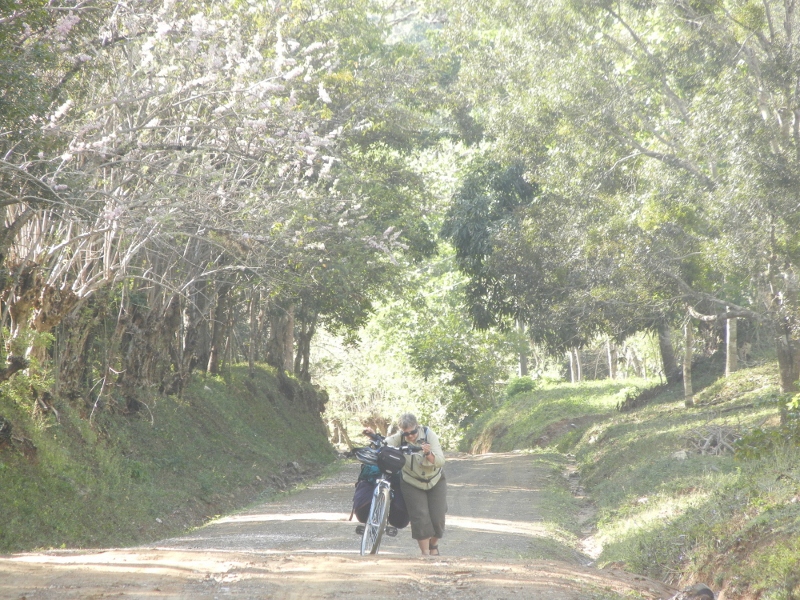
TBFH was not a hill climber. I had to push this hill (pic by Billy)
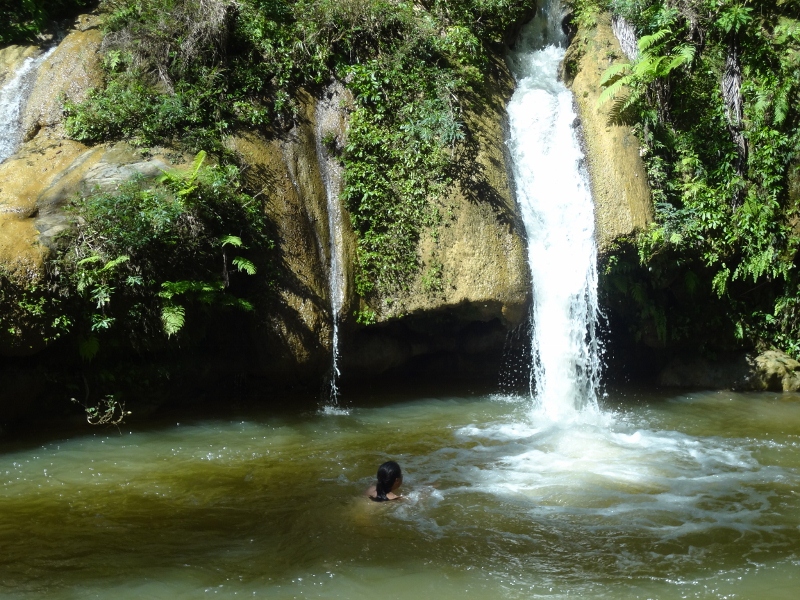
Refreshing swim
A few days later we were back, having hired Pupe and his 1950 Pontiac sedan with a diesel Fiat engine to bring us the 35 km from La Boca. Soon we were mounted up on frisky, surefooted little mules to make the 6 km, 400 vertical meter trek up the mountain. La Sabina is perched on a high ridge with a long view out to the plains and eventually the Caribbean.
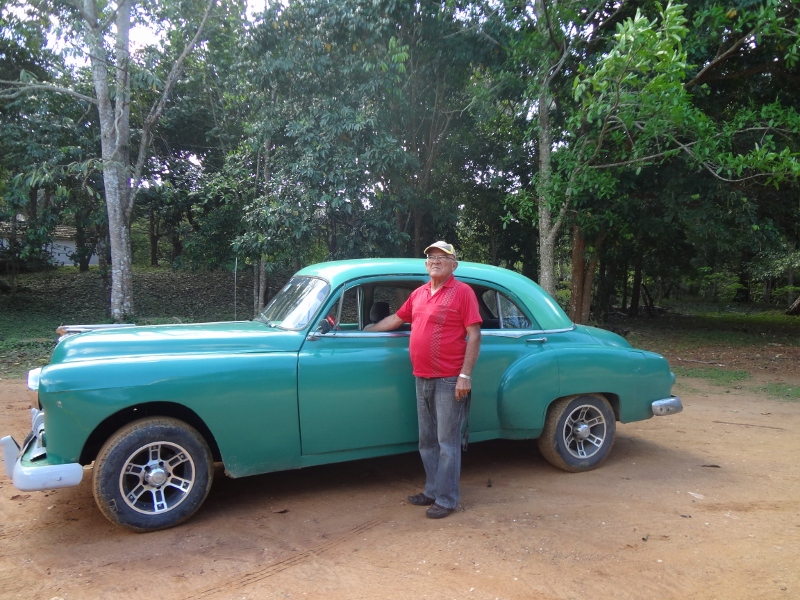
Puke and his Pontiac
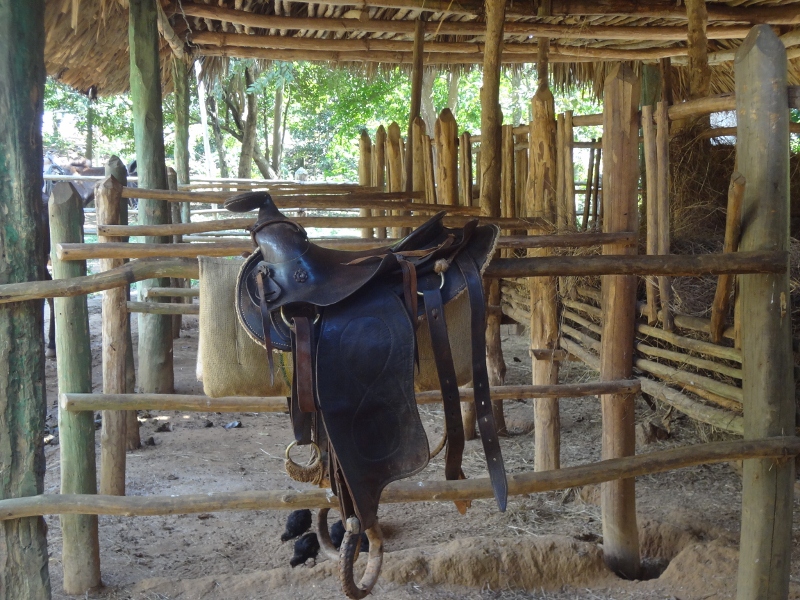
in the Mule Barn
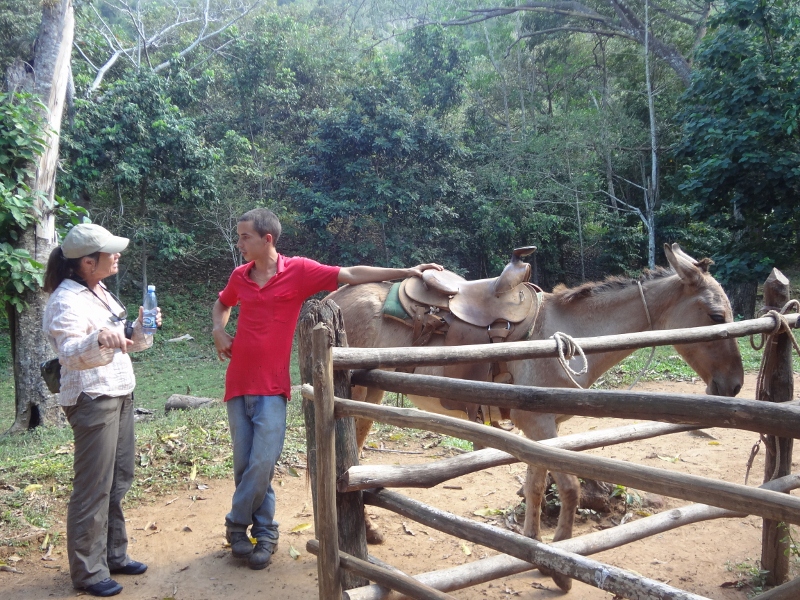
Margie talks mules
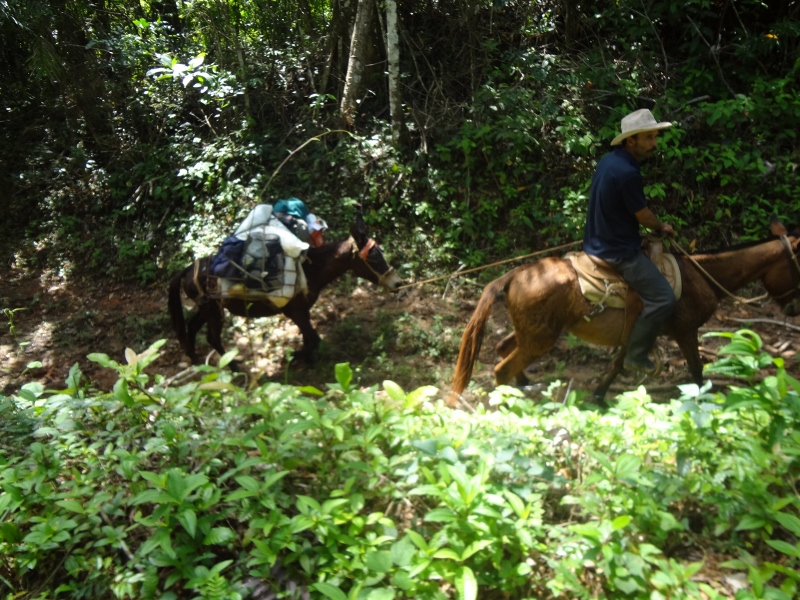
Ray the muleskinner
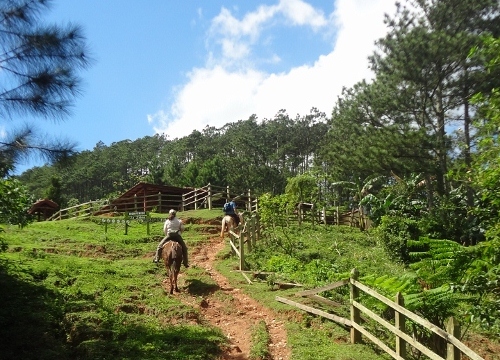
La Sabina
In the late afternoon we went for a short walk with our guide, Merlis. She knows every plant and every sound in the forest. We saw several species of birds endemic to Cuba including the national bird, the tocororo.
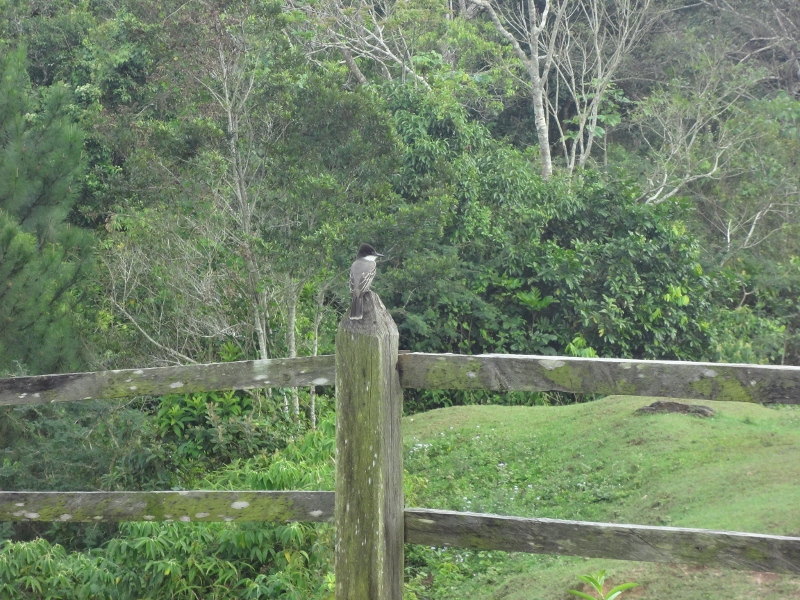
Loggerhead Kingbird
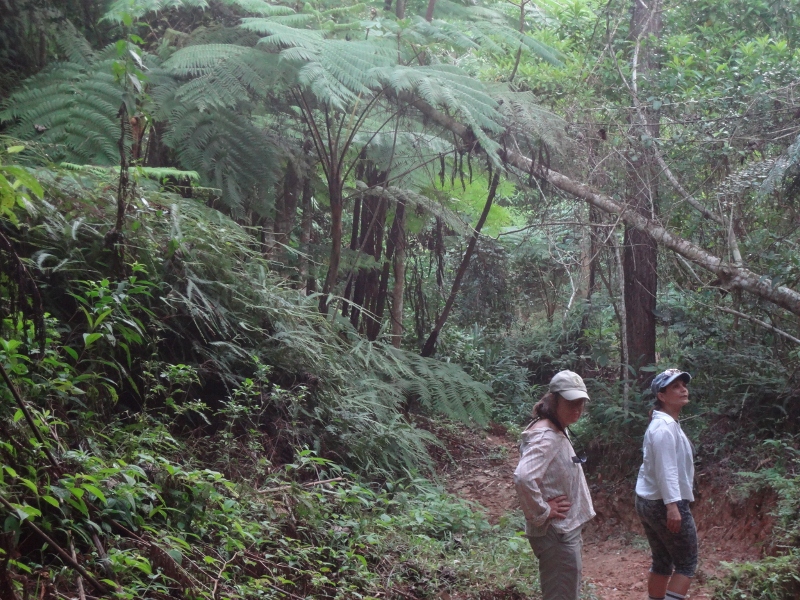
A walk in the jungle – Margie and Merlis
As dusk gathered around us, we sat in cane rockers on the veranda, listening to the birds and watching faint lights appear down in the valley. A hawk, probably a red-tail, swooped past riding thermals out over the steep drop off. Dusk is short this close to the equator; before long the velvet night enclosed us and stars dangled almost within reach.
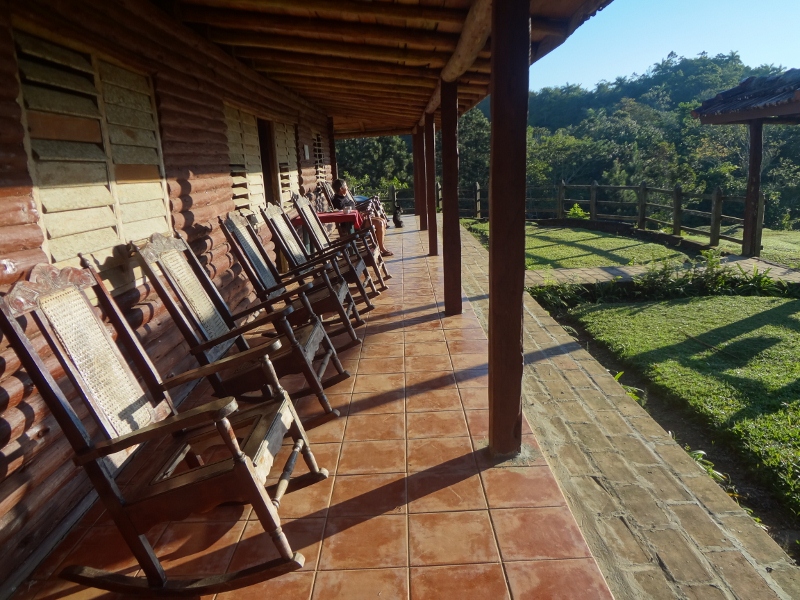
Chilling on the veranda at La Sabina
Irma and Prophilio, the lovely couple who caretake La Sabina, cooked an ample dinner of lamb, rice, beans, fried bananas, salad and sweet preserved papaya. We spend the evening playing dominos and receiving Spanish lessons from Merlis. The Empresa (Enterprise) that runs this Ecological Reserve tries to be a self sustaining as possible, and between its several operations, raises most of the food.
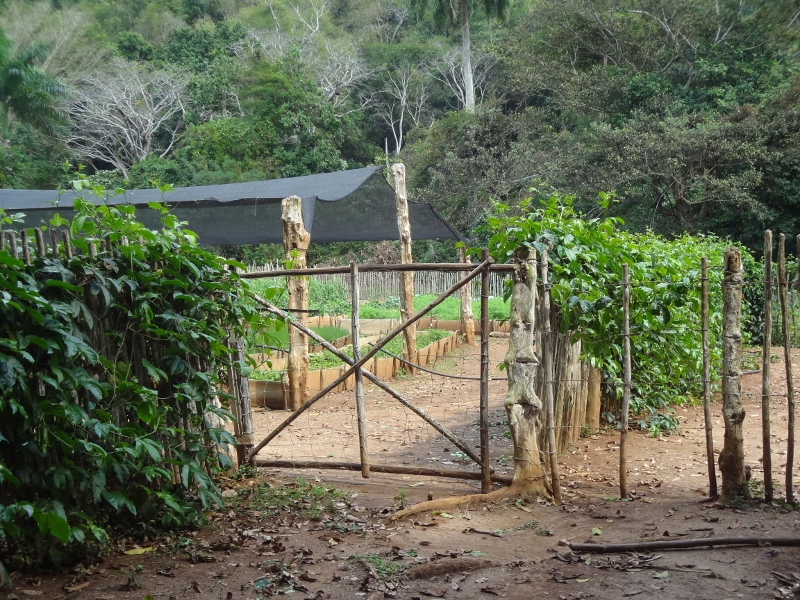
the organic gardens at Rancho Jerico supply food for the Rancho and for La Sabina
The next morning we travelled on foot further into the mountains, down into a beautiful valley with a tiny finca, with a coconut plantation, a banana grove and various farm animals. Some of the food for La Sabina comes from here. Along the way we continued our birding, adding a few more species to our list. We had a refreshing swim in a beautiful river surrounded by the verdant green jungle and then return to the farmhouse for a fresh coffee – fresh picked, fresh roasted, fresh ground and fresh brewed. This we needed for the afternoon climb back up the mountain to Sabina and another fantastic meal prepared Irma, including fresh limonada made with lemons from the finca. Merlis made us a fantastic sweet coconut desert with a fresh coconut and honey. And then on to more dominoes.
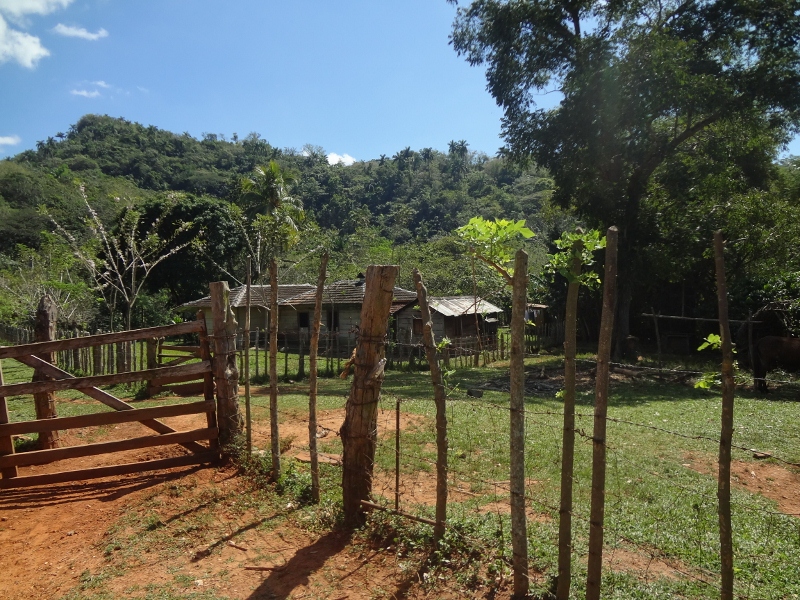
Remote finca in Alturas de Banao
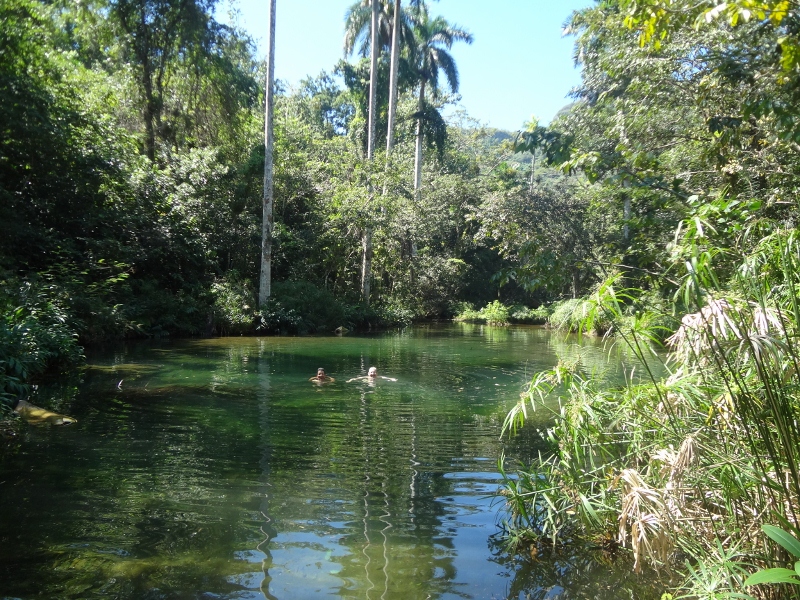
Another refreshing swim
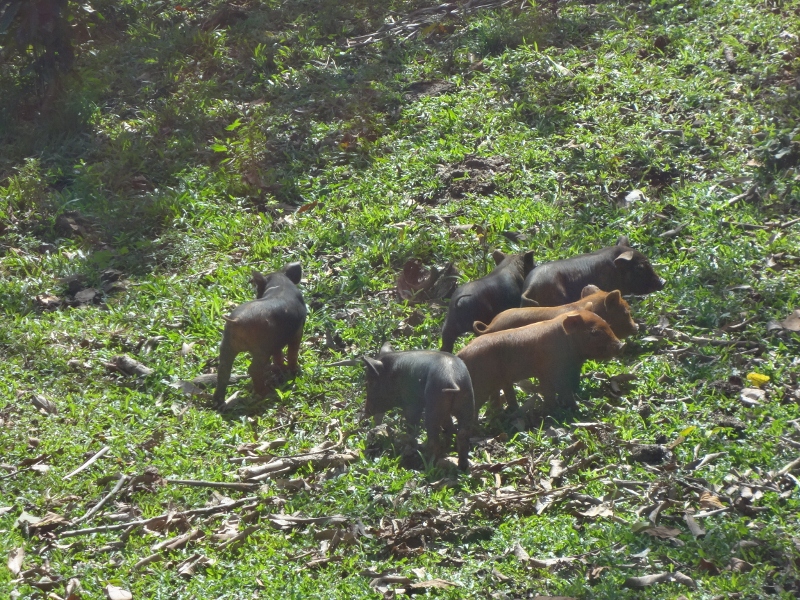
Piglets at the finca
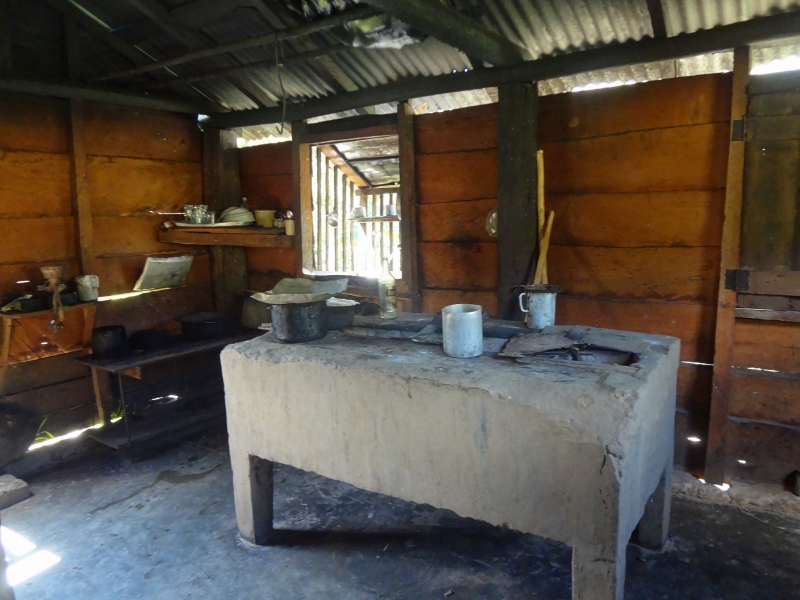
kitchen at the finca — no electricity
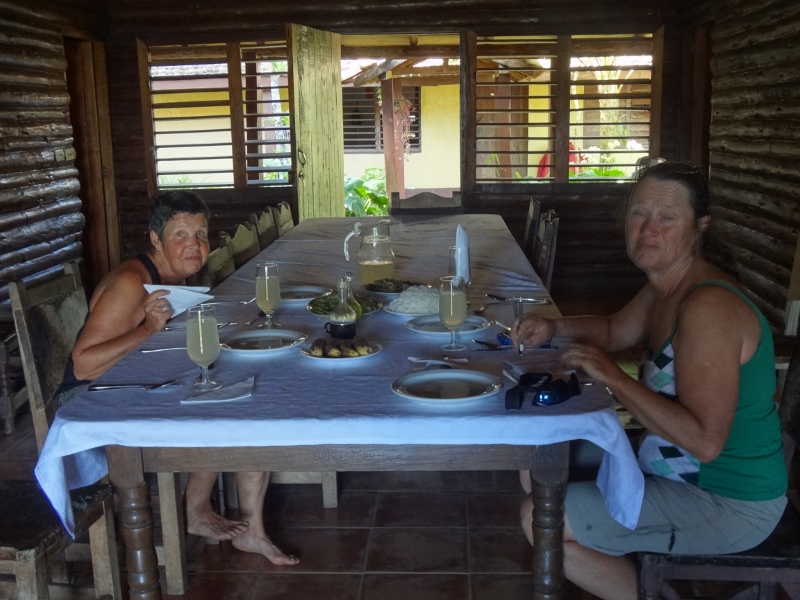
awaiting another fantastic dinner at La Sabina with fresh lemonade
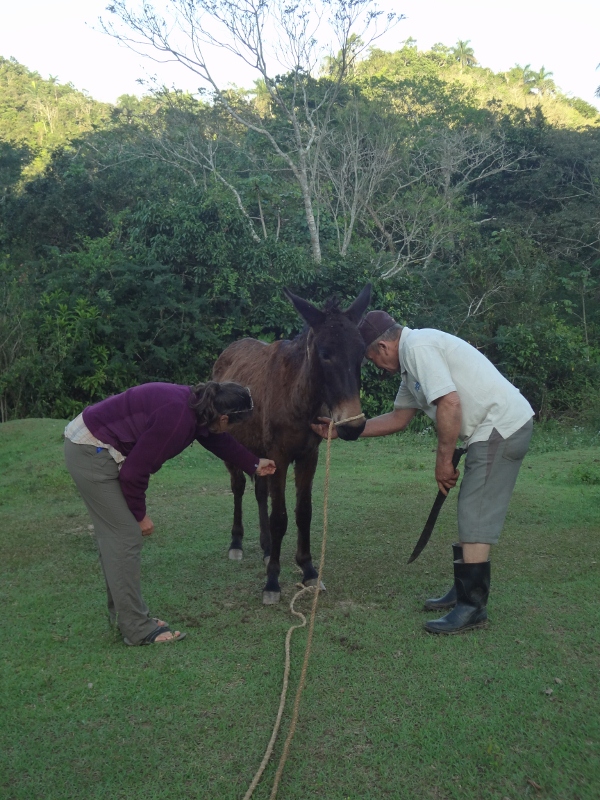
Prophilio removes the burrs from his mule with a machete in preparation for a trip to town
Dominos
We have discovered that there is much more to dominos that the kids’ game I remember. When Cubans play, it is serious business. In the evening, in Santa Clara or Santiago de Cuba, you often see men playing four at a time, on a square table pulled out into the street. A crowd usually gathers. A move is played by splapping your tile down on the table with a loud crack, accompanied by appreciative nods or groans from the crowd.
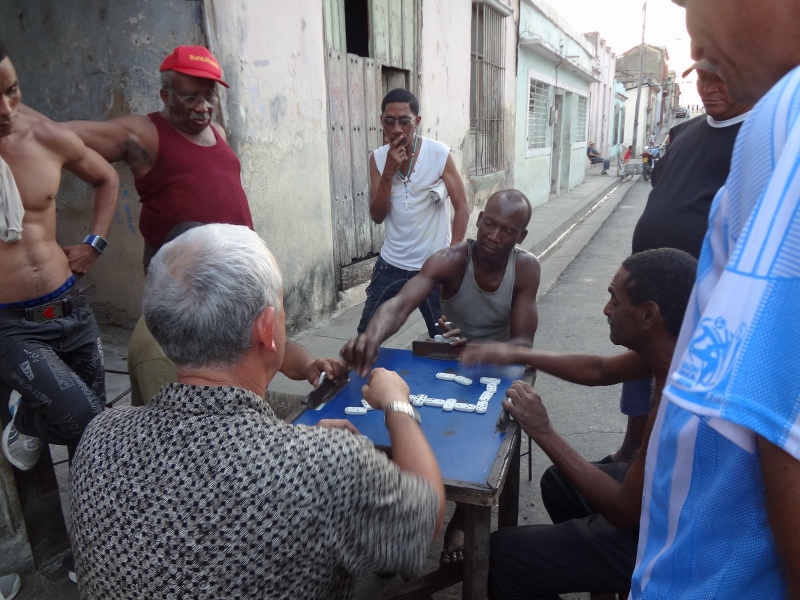
Dominoes – Santiago de Cuba – 2012
We played the first time last year in Playa Largo, when our hosts showed us the basics and politely played a few rounds with us. Then they went on to start a game of ‘real dominos’ which continued loudly long into the night.
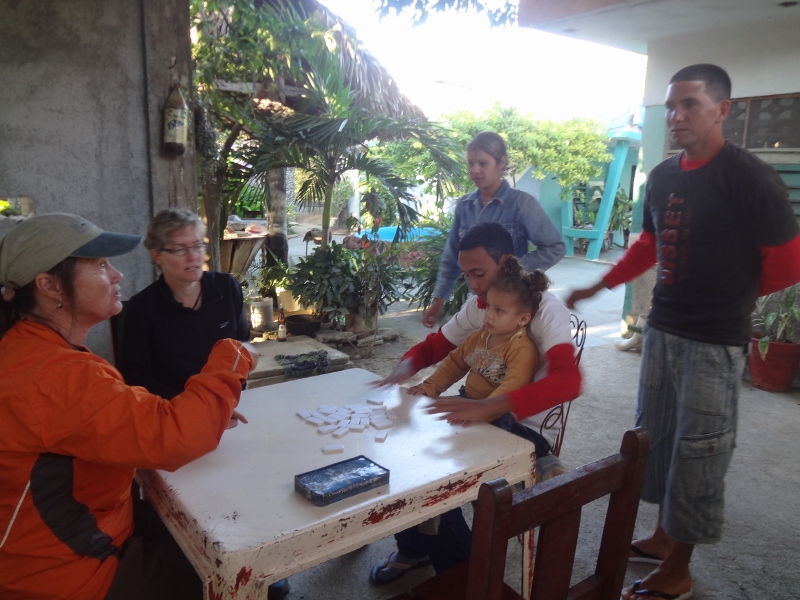
Teaching the newbies – Playa Largo – 2013
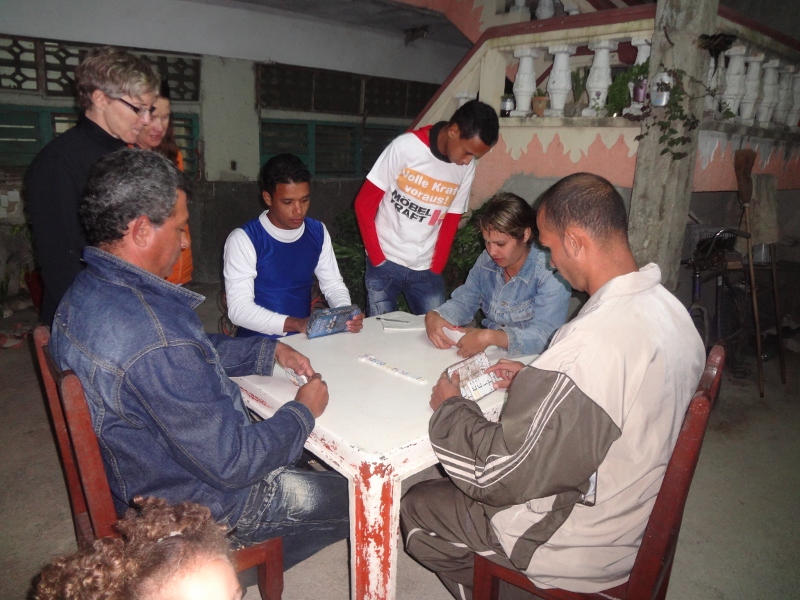
the professionals get serious
With Merlis speaking English, we attempted to glean from her the strategies for playing and winning this game in which the basic rules are dead simple. Although her answers only made partial sense to me, I realized that Cubans know exactly how many tiles of each denomination there are as well as their various combinations, and count and remember what is played, and can somehow deduce from that what people most likely have in their hands. Believe me, this is much more complex that counting trump and face cards in bridge and requires powers of concentration way beyond me!
The next day, after careening down the mountain on our peppy little mules, we had lunch with Merlis and hatched a new plan. She had a connection that could get us into some caves on the north coast that were being studied by the international scientific community not only because of their very early aboriginal pictographs and petroglyphs, but also because of the extremely unusual stalagmite and stalactite formations. The only catch was that we would have to commandeer a jeep to get us there, which turned out to be another adventure.
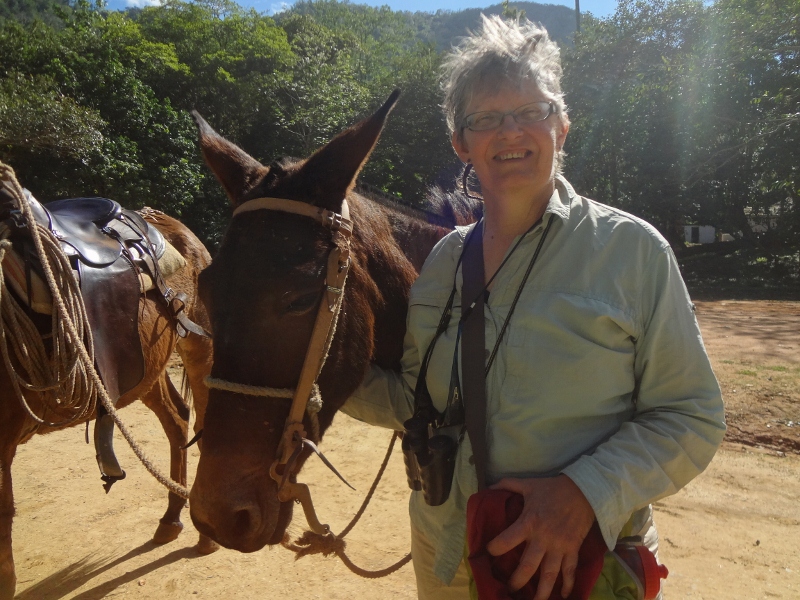
Me and my mule
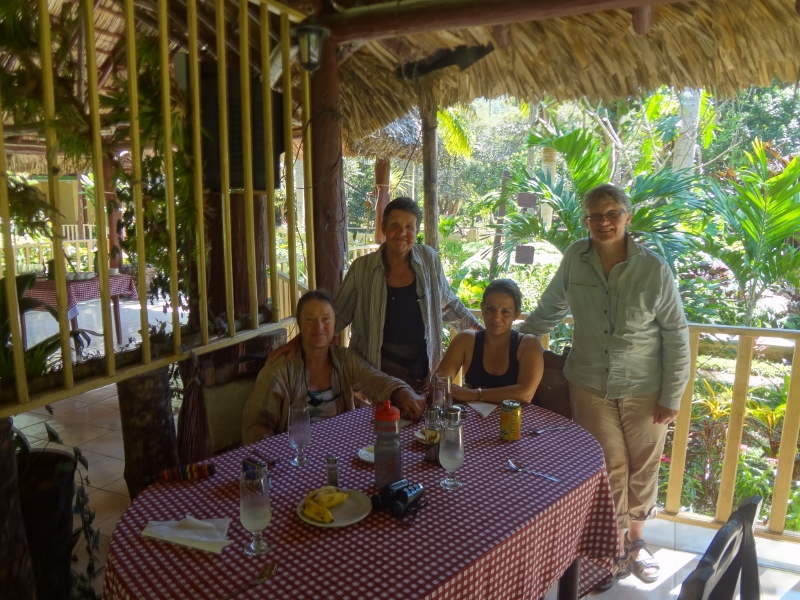
We hatch our next plan with Merlis
St. Valentine’s Day
Back in La Boca, Valentine’s Day was fast approaching, the Day of Love in Cuba. Margie suggested that we get José and Dulce a torte. As we did not possess any connections in the torte making department, we recruited Dianna, their daughter to assist us. We described what we wanted — a large heart shaped cake, with their names and lots of flowers. It was a great success, and as a result we were forced to drink the equivalent of the popular 70s drink “Dirty Mother”, usually made with tequila, but here made with rum. Not a good thing! (I have had a previous negative experience with Dirty Mothers which ended with me waking up lying out on the Mexican desert with buzzards circling overhead.)
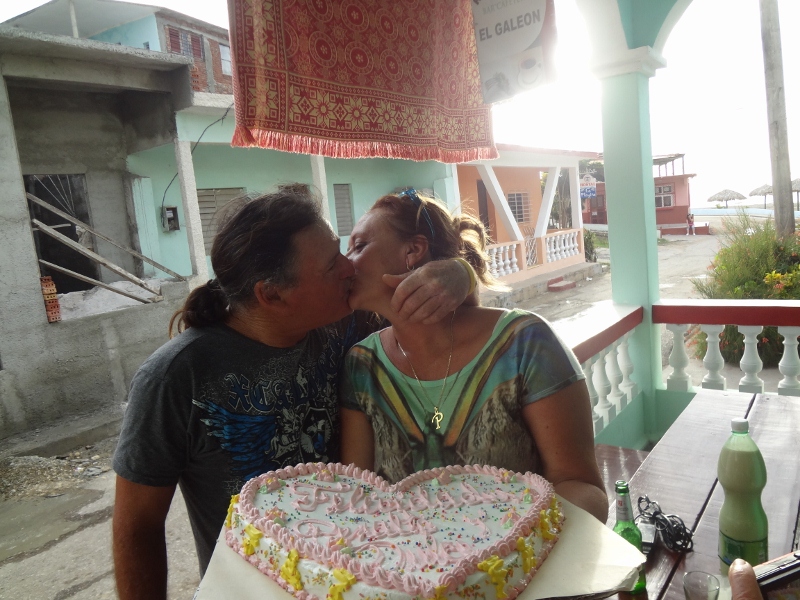
Happy Valentines Day Jose and Dulce
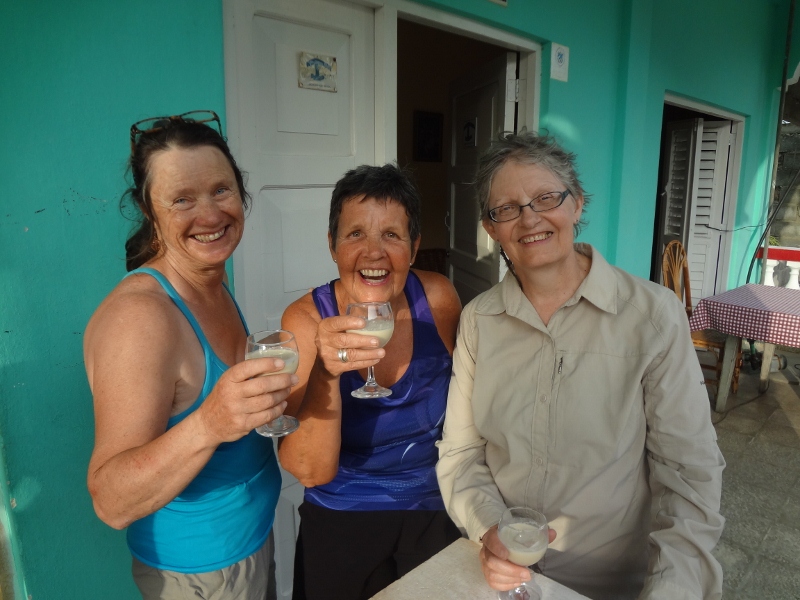
A dangerous drink
Around Trinidad and La Boca
We spent quite a few days exploring Trinidad, a beautiful colonial town and a UNESCO World Heritage Site, described in more detail in my 2012 blog. Margie and I noticed significant change in two years – there were more tourists and tour buses, but more notably there were many more shops, galleries and market stalls that catered to tourists. We also did some snorkelling and rode to Playa Ancon.
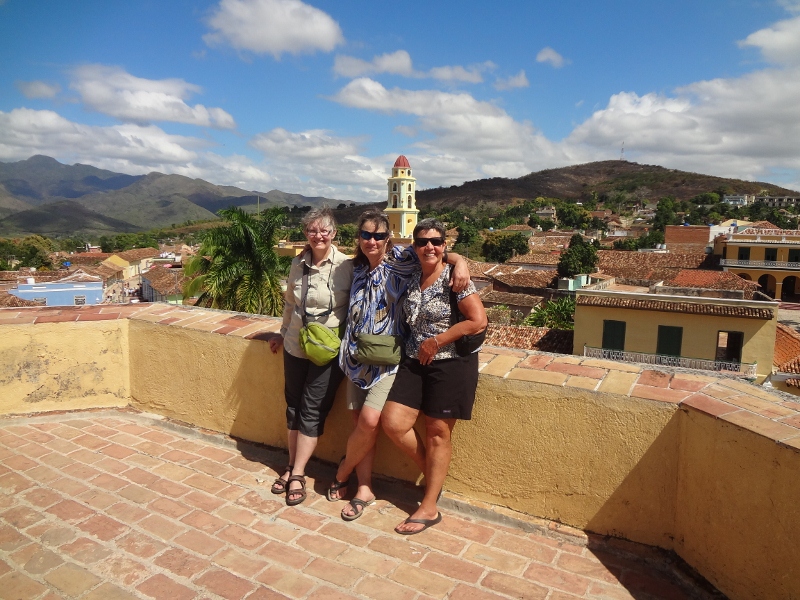
On the roof of the Museo Romantico in Trinidad de Cuba
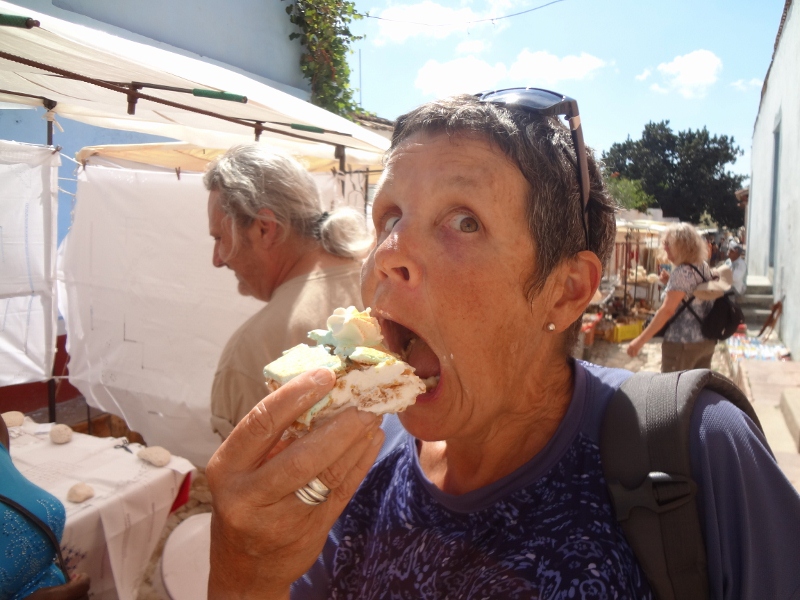
Billy scarfs a torte in one of the many tourist markets in Trinidad
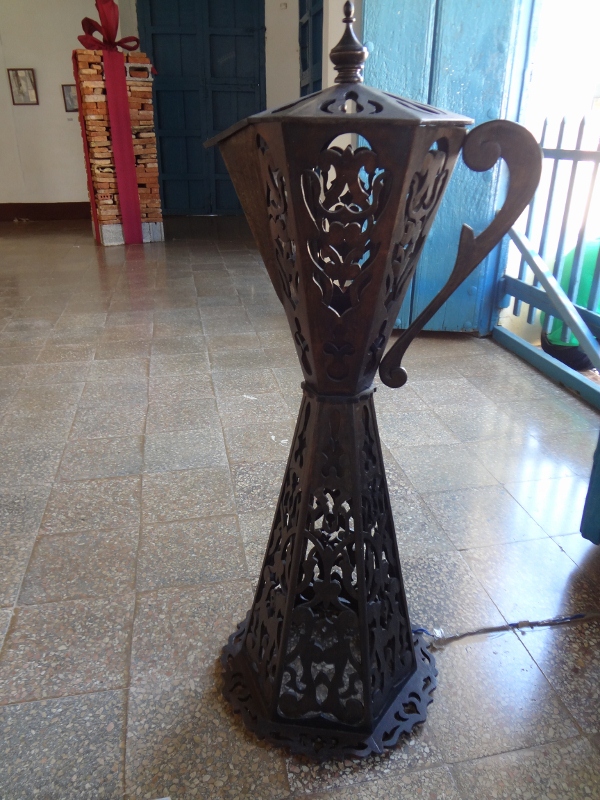
a ‘person-sized coffee pot by Yami Martinez, one of my favourite Trinidadian artists. I have two small coffee pot women and a couple of prints of hers which I love
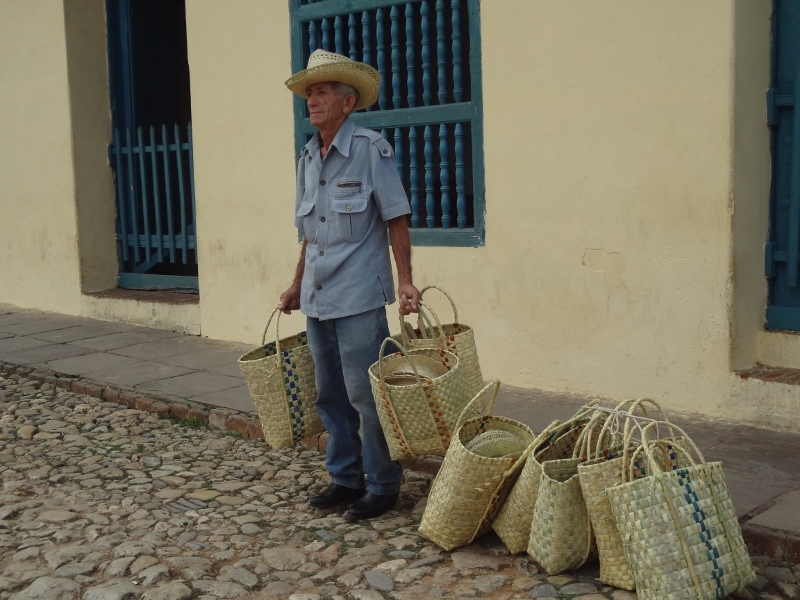
The basket man
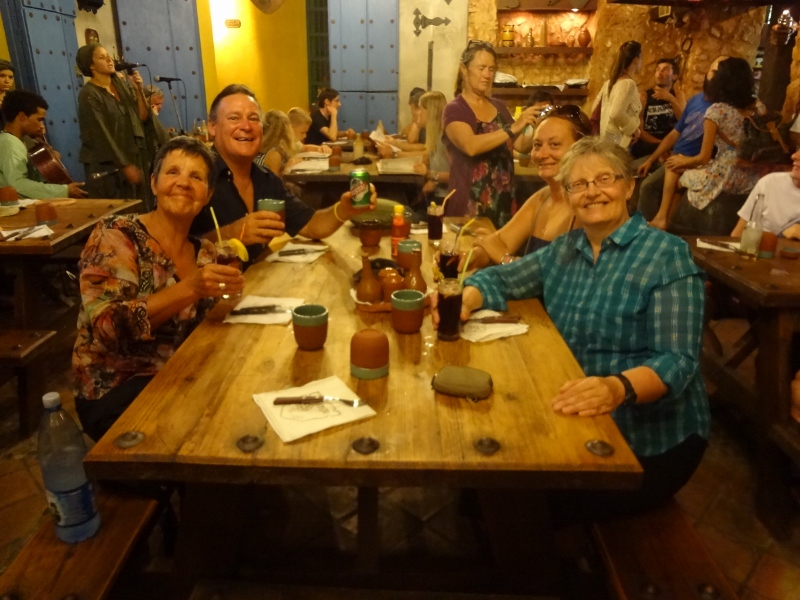
Out for a great dinner and a great band with Jose and Dulce in Trinidad
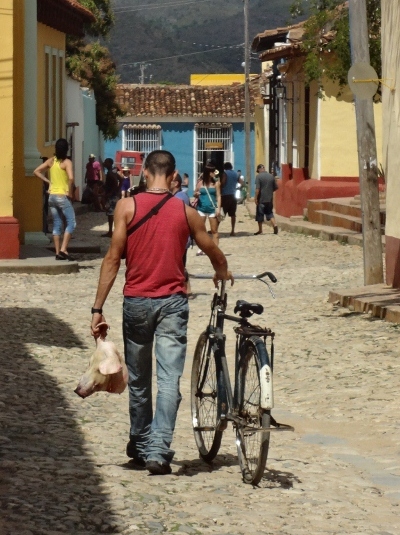
taking home the pig head
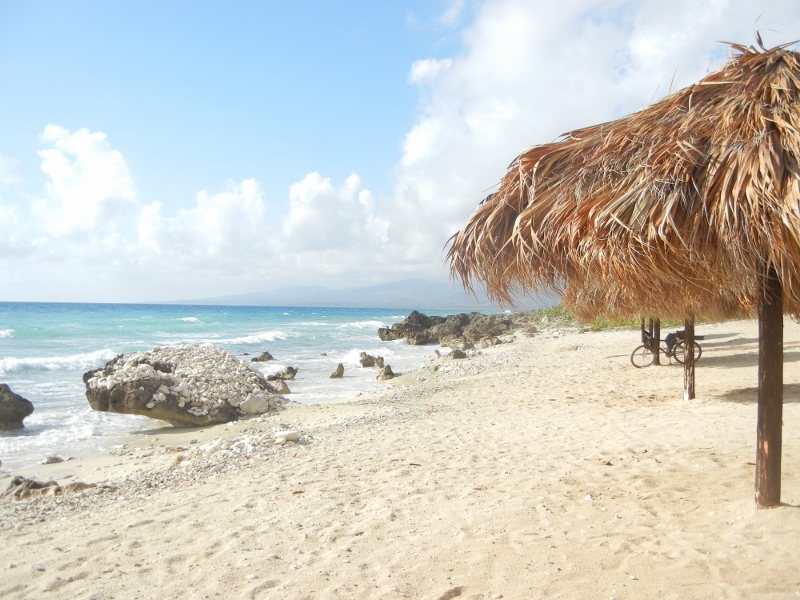
Playa Ancon (pic by Billy)
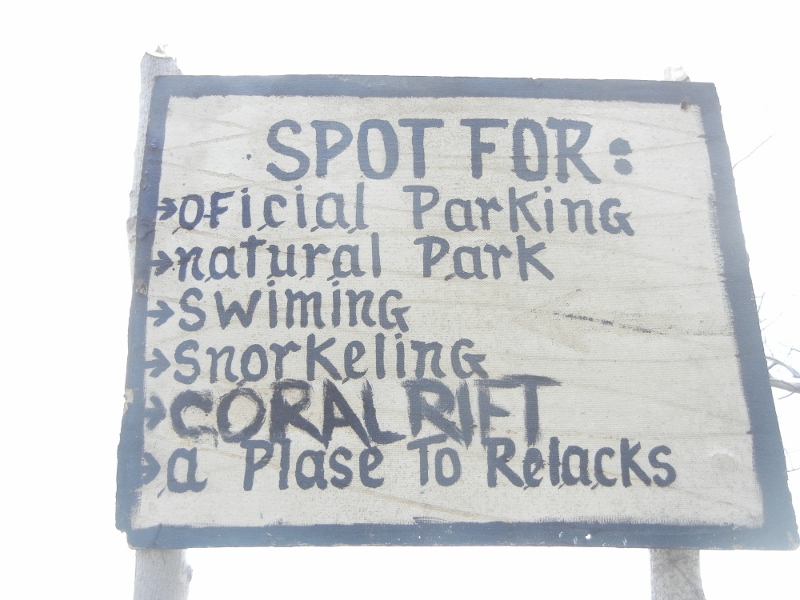
Snorkeling beach (pic by Billy)
On the Road to Cienfuegos
Much as we hated to leave La Boca, it was time to get on the road again. José and José Carlos had readied my 2012 bike for the road. TBFH would stay with them where it would be repurposed into a serviceable family bicycle. At the end of our trip José would meet up with us to collect the 2012 bike.
This is a lovely coastal ride which we road in the opposite direction 2 years ago. This year, instead of staying at Yaguanabo, we decided to stay at the low-key Cuban resort at Guajimico, famous for its off-shore diving. This divided the ride more equally into very enjoyable 40 km chunks. We had a nice cabin at Guajimico, an almost deserted pool, and a reasonable restaurant. We decided to pursue a little walking trail without reading the details of the sign in Spanish and were pleasantly surprised when it led to and through a lovely series of caves and grottos. But best of all, near the mouth of one of these caves, Margie spotted what we had been longing to see for 3 years – A Bee Humingbird! The world’s smallest bird! With a body barely an inch long and wing span less that 3”, it sat on a branch and preened for us before flitting away.
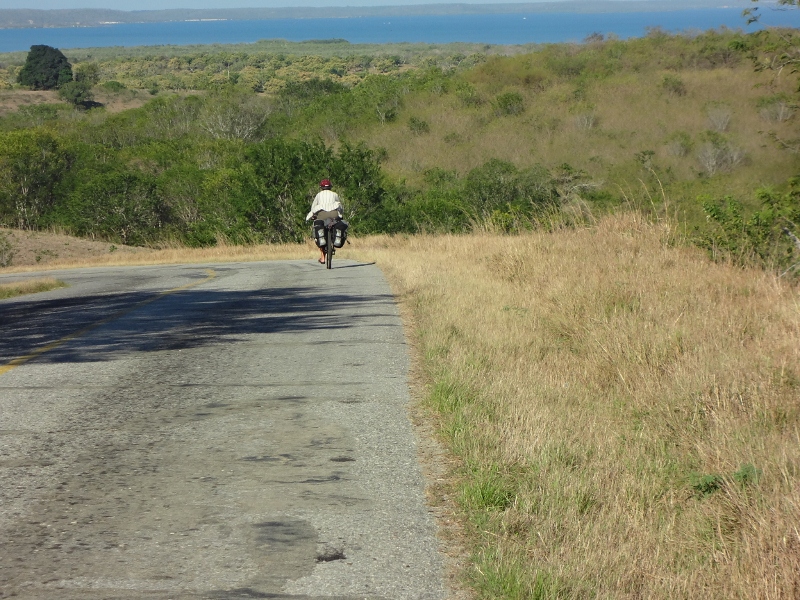
on the road to Cienfuegos
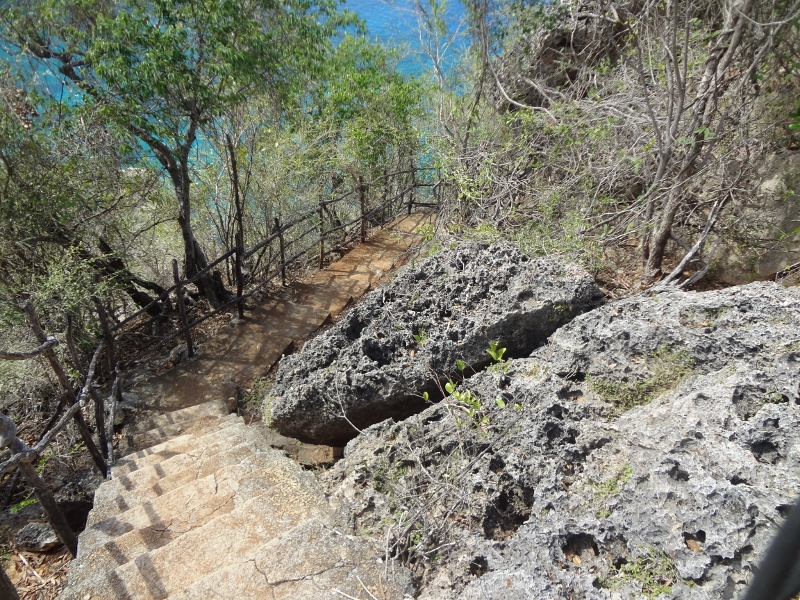
cool walking path at Guajimico
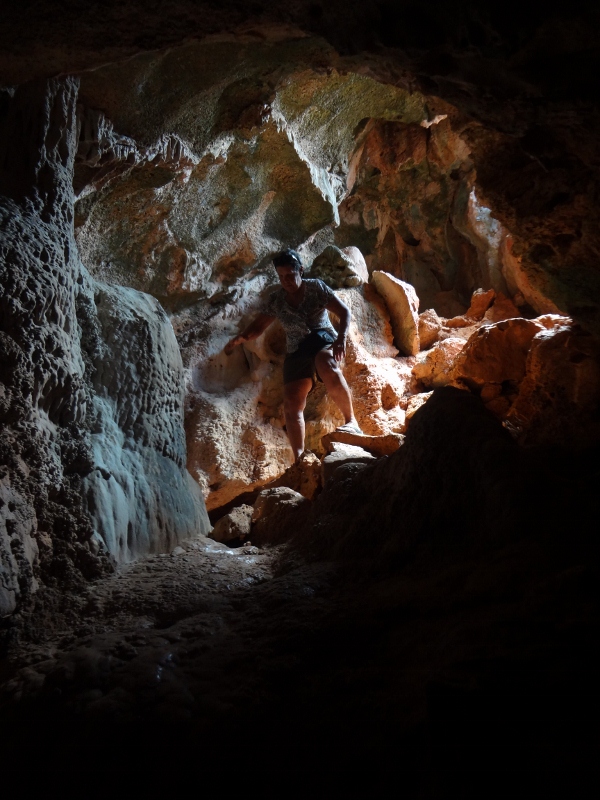
Grottos at Guajimico
In Cienfuegos we settled in at Lily and Fel’s lovely Casa. Since Billy had never been here before we revisited some of our favourite haunts. In Punta Gorda, we delighted to see that the Palacio de Valle, which has been under restoration for several years was finally open to the public. This building was a private home built in 1917 by the Spaniard Alcisclo Valle Blanco, which possibly explains the strong Moorish influences.
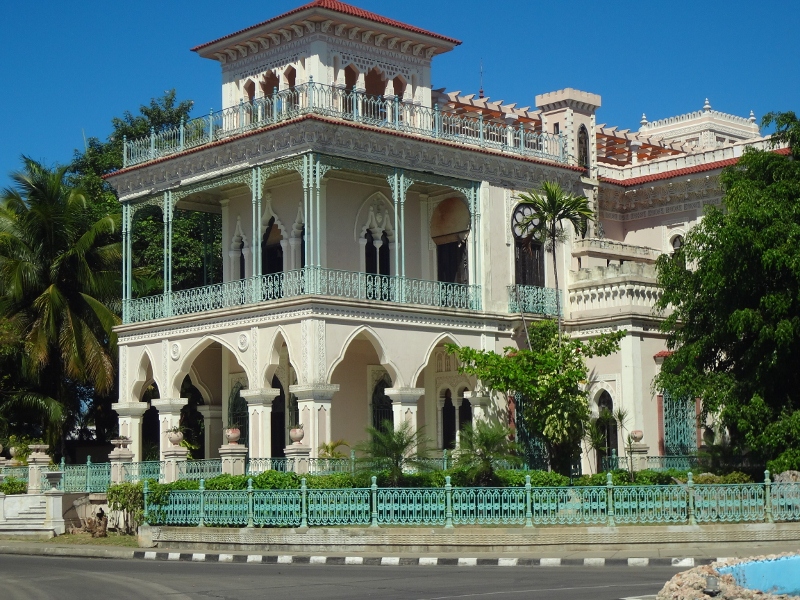
Palacio de Valle
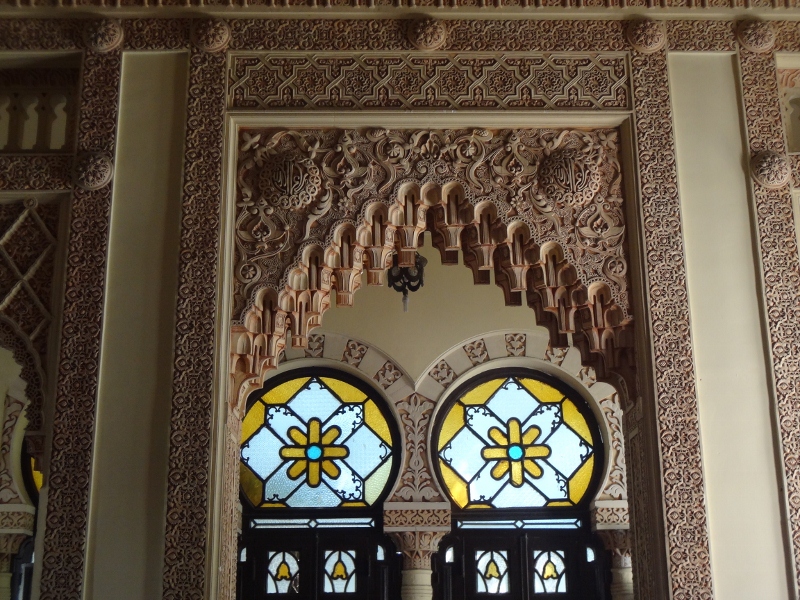
Interior detail in the Palacio de Valle
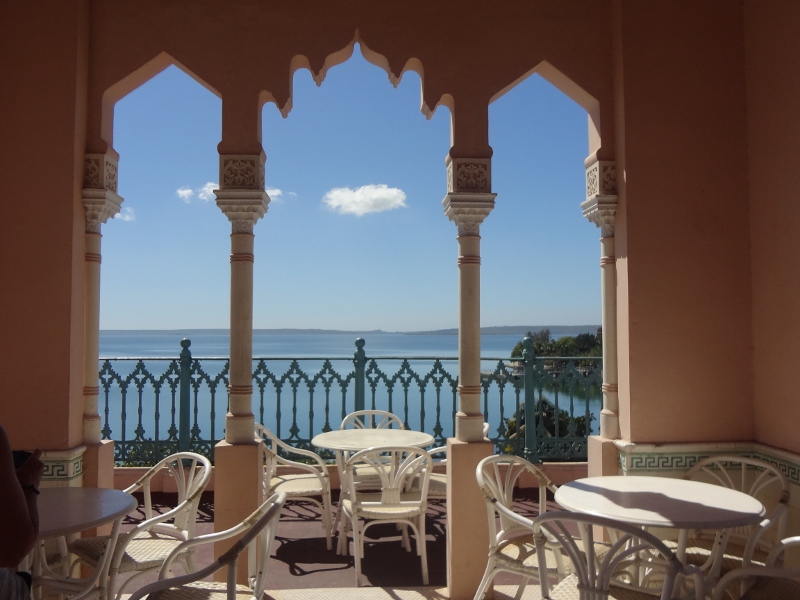
view from the rooftop patio of the Palacio de Valle
A night on the Town
We had made arrangements to rendezvous with Jose and Dulce in Cienfuegos. Dulce had a medical appointment. No many-month waiting lists in the very efficient and completely free Cuban medical system. To visit the specialist that was not available in the much smaller town of Trinidad, Dulce needed no appointment. She just needed to show up at the clinic in Cienfuegos on a Friday, any Friday. With the inconsistency of Cuban transportation, this system is much more practical. The probability of any Cuban being able to keep an appointment in a city 80 kms away on a specific date and time is not good. The local bus system is crowded and often unreliable; private cars break down regularly, and the more reliable Viazul bus or taxis are prohibitively expensive for the average Cuban.
José contacted us at our Casa and was keen for us to join them and some friends at the famous Costasur nightclub. We set off down The Prada, the wide Colonial boulevard that runs down towards the Malecon and Punta Gorda, with only a vague idea of where we were going. Near the waterfront there was a huge neon sign on a 20 foot pole, with a flashing arrow pointing towards the Costasur.
We turned down a dark side street. After 3 blocks we had seen no commercial establishment at all, much less one that would warrant such a demonstrative sign. We would have walked right by the night club, which was hidden behind a non-descript concrete structure across a large parking lot, had not José been watching for us from behind the large wrought iron entrance gates.
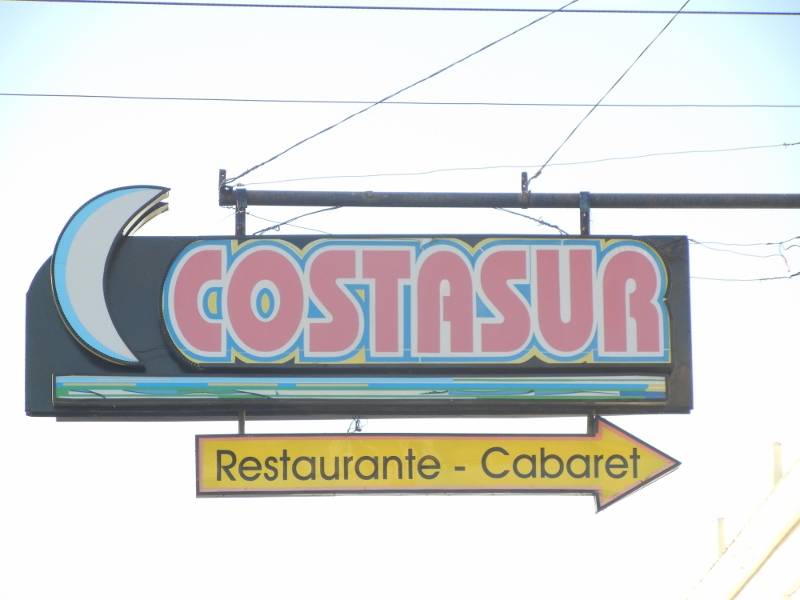
Recorded music blared as the band set up on stage. Tables to seat a couple of hundred people were set up on an ill-lit outdoor patio bordering the harbour, and were at least ¾ full even this early in the evening. José, Dulce, and their friends – José Carlo’s cycling coach and his wife and daughter – had demolished at least one bottle of rum. They had ordered several plates of unappetizing looking food including some sort of deep fried hotdog. The hotdog figures prominently in the Cuban fast food repertoire.
When it was discovered that we had not brought our passports with us, I was elected, as being the most practically dressed for the adventure, to accompany the Coach on his motorcycle back to our Casa to pick them up. All I can say is that I was very happy that the second bottle of rum had only been half consumed to that point. We never did discover the need for the passports, as we were never asked to present them. Cubans, however, are required to carry their identity cards with them when attending a function such as this, so I assume that we, as foreigners, were expected to carry similar identification with us, just in case we got drunk and disorderly.
The mediocre band played covers from the 70s and 80s, some unfamiliar Latin/funk heavy on the horn section, but mostly pop culture favourites by the Beetles, BeeGees, Eagles, CCR etc. Everyone at our table was up dancing, with or without partners. It was fun just to dance and not to be intimidated by the serpentine gyrations of Salsa dancers. This was not to last.
After a short intermission an oily MC in an ill-fitting suit began an audience participation shtick. It began innocently enough with inquiries about where people were from. Interspersed among the crowd were a surprizing number of foreigners, often with Cuban escorts, mostly Europeans, at least one American and one large group of Quebecois. We, of course, enthusiastically announced our Canadian identity and unfortunately our table fell under the eye of the MC. He began picking couples to come to the front and motioned me and José, who at that moment happened to be standing behind me, to come up and join a couple from Ecuador, the American and his escort, and a Cuban couple. He started by asking each couple embarrassing questions. I am already embarrassed enough because he thinks that José and I are a couple, and José has decided to make the situation worse by going along with it, and pretending he doesn’t speak Spanish.
The announcer jumps right in. Do I like love? Of course, I reply in Spanish. What position do you like best? I take his meaning more from his gestures than from my understanding of the language and am too flustered to come up with a witty answer in Spanish. José is having a giggling fit behind me. To my relief the MC soon moves on to embarrass the next couple.
This is followed by a dance contest in which we must mimic the dance styles suggested by ever-changing music spanning several decades and most of the world. I feel I do Canada credit by demonstrating my hips have the full range of motion, if not the sense of rhythm that a native born Cuban learns by age four. However, I am very ready to be out of the spotlight and return to our dark table at the back of the terrace.
But no, the MC now launches into a tirade in Spanish that has the audience in hysterics, the other couples blushing, converts Jose’s giggling to nervous laughter, and me entirely confused. However, the MCs graphic illustration leaves me with no question of what we are required to do. It is necessito for each couple to dance on the stage, with the man standing close behind the woman, doing their best imitation of ‘amour del perro’. My immediate reaction is that no, it isn’t actually necessary for me to do this. The couple from Equador, who have been married for 22 years, do an admirable job of this task. When our turn comes, I decide I have had enough bullying from this short, over-primped, macho MC with his hideous cologne and pointy-toed shoes, and when he says how necessary it is for us to do this, I tell him in Spanish just how unnecessary it is. He is caught off-guard and the audience loves it. This is some weird version of a TV show where couples are eliminated and there is a prize for the winning couple, so the other couples are doing their best to please him.
So when the music starts, José and I dance face to face, hips gyrating with suitably subdued sexual innuendo. The MC taunts me to move my hips faster, faster, and he starts to look pre-orgasmic. I grab the mike from him and tell him in Spanish, that this is not for his pleasure, and that I, like most women, prefer slower, slower. This brings the house down, and completely annoys the MC.
Needless to say, and much to my relief, we are the first couple eliminated. The couple from Equador won the grand prize, which is was a meal at a nearby restaurant and a night at, you guessed it, the Costasur!
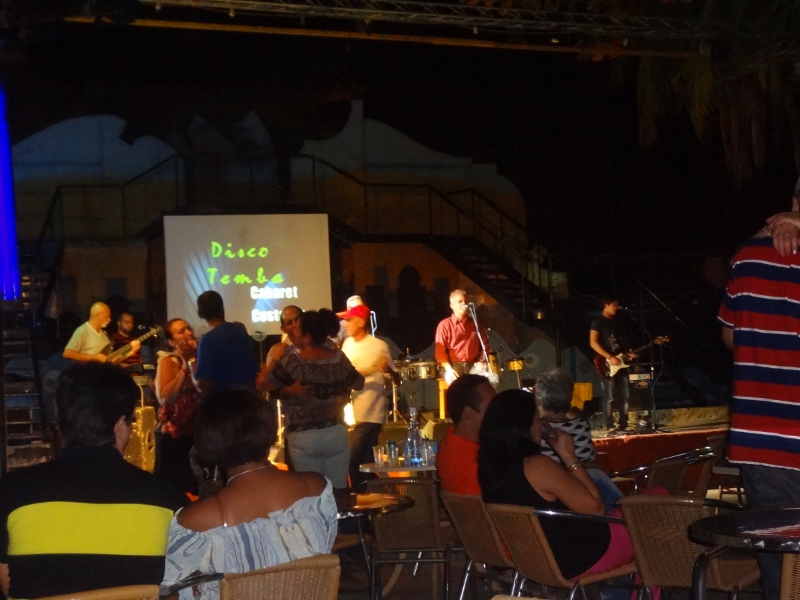
Fun at the Costasur
The Disco Temba (disco for the over 50) continues, but by this time there were 4 dead 26ers on our table and number 5 half down. Given I wasn’t drinking rum, and was still nursing my second beer and Margie and Billy weren’t drinking heavily, the other 5 adults were in fine form. Billy indicated that the washrooms were not to be contemplated under any circumstances, so I was hoping the evening would wind down soon. When the three of us left, the rest were still going strong.
Parque Nationale del Caguanes
Merlis, our guide at Alturas del Banao, had indicated she might be able make arrangements for us to visit this ‘restricted access’ area on the north coast near Yaguajay. One of the scientists who had been working with the international community to research this incredibly significant cave system was her neighbour. But we would need a jeep to get there. Merlis was optimistic that we could locate a jeep and driver in Remedios or Caibarien. We called Eberto and Ania from Cienfuegos to see if they could find something. After much looking, Ania eventually located a man with an old Willys, so on the appointed day, we picked up Merlis and Elier in Yaguahay. Heading north from Mayajigua to the eastern end of the park, it soon became obvious why we needed a jeep. The road deteriorated to deep ruts that during the wet season would have been impassable to everything but a tractor, but our skilled driver kept us from high centring. When we entered the mangroves, the road became a creek. Eventually we emerged onto a dry grassy headland and the ecological station.
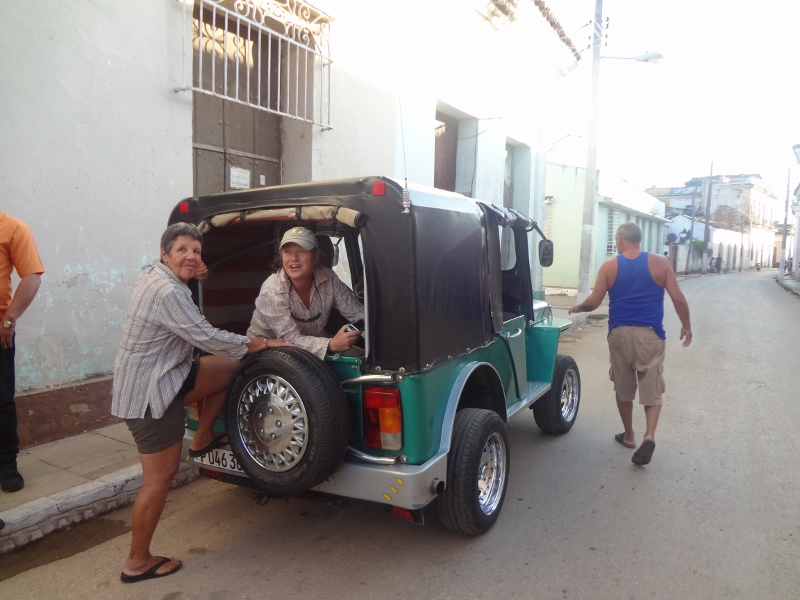
our Willys jeep
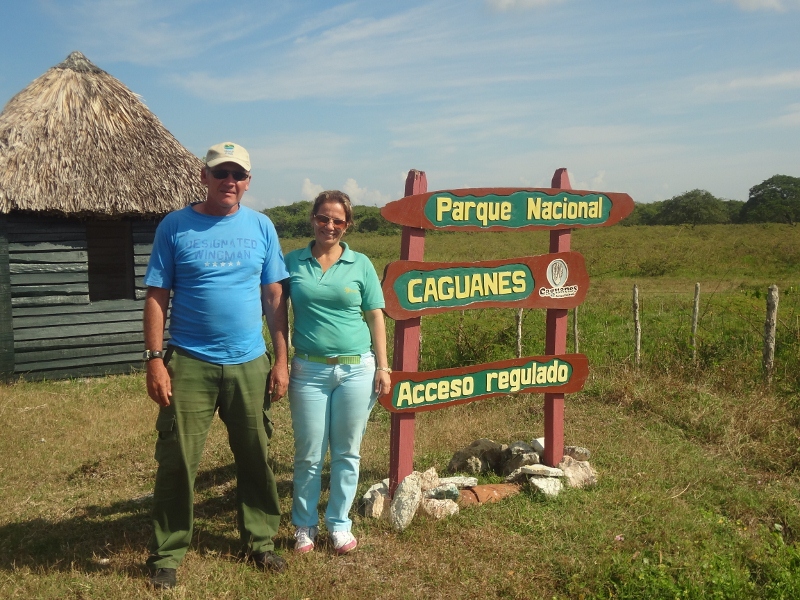
Our guides – Elier and Merlis
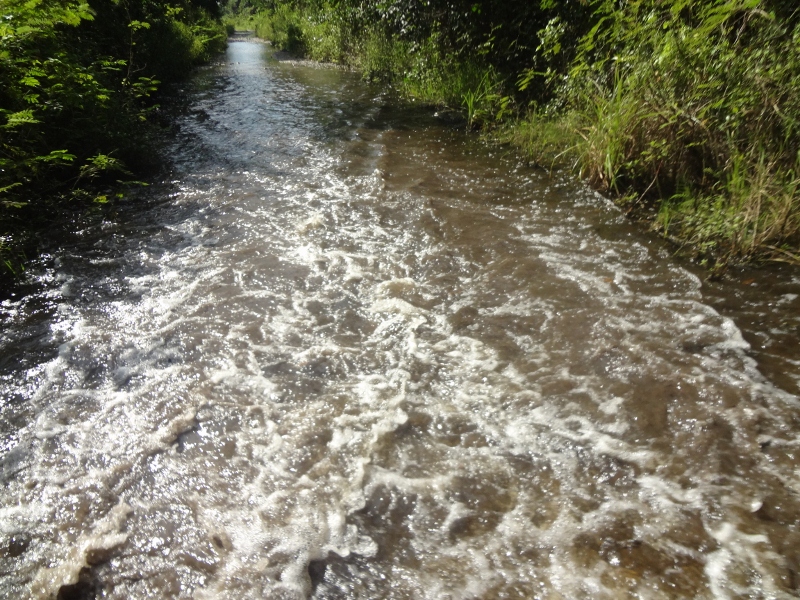
The access road
Elier issued us with hard hats and lanterns. A short hiking circuit would take us to three caves in the system (of about 30) that were suitable for visits by the public and which showed a cross-section of the features that made these caves so interesting to the scientific community worldwide. Of particular interest to Margie and I were the pictographs and petroglyphs. We had spent quite a bit of time in the American south-west visiting and studying aboriginal paintings and carvings. These Cuban ones were from a much earlier period (Mesolithic) and much more primitive. One of the caves showed the remnants of army occupation during the Cuban Missile Crisis, as well as tire tracks permanently etched in the stone floor from the mining of bat guano as a source of nitrogen for fertilizer. The last cave was the most spectacular, including many types of formations I have never seen before, including some which are baffling scientists.

Ready to go

pictograph
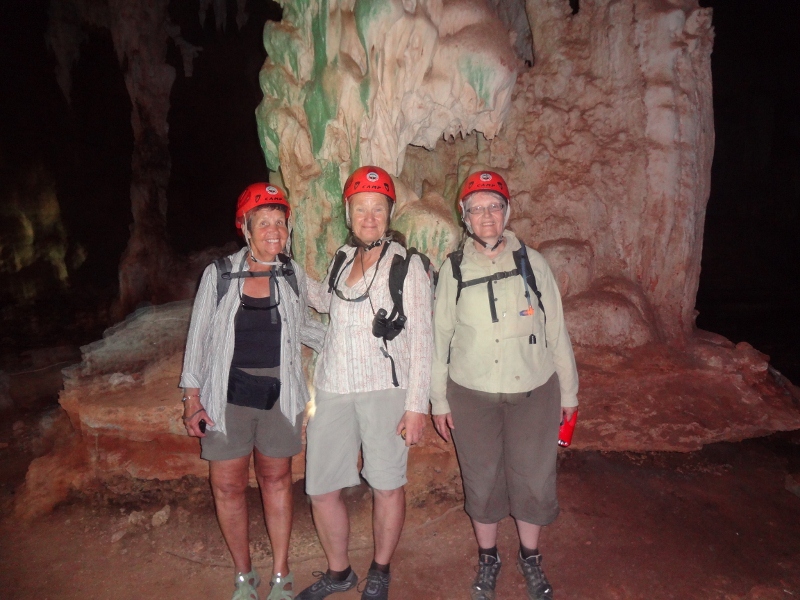
spectacular colours
Elier explained, with Merlis translating that scientists did not yet fully understand how water droplets that form stalactites could run uphill to form these transverse arms. We felt very lucky to have been able to visit this reserve, to which a limited number of groups are allowed each year.

unexplained formation

unexplained formation
Another Cuban Car Repair
After dropping Merlis and Elier off in Yaguahay, we were going down the main road at a fair clip when one of the back wheels came flying off. Luckily Billy and I, who were riding in the back, were holding on as we scraped and swerved along the pavement. My main concern was that the flying sparks would ignite a leaky gas line, but our driver, Pepido, got us stopped without incident.
‘This will be a long one’ I thought to myself. We often passed groups of Cubans broken down at the side of the road; now we were joining the ranks. The issue in Cuba is lack of replacement parts and lack of tools. I have never seen a tow truck there; so something has to be improvised at the roadside. We looked at the flattened brake drums, leaked brake fluid and sheered bolts glumly.
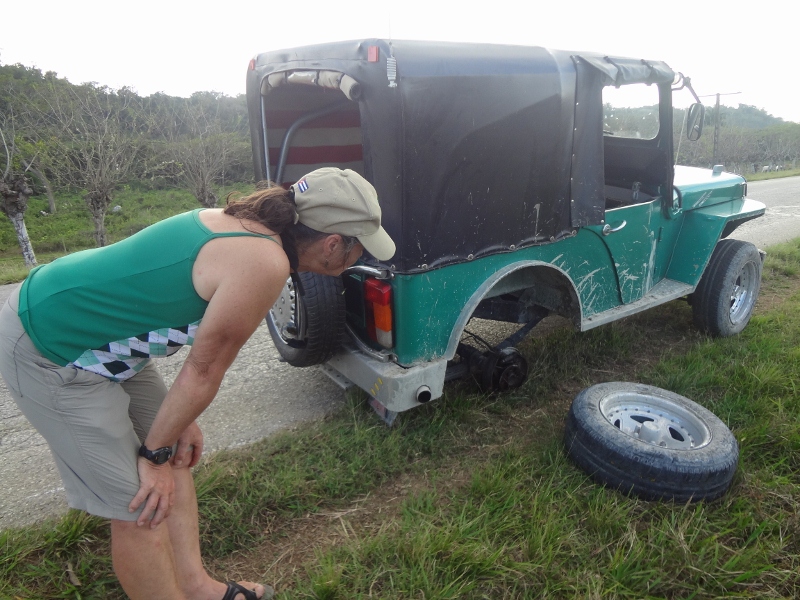
Hmmm! Doesn’t look good!
Pedido went to a nearby farmhouse to make a phone call. After he returned, he proceeded to try to jack the car up with a pathetically inadequate jack. The men from the farmhouse appeared with a better jack, and continued to offer moral support while Pepido worked. There was much laughing and joking in Spanish too colloquial for us to grasp. We failed to see the point of the exercise until Pepido reached behind the seat and pulled out a spare axel. Then we watched amazed as, with only a pair of needle-nosed pliers and a crescent wrench as tools, he changed out the axel and remounted the tire.

Cuban car repair as a spectator sport
Soon we were off again, but now of course we had no brakes. Pepido proceeded very slowly, never going above 2nd gear. Before long we were flagged down by a white car coming from the opposite direction – Pepido’s friend come to take us back. This was the phone call he had made earlier. He had no doubts about his ability to fix the car, but he didn’t want us riding in a vehicle with no brakes.
Farewell
Giving our bikes away has been a highlight of all three of our trips to Cuba. These gifts are so appreciated and can make such a difference in a family’s life. I had, of course, already bequeathed TBFH to José. Margie gave her bike to Eberto, who was thrilled. Billy gave her bike to the young woman who worked for Ania and Eberto at the Casa. Ania later confided in us that this was a great gift because the girl came from ‘bad circumstances’ and would really benefit from the gift.
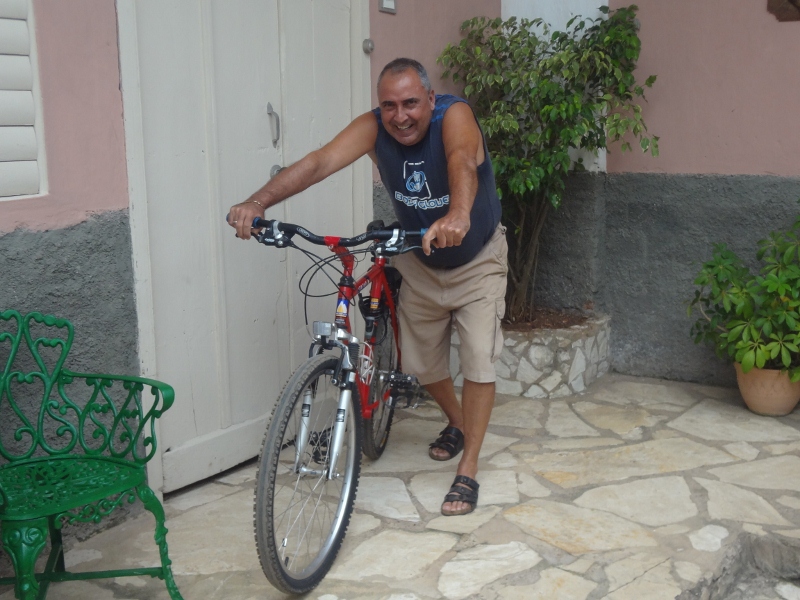
Eberto with his new bike
Our last day in Cuba we spent chilling at La Rueda with Ania, Eberto and the family. We have gotten to know this family very well, as we stayed with them for several days in 2012, and spent 3 days with them at the beginning of this trip. All too soon we are piling into a blue Chevy, bikeless, but with great memories of our recent adventures, reluctantly returning to our cold, snowy homes.
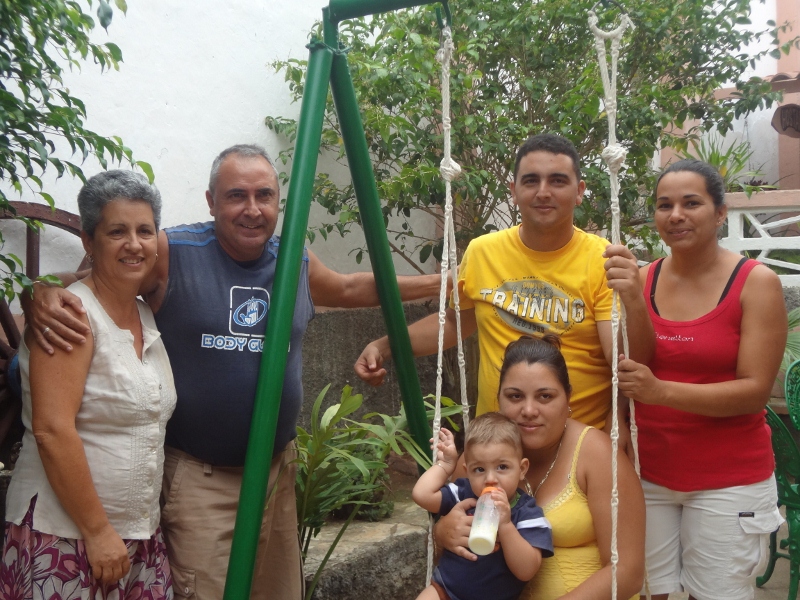
the whole family
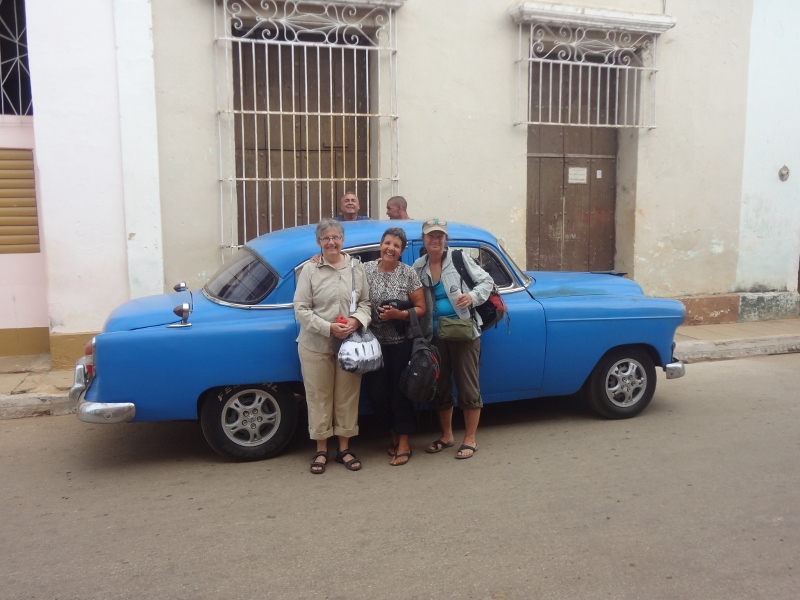
Back to cold Canada
 jcstravels
Canadians are so lucky to be able to visit Cuba freely ..
As an American citizen and owner of a travel agency I have just returned from a “people to people” US government licensed tour to Cuba (the only way that Americans can legally visit Cuba although that may change as time goes on ).
While on the tour and in Trinidad I did purchase two small prints of Yami Martinez’s coffee pots but unfortunately I cannot not remember the exact symbolism/meaning of each of the pots in their different poses although I do know that they are an earlier expression of women being restrained to domestic chores.
Since you indicated in your discussion of Trinidad that she is one of your favorite artists I thought perhaps that you may know the answer to my question., I have searched the web to no avail….when I hit upon your very interesting site.
As far as Cuba goes I am fascinated by her and hope to organize a group to visit her even under the restrictions of US/Cuba relations at this time.
Hope you can reply to my inquiry.
Joan Badgley
Leatherstocking Travel
Cooperstown NY USA
lstvl@stny.rr.com
Hi Joan,
I am afraid I can’t shed much more light on it. I met the artist very briefly in her gallery in 2012, but my Spanish wasn’t so good. In 2014 I only talked with the shopkeeper. I think you are right about women’s connection to domestic activities, but also I find that most poses tend to be quite joyful. I will send you a couple of photos by email.
Cheers
Judy